As CCIRA has faced many of the same challenges schools have faced in 2021, one theme has emerged: innovate. Our organization has had to reinvent itself numerous times over the 50 plus years since we began. As we continue to look for ways to add value to the lives of literacy educators, we are grateful for our community. The audience who reads this blog does so with a passion for learning and teaching. Our blog is shared widely on social media and between colleagues so that we can all benefit from each blogger’s expertise. Each guest blogger brings a different lens with which to view literacy teaching and learning. We are indebted to each of our bloggers of 2021, who squeezed in writing time amid many other tasks. These literacy experts gave a gift that will continue giving as the posts are reread in the months and years that follow. Each year our audience grows, expanding the reach of CCIRA. Below you will find the Top 5 Blog Posts of 2021, listed by order of popularity.
Oscar Wilde is reputed to have said, “Be yourself, everyone else is already taken.”
Here is what I believe: being your true and genuine self is a freeing experience which leads to joyful teaching and deeper connection with students.
But can you achieve this? And why would you even try? Educators have enough to deal with in the midst of a pandemic. Trying to incorporate something new might just be the proverbial straw on one’s back.
Here are some simple ideas that help me. I am hoping, in turn, that they can help other educators without adding pressure to a teaching day.
1. Share childhood stories and photos with students.
Growing up I was my big sisters’ live dress up doll. You may ask, did I like it? The answer is…it depended. Once when I was four, they decided it would be grand to dress me as The Highwayman, based on the poem by Alfred Noyes. I was NOT impressed. When they recited the poem, I was to act out this part of The Highwayman’s fate as written here:
“…When they shot him down on the highway,
Down like a dog on the highway.
And he lay in his blood on the highway with the bunch of
lace at his throat.”
Even the sprout I was then realized my experiences were too minimal to use the method acting technique! Performing as a dying man, sporting a blood soaked lace cravat was out of my repertoire! Some protestations in the form of screaming ensued – most likely stopped only by a bribe.
Photo courtesy of the author.
One of the reasons I recall this episode so well is because I have a photo of myself in the make shift costume my sisters created: a coat set at a rakish angle to emulate a cape, an artfully tied scarf around my neck, all topped off with my father’s cap. The marked disdainful expression on my face was captured for eternity.
Kids love that photo of me and hearing about the exploits my big sisters enjoyed at my expense. It opens them up to their own experiences as younger or older siblings. It is a great strategy for facilitating talk during social emotional learning or for exemplifying personal narrative in writing.
2. Go off the script.
We all have curriculum to follow. I say, go off the script and make it your own. It is all too easy
in times of stress to be robotic and follow the formula piece by piece. Your students love YOU. Bring YOU into the pedagogy. During reading, pull in books that you think resonate more than the suggested curricular ones. Students will sense if you are reading or referencing a book that leaves you cold. It’s highly likely that the book is not lighting a fire under them either. There are so many resources to find new and vibrant books which exemplify diversity and good writing. Teachers College, Columbia University is an amazing resource for great books. If you haven’t joined Twitter, do it! There are so many wonderful educational resources on Twitter. You can follow authors, and publishing houses. In fact, no matter what disciplines you teach, you can find resources for those disciplines on Twitter!
3. Bring your own unique teacher gifts to the classroom as a catalyst for kids to share their talents.
Maybe you are a gardener and can start a garden with your class. (True confession…I love gardens but lack a green thumb. However, we have a classroom garden and parents and kids are the ones who keep it alive.) Maybe you are a music expert and can share this with students. I play guitar very badly. But guitars come in handy for class sing-alongs. Heck, all you need is a few chords, and you are Eric Clapton as far as young kids are concerned.
Some of my favorite memories consist of me and my class serenading the school office with Irish ballads on St. Patrick’s Day. My students are all too willing to join in when I tell them that my dad ran an Irish pub/restaurant for years and he insisted I sing in it. (Much to my horror!) And my great grandmother used to dance the jig in old San Francisco with Gracie Allen. So I tell students about this and demonstrate it myself on St. Patrick’s Day.
Years later former students ask me if I still dance on the table….
Please note, when I say I play guitar badly, that I’m not exaggerating. But it just reinforces that nothing has to be perfect to inspire community. Everyone has talents, whether you are a true musician or someone who plunks three chords like me. Use your talents!
Recently, I had a budding magician in my class share a magic trick with me. (Remember, I teach really young children.) He was squealing with excitement about a magic trick he needed to show me.
Student: Ms. Donohoe, I can make this key disappear.
Me: Please show me!
So his enthusiasm was palpable, even with a face mask. This young fellow held up the key and
VERY OBVIOUSLY, slipped the key behind the mask. Then, held up his hands to show the key had disappeared.
Student: Ms. Donohoe, I stuffed the key behind my mask.
Me (trying to keep a straight face): Magicians never reveal their secrets. Remember that!
I hope that some of these ideas may be of service to you as an educator. Right now I am recalling my older sister telling me about Peter Pan and company flying to visit her at night. But, I was to keep the secret and not tell anyone else. At six, I of course believed her even though I never witnessed this miracle personally. We, as educators, have it in us to remind kids that they can soar, over covid, over anything, and fly! And all we need to do is help them believe. I believed Peter Pan visited my sister, your students will believe in the potential you see in them.
Kitty Donohoe has taught primary grades at Roosevelt Elementary School in Santa Monica, CA for over thirty years. She received her B.A., Master’s in Education, and Multiple Subject Teaching Credential from UCLA. She and her husband Homi live in Los Angeles, near UCLA. Kitty’s first book, HOW TO RIDE A DRAGONFLY comes out in May 2023. The publisher is Anne Schwartz Books, an imprint of Penguin Random House. You can follow Kitty on Twitter: @donohoe_kitty. She has just launched her children’s author website: http://kittydonohoeauthor.com
By now you’ve heard of Ted Lasso, I’m sure. And, if you are like me, at the end of a tough week you just need a little Lasso in your life to rejuvenate. There’s something kind of special, something timely, about Ted Lasso’s one-liners: “With every choice, there’s a chance.” Even though this guy is a fictional character, he sort of feels like a friend, a cheerleader, a coach. I think it’s because his words of wisdom apply to so many educational circumstances. Ted, like many of us, works really hard to be capacity-builders.
Capacity-building occurs when the talents and needs of everyone across the learning community converge to move a school or district in a unified direction.These aren’t one-and-done triumphs–when we build capacity, we create a longer lasting momentum of human potential. . These are enriching experiences that are repeated over and over again. Day after day, month after month, year after year, educators know how to share their knowledge and experiences with others to create a culture of getting better all of the time…together!
Building capacity doesn’t happen overnight, but can be a bucket-filling process when we work off of the good versus harp on the negative. There are many ways to initiate asset-based, capacity building opportunities. Here, I’ll share two do-it-tomorrow ways that I’ve found pretty foolproof.
Get people reading and talking.
Get people walking and observing.
Get People Reading and Talking
There’s a reason that pediatricians read medical journals. They need to be informed of the latest research and findings so that they can provide the best care for their patients. Teachers need the same updates. Whether it’s reading and discussing an excerpt, infographic, article, or a chapter of a book, teachers re-fuel their thinking and reboot their practices when they stay current with theory and research.
Try It
Invite a small group of teachers to join you during lunch time to talk about a short article or piece of text from a professional book. You can give them the text to read ahead of time or build in reading while eating lunch. Then, discuss the text together. Consider using the this version of the 4 A’s Protocol, adapted from www.schoolreforminitiative.org, to get discussion moving:
Here is a template for an invitation. Adopt or adapt it to fit your needs and purpose.
Join me for a “Lunch & Learn” on ____________ [insert date and time]. During that time, we’ll be talking about _____________ [insert topic or link to article]. Bring your lunch and I’ll bring a dessert to share. Let me know if you can make it. Hope to see you there!_____________ [insert name]
Not sure if lunch time is the best time? Well, consider one of these during a different time: Dine & Discuss, Popcorn & Ponderings, or Snacks & Study.
Get People Walking and Observing
Gather a group of curious educators to participate in an asset-based learning walk. Picture this. Administrators, instructional coaches, and teachers on a quest to “sniff out the good” across the learning community. The goal is to capture all of the choices and instructional decisions that were being made and envision all of the chances, or opportunities, that those choices afforded for future student learning.
Try It
As you walk from classroom to classroom, have each educator use a note catcher (try one of these!) to capture all of the good happening across classrooms. Instead of collecting and analyzing quantitative data, consider a learning walk focused on data collected by observing students, or kidwatching, in the round. Write down what you see and hear and name how those noticings make a difference to student learning.
By kidwatching, the focus isn’t evaluation. Instead, you and your colleagues give yourself permission to trust your gut, to thin-slice. Thin-slicing refers to the ability to find patterns in events based only on “thin slices”, or narrow windows of experience or data. It’s learned intuition, and it flickers in our minds as we process information to make decisions. Teachers do it all the time in the midst of teaching and watching how students are responding to their instruction. It’s powerful when we deliberately use it as a lens for a learning walk that focuses on what seems to be going well. Strengths; what’s harmonious; productive, uplifting, surprising, and so on. To try it, encourage your colleagues to trust their instincts as they take in–and take notes on—the following:
Student talk (what students say, discuss, and share)
Student work (what students write, make, create, design, solve, perform, and do)
Learning environment (what is on the walls and bookshelves, furniture arrangement, and supplies used for learning)
Instructional resources (what students read, listen to, or view)
Here’s an excerpt of an example.
Class: US History
Block: 2
Background: The teacher jump started learning time by sharing a series of images with students, asking them to write what they thought the image represented or what was happening in the image. By the end of the class, the students made connections about how each of these images connected to the learning progression question: How do the powerful hold onto power?
What assets do I see/hear?
How do these assets make a difference to student learning?
Student Talk
Ss shared observations of each image with a partner Ss tossed around ideas, nudging one another to inspect some images a second time for new or different noticings As the T nudged ideas, sharing places where Ss could lean in and look closer at certain images, Ss responded verbally and through writing
Ss shared and gained new ideas from others The classroom was filled with S talk
Ss had more than one way to share their ideas and understandings
Student Work
Ss wrote bullet points, blurbs and sentences about what they thought each image represented or what was happening in the image After speaking to others, Ss made new observations using the comment feature in their google doc
Looking across past entries, it is evident that this activity is repeated (with different images) across time giving Ss multiple opportunities for deeper learning
Learning Environment
As Ss entered the classroom, there was gentle lighting in each corner of the classroom, creating a calm, productive atmosphere Each S had their own learning space with proximity to peers and T Each S had access to and could easily see the screen with images and the ability to move closer if needed or wanted
This classroom invited a mixture of social with academic
Ss jumped right into the learning at the start of class
Instructional Resources
Each S had 1:1 access to a laptop, google classroom, and individual digital folders Ss were invited to view and review images as often as needed Instructional resources encouraged risk-taking, connection-making, and integration of ideas
When Ss have access and autonomy, they are in charge of their own learning
When Ss make connections, especially through integration, learning can go from surface to deep
Ss=students T=teacher
So Why Does This Matter?
Capacity-building is one of those terms said so often it becomes a pleasant white noise. It exists as a bullet point in memos and professional learning initiatives. It’s time to make it vivid, real and action-oriented. Whether you are a district leader, a principal, a coach, or a teacher, you have the power to build capacity in students, and in colleagues. Start small. Get people reading, talking, walking, observing, and talking some more. You might focus on students first, and then do the same sleuthing on what leads to meeting a team, department, or building goals.
Begin with the assets you see. Name them, together. Negotiate what they mean in your school. Consider their implications for day- to-day practices. Get curious, and use these insights to frame professional learning questions that are most productive–and most pertinent to your learning community– for future growth together. That’s because with every choice, we uncover new opportunities, or chances, to grow our teaching practices.
References
Gladwell, Malcolm. Blink: The Power of Thinking Without Thinking. Penguin Books Ltd., 2005.
Wright, J. What’s Our Response? Creating Systems and Structures to Support ALL Learners. FIRST Educational Resources, 2021.
Wright, J. Side by Side Coaching: 10 Asset–Based Habits That Spark Collaboration, Risk–Taking, and Growth. Benchmark Education Company, 2022.
JULIE WRIGHT is a teacher, instructional coach, and educational consultant with over twenty-five years of experience in rural, suburban, and urban education settings. She holds National Board Certification as well as a B.S. in Education, M.A. in Language Arts and Reading, a K-12 Reading Endorsement, and extensive school leadership post-graduate work, including a pre-K through grade 9 principal license from The Ohio State University. Julie serves as an Adjunct Faculty Member at Ashland University and is the co-author of What Are You Grouping For? How to Guide Small Groups Based on Readers–Not the Book (Wright & Hoonan, 2019). Follow Julie on Twitter @juliewright4444 or for more information on how she can support your efforts, visit www.juliewrightconsulting.com.
Okay. I admit it. I’m a word nerd. There’s nothing I like better than a word-a-day calendar. I’m a sucker for books with titles like The Grammarians and The Liar’s Dictionary. I subscribe to three, well maybe four, word-centric social media sites. I always click on articles like “15 Americanisms You Won’t Find Anywhere Else” and “9 Words Removed from the Dictionary”. I kind of get a thrill when I come across words like hyponatremia or callithump or ctenophores in my reading. I’ve been known to send pictures to family and friends of signs that use language in interesting ways – like the one I just sent my bird-shirt loving son that read: One Bird Can’t Make a Pun . . . But Toucan! And don’t get me started on how much I love a good “made-up” word that is perfect for its context and absolutely should be added to Webster’s dictionary (like when a writer coined schlockenspiel to describe the ridiculous Triforium in LA or when the Denver Post proudly coined Omahallelujah when the Broncos won Super Bowl 50). Yes, I’m a word nerd.
And my goal is to build the ranks of fellow nerds. After a year together, my kindergartners were proud, badge-wearing “Word Explorers”. My 5th graders proclaimed themselves “Word People”. In both cases, I felt a sincere sense of mission accomplished.
Regardless of the title we gave ourselves, we shared a love for the sounds and sentiments of language. We were curious about letters and words and sentences. We found JOY in the messiness and wonderment of it all.
With today’s heavy-handed push toward published curriculum, letter study and word work isn’t inspiring much curiosity and even less joy. So what to do if, like me, you want to support and celebrate rooms full of word nerds?
Make Room for Study that Begins with Students’ Questions
In the introduction to his book, The Curious Classroom, Harvey “Smokey” Daniels defines teaching via inquiry this way: “. . . building instruction out of children’s curiosity, rather than from a curriculum guide, a standard textbook, or a handed-down unit . . . investigating and exploring, instead of just sitting and listening . (creating) an active, lively space where children make choices and take responsibility for their learning . . . (building) classrooms where teachers flow between their role as an expert and their job as lead learners . . . “ (pg. xi) This sort of inquiry stance grows students’ word consciousness, e.g., their awareness, enjoyment, playfulness, interest, appreciation and satisfaction in knowing and using words well!
“How come it sounds like /t/ but it’s spelled ed?”
It’s questions like these that give our studies direction. We start with a question. We search for words/examples that might provide an answer(s). We name possible patterns that lead to a ‘rule’ or generalization we might test out in our daily reading and writing. We find exceptions or ‘non-examples’. And finally, we name all the ways this new knowledge, new thinking matters.
Curate Book Stacks that Mentor a Love of Language
We all know the power of a great stack of books. They can teach us everything from how to treat a new friend to how to craft a fabulous sentence. They can also help us fall in love with words. My friend and colleague, Franki Sibberson, is spending the year sharing various text sets in her blog, A(nother) Year of Reading. A few weeks ago she wrote about her collection designed to help readers fall in love with words and word play. In this blog post, she reminds us that kids “are much better able to pay attention to the skills of words (vocabulary, parts of speech, spelling patterns, etc.) once they see how amazing words are.” A book stack can invite learners to simply delight in words. A few favorites in my stack are:
CDB! by William Steig (my first in the stack)
Take Away the A by Michaeil Escoffier
Wonderful Words by Lee Bennett Hopkins
Misery is a Smell in Your Backpack by Harriet Ziefert
Words by Roald Dahl
A Dictionary for a Better World by Charles Waters and Irene Latham
A Walk in the Words by Hudson Talbott (my most recent in the stack)
Study the Word-Level Patterns in Students’ Reading and Writing
The most reliable source of information for planning authentic, ‘just in time’ instruction is now, and always will be, the learners themselves. When I take the time to study what students are figuring out about print, through the conversations we have about their reading/writing and through samples of their actual reading/writing, I always come away with a plethora of next steps for my teaching. When I let kids lead the way, learning always follows!
My friend and colleague, Cheryl Zimmerman, shared this ‘flow map’ that captures what I mean:
Gather Student Work Samples
Anchoring word study instruction to students’ ongoing writing helps create long-lasting impact for students.
↩
Clarify Assessment Lens
Each piece of writing can offer insights into students’ progress toward achieving overall literacy standards and/or specific standards that match recent instruction.
↩
Name Strengths
It’s essential to always have an asset mentality when examining student work. It’s all too easy to get lost in what students can’t yet do and miss all the successes they are having as writers and thinkers.
↩
Plan for Next Steps
What new piece of information will offer the greatest leverage for students’ writing success? What context would this instruction best fit? In a one-on-one writing conference? As a whole-class inquiry study? With a small group of writers?
Trust Yourself
It might sound simple, maybe too simple, but classroom teachers are the most important factor in creating legions of word nerds. Without teachers, kids might discover the power of language. Then again, they might not. But when learners get to link arms with others who are fascinated by the words in our world, and when one of those fellow word nerds is their teacher, they become wide-awake word wonderers! So trust that you play an amazing role in this journey. Like Jennifer Scoggin and Hannah Schneewind state at the end of the introduction to their book, Trusting Readers: Powerful Practices for Independent Reading (and I’m paraphrasing):
“I invite you to trust yourself to make decisions about what is best for the students in your classroom based on what you know about them. I invite you to trust your students to lead the way. I invite you to trust the beauty of naming students’ strengths and using those as a jumping-off point. I invite you to trust in the power of having your own life as a word nerd!”
Whether you call me a logophile (a lover of words) or a logomaniac (a person who is obsessively interested in words), my name is Lori and I’m crazy about words!
Lori L. Conrad has over 36 years of experience as a teacher, literacy consultant and classroom coach. During these years, she’s worked alongside some pretty amazing learners and wonderfully thoughtful colleagues throughout Colorado and the United States. She’s published numerous articles about reading and writing, and is the co-author of Put Thinking to the Test (published by Stenhouse). Lori’s family includes four dear adult children, a terrific husband, a big dog, and a beautiful new grandson. Lori is co-chairing the 2023 CCIRA Conference with Patrick Allen. She can be reached via email at lorilconrad23@gmail.com.
As the pandemic continues, stress, time and the health of staff continue to be major concerns. And yet, what if professional development was reconfigured? What if district professional development was redesigned to include personal development? What if teachers were allowed to dream about professional learning that met their personal needs?
What should professional development consist of?
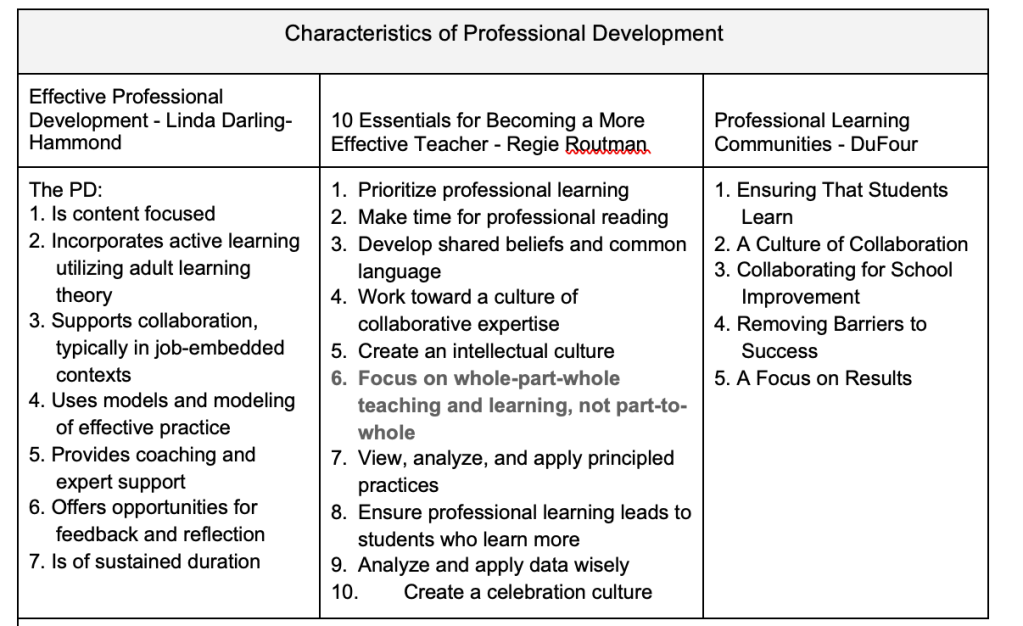
Lists, lists, and more lists abound of the most important characteristics of professional development. District leaders may choose a “research-based” list without a deep study of the specifics of the research. Influences on choices may include the authors, publishers or other messages from similar topics. In a literature review, three favorites stand out because of their specificity but also because of their overlapping nature.
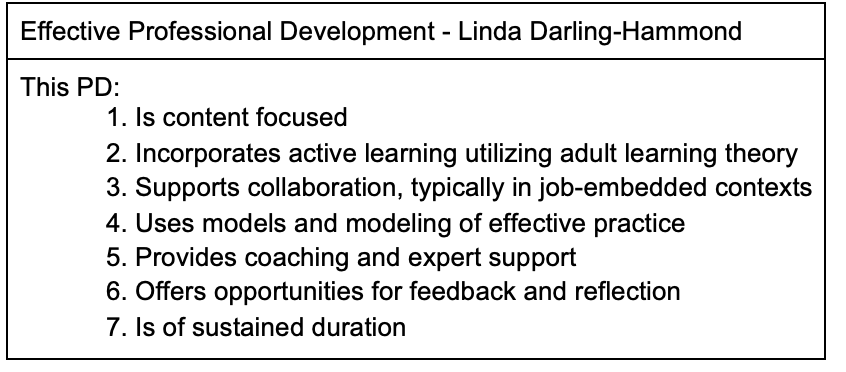
Linda Darling-Hammond is synonymous with professional development and decades of research in the field of PD for educators. Darling-Hammond and associates at the Learning Policy Institute (2017) identified seven characteristics of effective professional development (PD).
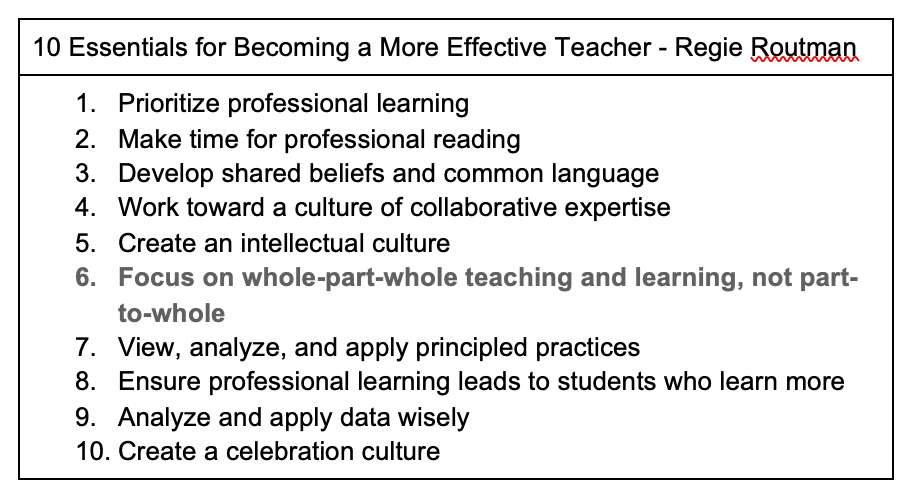
Regie Routman has decades of research in effective literacy teaching and she takes a little different view of PD in her blog post titled, “What You Need to Know about Professional Learning: 10 Essentials for Becoming a More Effective Teacher.” Regie shifted the focus to the effectiveness of the teacher. These attributes could be measured and quantified with a bit of planning (or not).
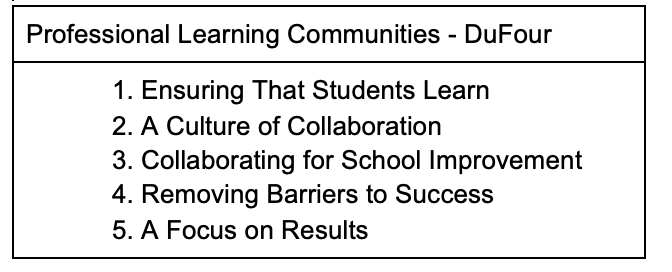
Richard DuFour in ASCD’s “What is a ‘Professional Learning Community’? focuses on the principles of a professional learning community. It may be “assumed” that teachers and administrators are part of a professional learning community, but is that really true? And are the right people included? Or are they “going through the motions and checking it off a list”? His list for learning communities includes the following principles.
As I thought about this blog post, I scrolled back and forth among these characteristics so much that I finally had to put them side by side to study them. If I were in charge, how would I proceed?
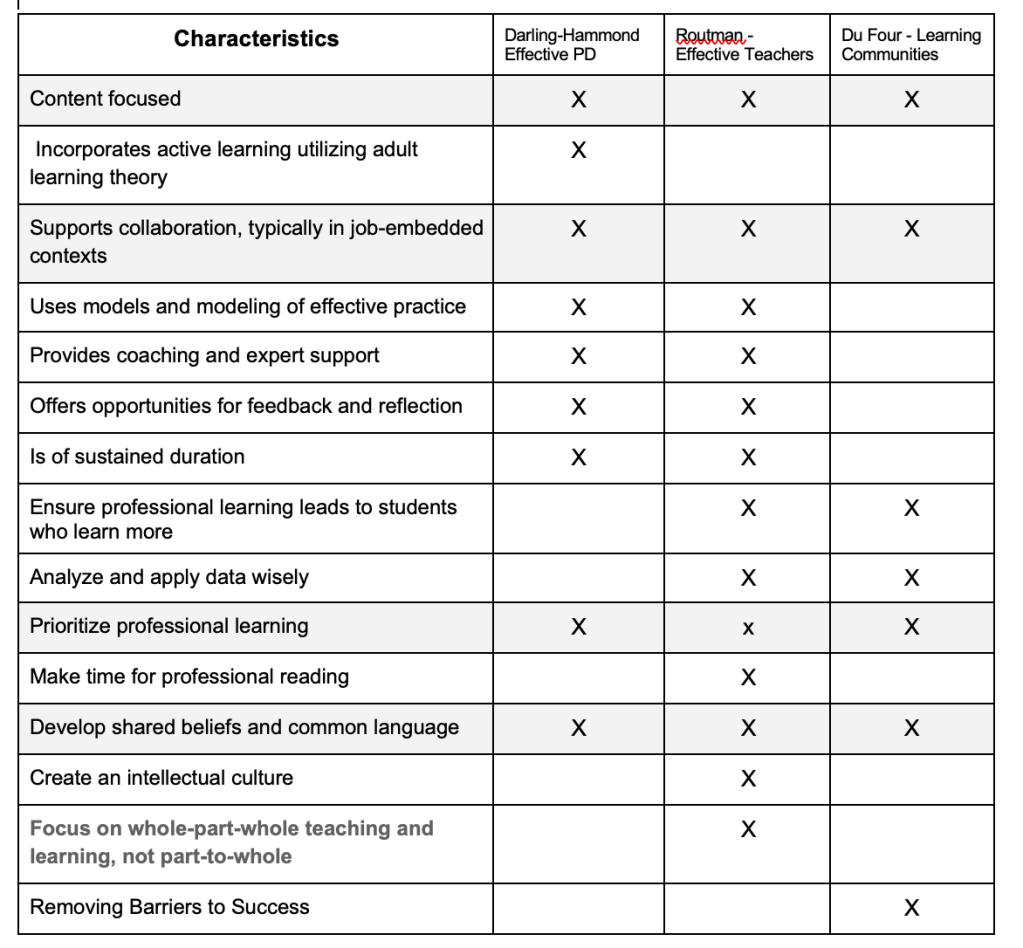
How much do these three lists overlap?
My first question of study required a way to organize the data in the three columns. I considered a Venn Diagram, but I quickly rejected it as I find the disorganization of a Venn Diagram to be confusing when trying to explain relationships that have previously been prioritized. Many of these had the exact same word “collaboration” for example but the reasons for the collaboration may have varied. Through this process the original 22 items became 15. Someone else completing the same activity may mark items differently and that’s okay because the point is the conversation that occurs when the same items occur again and again: content focused, supports collaboration, prioritizes PD and develops shared beliefs and common language. If these are already in place in your district, building, grade level, it might be time for a quick check of how you onboard new staff to increase their understanding.
A leadership team could read these three pieces and engage in this activity as they develop or review their action plan and determine goals for Professional Development. Don’t neglect any items with one “X” if it matches current instructional expectations like “incorporates active learning”.
Time is one of the most valuable resources a district has at its disposal. District PD time is not the place for a continued stranglehold on teacher attendance for all staff to view Zoomed in experts while the pandemic continues. This district-mandated PD should be half or less of the district’s PD in terms of time and expenses. Let me repeat that, this PD should be half or less of the allocated time for district PD in terms of time and expenses.
PERSONAL LEARNING MUST BECOME A PART OF DISTRICT PD PLANS
And this part of the PD is the dreaming part. Half or more of the district PD time and expenses should be allocated for personal learning. What if teacher teams developed their own action research? What if teachers had their own book studies? What if teachers visited via Zoom with teachers working on similar goals in another state or country? What if teachers developed their own Twitter chats to engage in conversations with teachers around the world. What if teachers had CHOICE in their learning in terms of the questions they want to explore and the time and location for those explorations?
Of course there would be some accountability measures in terms of approval processes, timelines, goals, etc. because the ultimate goal is to increase the effectiveness of all teachers. But what if we dared to dream? And if the district helped provide the resources?
Resources
Books, articles, videos and experts. What if these could be accessed when teachers have time to relax and think? Not necessarily during the early dismissal every Wednesday afternoon. How could teachers be empowered through a commitment to provide resources that will improve their knowledge and skills and the desire to promote differentiation and collaborative opportunities to best meet the individual personal goals of each and every teacher.
Let’s make personal learning personal. Where do I go for personal learning? I firmly believe that learning is my responsibility. When I have a question or need help, I can ask about it on Twitter or an email. The results are often almost immediate. What other sources exist?
Free:
Twitter is often my first choice. So many hashtags to check on in Tweetdeck. #NCTE. #ILA. #CuriosityCrew. #TextTalkTea. #G2Great. #TheEdCollab. #TCRWP.
Twice a year #TheEdCollab sponsors a day of free workshops and their sessions remain available until the next meeting day. There are multiple choices on hot topics all day long. Access: https://gathering.theeducatorcollaborative.com/
Twice a year #TCRWP offers a Saturday Reunion of free workshops. Their sessions are not videotaped but twitter often has a steady stream and “watch parties” offer participants many opportunities to share their sessions. Access on Saturday, October 21, 2021: https://readingandwritingproject.org/events/october-2021-saturday-reunion
Blogs are a great source of information. Typically the “About” headings provide background about the authors in order to determine the perspective behind the writing. Affirming? Disrupting? Challenging your beliefs? These may be different lists. What are some examples of blogs I read and reread? When I want reading and writing information I turn to Two Writing Teachers and many of the individuals who are daily bloggers as “March Slicers.” For poetry, I go to Amy Ludwig VanDeerwater’s “Poetry Farm”. To study information writing and reading I go to Melissa Stewart. To study leadership I turn to Matt Renwick. Some publishers like Heinemann also have blogs that fill my learning heart and brain. Again, these are just a few of my examples to give teachers a starting point for their own passions and creativity.
A learning community: I’m fortunate to be in several groups where information, articles, resources, are shared on a daily basis. Then it’s my choice on whether they become a MUST READ NOW or the link or title goes on a resource page for perusal at a more leisurely pace.
Paid:
Memberships in groups including state and national organizations like ILA and NCTE. These have annual conferences, published research and webinars throughout the year.
#BookLove Book Club – The summer 2021 calendar of speakers plus the elementary and secondary book studies connected over 1,000 teachers who discussed books, reading, writing, author’s craft, translanguaging and actually listened to authors talk about their books. And participants can access those videos throughout the school year so students can also personally hear from authors.
What if districts paid for these memberships? Or for professional journals? Or the books? What if there was a professional stipend allocated for each teacher?
THE NEW DREAM
Before “Normal” returns, we can and MUST re-envision professional learning, not professional development. Normal PD wasn’t working before the pandemic or now if it resembles the all district cattle calls. It must lose its top down, district-driven mandates in order to bring back personal learning and joy for teachers. Many teachers currently do seek out their own learning opportunities, but what if it were to become a valued opportunity for districts to respect teachers’ choice of optimal learning times, modes and topics? There is a reason that Regie Routman has these as her top two elements: “Prioritize professional learning” and “Make time for professional reading”. Ensuring that teachers have the time, energy, and resources for learning and reading are the new professional rights of teachers. Districts need to loosen their grip on time spent on whole district PD and encourage collaboration and differentiation that supports the needs of all their learners: students AND teachers. Now is the time to dream of the possibilities and make necessary changes!
Fran McVeigh is an Academic Coordinator for Morningside University, Sioux City, Iowa, as well as a Literacy Consultant. Previously she has been an elementary teacher, a special education teacher, principal, district curriculum and professional development coordinator and a regional literacy consultant for multiple school districts. Fran is also a co-moderator of the #G2Great chat, can be found on twitter @franmcveigh and on her blog “Resource-Full”.