
How to Get the Most Out of a Virtual Author Visit

By Melanie Conklin, 2021 CCIRA Conference Author and Presenter

In the time of coronavirus, there is a lot of uncertainty about how to preserve the educational traditions that we cherish. Recess. Team sports. Clubs. Library visits. Maker spaces. Read-Alouds. Some of these activities are difficult if not impossible to re-imagine as a virtual activity in a distance learning setting, but technology has made great strides, and when it comes to author visits, there are options!

Author visits are a unique opportunity for students to interact with creators and gain insight into writing. Typically, an author visit involves an author attending your school in person for a portion of the day, during which the author gives various presentations, speeches, or writing workshops. I’ve been fortunate to visit many schools across the country. Young scholars have the best questions, the most enthusiasm, and an almost tangible energy for learning that is inspiring.

Now that it’s no longer possible (or wise) to visit schools in person, I’ve spent a good bit more time doing virtual author visits. Virtual visits have always been part of my work as an author, but now there is a key difference: the students on my screen are no longer in the same place. They are joining from different locations and environments. This can make a virtual visit a bit more challenging, but there are ways to ensure that you get the most out of your time with an author. Here are my tips for having a successful virtual author visit as part of your distance-learning school year.

Finding an Author for a Virtual Visit

One of the questions I hear regularly is: how do you find authors for an author visit? I think this really means how do I connect with authors or find authors who are local to me, but first I’ll address the larger question of how to find authors to invite for a school or library visit.

Start by tracking your reading and classroom reading. I use Goodreads, but you can also use Library Thing or Reader Tracker. This way you have a handy list of authors you would like to connect with. Tracking your reading can also help you identify areas where you are under-read to broaden and diversify your reading life.

Find authors who live in your area by contacting local bookstores or book festivals. There are many booking agencies such as The Booking Biz, Provato Events, and Phil Bidner’s Author Village. Author Kate Messner also maintains a list of authors who Skype for free.

Social media is perhaps the easiest way to find and contact an author. If you read an author’s book, tag them in a tweet or Instagram or FB post. Then, when you reach out to inquire about an virtual author visit, you can introduce yourself by mentioning that you recently tagged them about loving their book.

Most authors provide email or a contact form on their website. It’s okay to write with questions or rate inquiries. Your questions are not a burden. Just remember to be respectful of the author’s time by replying to their communications. No one likes to be left hanging!

Include scheduling details in your message. When reaching out to schedule a virtual visit, be sure to include your time zone, the days and hours that are best for you (several options is good), and any honorarium you may be able to provide. Many authors will provide a short virtual visit for free (15-20mins). Longer visits warrant an honorarium.

Preparing for a Virtual Visit

Once you’ve scheduled your virtual visit, it’s time to prepare. Like everything in school, success depends heavily on the work done in advance.

Be sure to introduce the author and their work to your classroom. This can be done by sharing virtual read-alouds, Youtube videos, and electronic previews. Include information about the virtual visit with parent communications so they can support the connection at home. Direct parents to your local independent bookstore for copies of the author’s books, and be sure to let the bookstore know. They will be thrilled to coordinate, and might even be able to get signed books!

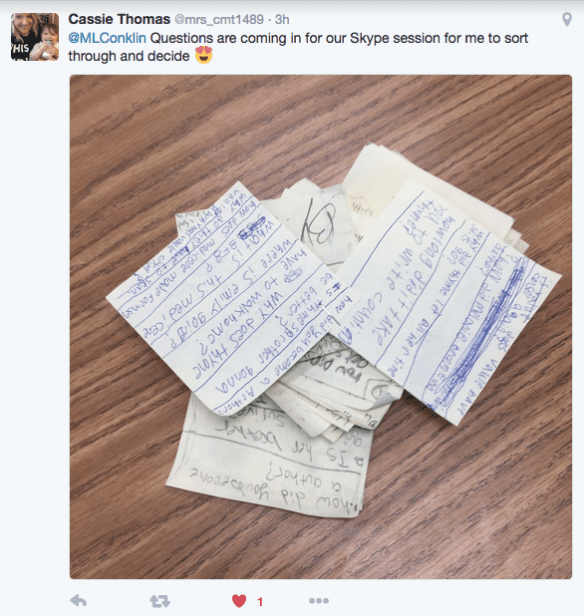
Prepare questions for the author in advance. This can be a fun activity for the classroom. Students can submit questions and even vote on which ones to ask. Author visits have a limited timeframe, so a realistic number of questions is important (around 10 questions in a twenty minute visit). Developing questions as a team can help all students feel included.
Screen Shot 2020-07-21 at 8.19.51 AM

Use a pre-visit activity to allow all students to interact with the author. Many authors have printables, writing prompts, or educator guides on their websites. Share a printable activity with students so they can hold them up to share with the author during the virtual visit. This interactivity is key! Even if we can’t read all of their writing, we can cheer them all on!

Test your technology. Whether you are using Skype, Zoom, Google Hangouts, or another platform to host your virtual visit, make sure you have practiced ahead of time. It’s a shame to lose time in a virtual visit due to technical issues, and familiarity can help with trouble-shooting. Some authors will do a quick technical check, too.

Day of the Virtual Visit

The logistics of a virtual visit are just as important as the logistics of an in-person visit. You want to get the most out of your limited time with the author, so be prepared to start on time and have a clear plan in hand.

Many authors will log in a few minutes early to get set for the visit. This gives you time to confirm any last-minute details and troubleshoot any sound or image quality issues.

Have an arrivals strategy in place. When dozens of students join a video chat from different locations, it can be even harder to wrangle them than in person! Make sure you know how to control volume and mute voices. Give students a Right-Now type of activity to engage in when they arrive to the visit. That can be as simple as holding up a drawing that is related to the author’s work, or showing off their pet, or dancing in their seat to show how excited they are. You can also utilize the comments section as an interaction tool, though it requires moderation to maintain a safe space for all.

Ask questions equitably and clearly. Some authors wish to call on students to ask questions, but that can be tough when only twenty faces fit on your zoom screen! Plan ahead so that all students feel included and utilize your mute button as needed.

Look for opportunities to interact. Some authors are well versed at virtual visits and will get your students engaged easily. Others may be new to this platform, so allow students to interact during the visit by raising their hands to indicate their choice, waving or wiggling fingers to show applause, or holding up pre-prepared signs or pictures.

After a Virtual Visit

Time flies during a virtual author visit, and your students may feel they did not get to interact as much as they would have liked. Give students an opportunity to communicate after the visit via written messages. These don’t have to be delivered on paper. You can collect photos of handwritten letters or compile typed thank-you messages into a follow up email to the author.

The way we connect may have changed during the age of COVID-19, but authors still want to visit schools and libraries. We share a common goal: literacy engagement. If you follow these tips, by the time the author visit arrives, the whole class will be buzzing in anticipation, and afterward the enthusiasm will last for weeks. That is the value of an author visit.

Happy planning to all!

Melanie Conklin grew up in North Carolina and worked as a product designer for ten years before she began her writing career. Her debut middle grade novel, Counting Thyme, is a Bank Street Best Children’s Book, winner of the International Literacy Association Teacher’s Choice Award, and nominated to four state reading lists. Her second novel for young readers, Every Missing Piece, published with Little, Brown in May, 2020. When she’s not writing, Melanie spends her time doodling and dreaming up new ways to be creative. She lives in New Jersey with her family. Connect with her on twitter @MLConklin.



The Journey to Becoming Well Spoken

By Erik Palmer, CCIRA 2021 Featured Speaker

Student voice. What a hot topic! I see tweets about it, conference sessions about it, articles in educational publications about it—it’s all the rage. How can we give students voice? Oddly, every single one of the mentions of student voice ignores the first and most important meaning of voice, speaking. 

Screen Shot 2019-05-21 at 9.40.52 AM

When you see the word voice used by educators, it might mean choice or options as in “give students voice instead of directing their learning.” Sometimes it means opinion as in “we need to value student voice and make them feel comfortable expressing their ideas.” Sometimes it means literary style as in “Hemingway has a unique voice in his writing, and we want students to develop their voice as well.” I’m not arguing with any of those: I think we should give students choices, we should value their opinions, and we should let them have their own style. But we should also give them the gift of being able to verbalize well, because when you see the word voice used by everyone else on the planet, it means sounds from the mouth. 

Dictionary.com defines it this way:

voice

noun

      1. the sound or sounds uttered through the mouth of living creatures, especially of human beings in speaking, shouting, singing, etc.
      2. the faculty or power of uttering sounds through the mouth by the controlled expulsion of air; speech

https://www.dictionary.com/browse/voice

I think you’ll find every dictionary thinks of speaking first and foremost. How can so many educators, then, talk about giving students voice without thinking about oral communication? That’s the original and most important voice! How do we declare what we want? How do we express our opinions? How do we share information? How do we socialize? Overwhelmingly by speaking. We say things out loud. Often, that speaking is face-to-face, but increasingly digital media are used expanding the reach and importance of verbal communication. Tools such as FaceTime, Skype, Zoom, TikTok, Flipgrid, and so many more showcase oral communication. All students can make videos and podcasts designed to let us hear their voices. If we listen closely, we hear that students don’t speak well. You’ve noticed. You’ve struggled to listen to the end of a student’s two-minute podcast. And if you think back to how mediocre those in-class poetry recitations were, you shouldn’t be surprised.  

Remember how amazed people were when students at Marjory Stoneman Douglas High School spoke? You heard many comments about how well they communicated, and some conspiracy types thought they must be paid actors because normal kids just don’t speak that well. Two important points: one, we were impressed because good speaking is not the norm for students and two, the way they captured America’s attention was by speaking. As much as we value writing, speaking is by far the number one to have an impact, to have voice, if you will. 

Why have we let kids down on their journey to become competent, confident oral communicators? We have been focused on reading and writing. I joke that we should have a new word: readinganwriting. Those words always seem to come together, and they are the only words mentioned by English and language arts teachers. No one ever says reading, writing, and speaking. We have an enormous blind spot. By consistently shortchanging and often downright ignoring the number one language art, speaking, we have robbed students of their most important voice. We have excuses: “Some kids are just naturally good at it and some aren’t.” “Speaking is not on the Big Test.” “I have activities where I make students speak so I have this covered.” These excuses keep us from giving the direct instruction needed to give students real voice. I especially worry about the last one. Making kids talk as an afterthought in some other activity does not teach speaking. At the end of the poetry unit, have students mutter a poem. After reading the book, make students give a book share that inspires none of the listeners. Listen to those with new ears. How many students demonstrated an effective voice? Few. They were never specifically taught the skills of verbal communication.

The truth is, it isn’t that hard to teach students how to speak well. Just as there are specific lessons on specific topics (e.g., punctuation, capitalization, word choice, sentence structure) to improve writing and specific lessons on specific topics (e.g., genre, setting, metaphor, plot line, textbook structure, character development), to improve reading there need to be specific lessons on each of the specific skills needed to improve speaking. I’ll give you an example of how to teach one speaking skill. 

The biggest weakness of almost all speakers is that their talks are dull. They speak in a lifeless way. We suffer through this in the classroom, but when we listen to recorded lifeless talks, we stop the podcast 30 seconds in. See if you can make it past that amount of time with this clip: https://youtu.be/BKRvk4-Xk70 I’m not criticizing the student, I’m criticizing us. We had this child in class for eleven years and did not teach her how to be well spoken. As we went to remote instruction and asked students to submit presentations digitally, these sorts of clips were the norm. Because recorded voices are always less impressive than voices in person, and because distance learning involves more recorded voices, maybe more of us will come to notice that students have never been taught how to avoid being dull. You taught how to choose better adjectives in writing, so teach how to add life in speaking.

Lesson one: to demonstrate the importance of adding inflection, let students practice with phrases where the meaning can change depending on how it is said.

I don’t think you are dumb. (But everyone else does?)

I don’t think you are dumb. (You know I am?)

I don’t think you are dumb. (You think he is?)

Lesson two: Play this: https://www.youtube.com/watch?v=Ouic59Gv0x0 There is a quick visual showing what a voice with no life looks like compared to a voice with life as well as an audio modeling the difference—1:20 of no life followed by the exact same words with life. 

Lesson three: Give a small practice speech where adding life makes a huge difference. Have different students speak encouraging each one to add lots of feeling. 

One time, we had a squirrel in our house. When we opened the door to let our dog out, it ran right in. Everything got crazy! The squirrel was running all over! My mom was yelling, “Do something! Do something! Get that thing out of here.” My sister jumped on a chair and stood there crying her eyes out. My dad was chasing the squirrel with a broom from room to room.  “Open all the doors!” he yelled to me. “I did already!” I yelled back. Finally, it ran out. After a minute or so, my dad started laughing. “That was interesting,” he said with a chuckle.

All three of those combined might take 40 minutes of instructional time, and every student will learn one on of the keys to effective speaking. Will all students master this? Of course not, just as not all master the skills of writing or of reading or of drawing or of anything. But all will get better, and all will understand one aspect of how to communicate better. 

One aspect? What are the others? When I ask teachers at workshops to give me descriptors of effective oral communication, answers vary wildly: inflection, articulation, enunciation, vocal modulation, loudly, slowly, clearly, pacing, body movement, expression, eye contact, gestures, stand still, humor, and many more. Some of the answers are wrong. You’d hate me if I talked loudly and slowly—obnoxious and boring! Many are confusing for kids. Vocal modulation? Say what? I created six-trait speaking to solve the problem. You know one of the traits, life. That’s a teaser. There isn’t time in this blog post to explain them, so visit pvlegs.com. The site name will make sense once you get there, but I bet you can guess what the “l” stands for.

Bottom line: do not ignore the most common and most important definition of voice. If you really want students to have voice, give them the gift of being well spoken. They can’t get there on their own, they can’t get there just by speaking a lot in class. They need you to be the guide.

Many more resources here: https://pvlegs.wordpress.com/2018/06/10/shortchanging-speaking/

Erik Palmer is a Denver-based education consultant who has published two books with Stenhouse: Well Spoken and Good Thinking. He presents often at the CCIRA conference and his sessions are favorites among attendees.

The Fab Four Comprehension Strategies: Accelerating Reading NOW!

By Lori Oczkus

Summer reading loss is real! We know that many students lose anywhere from two weeks to two months when they don’t read much in the summer. Couple that with the months of learning loss due to Covid 19 and researchers estimate that students could fall as much as 30% behind in their reading this school year. (NWEA, 2020) Our students desperately need a boost in their comprehension and engagement to catch them up in reading now and in the fall. 

My favorite go-to strategy to accelerate reading, is reciprocal teaching (Palinscar & Brown, 1984), or the “ Fab Four” (Oczkus, 2018) Reciprocal teaching is a scaffolded discussion technique based on four of the strategies good readers use; predict, question, clarify, and summarize (Oczkus, 2018). Reciprocal teaching is backed by over 30 years of solid research with consistent gains of .74 or nearly two years in one year. (Hattie, 2008) An added bonus is that the Fab Four easily adapts to a digital setting at any grade level with any text. 

In my travels to schools around the globe, I collaborate with teachers and work in classrooms to find ways to engage students in reciprocal teaching while raising reading scores. Here are some tips, pointers, and my “go to” lessons to get you started. In February I will present more ideas at CCIRA 2021. I can’t wait to return to Colorado to meet more fabulous colleagues and to visit my “home” state where I grew up! 

Best Pointers to Yield Results 

Teach the Fab Four Package

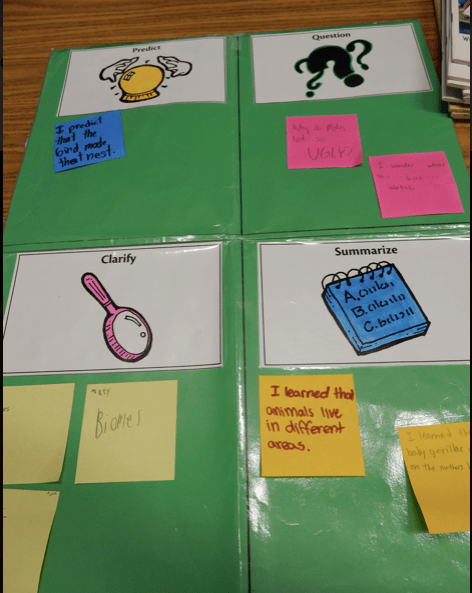
Teach all four strategies in ONE lesson! Represent them in a poster to ensure you cover them all. Designate one student as the “checker” who checks off each strategy as the class discusses it. Students predict what they will learn; clarify tricky words and discuss how to figure them out; ask questions for the group to answer; and summarize what they read. Try color coding the four strategies live and in online discussion boards. 

Follow a Gradual Release Model with Discussion 

Ensure success with a gradual release model of teaching by modeling the strategies. Then provide opportunities for students to discuss the reading and the strategies in pairs and teams. Students may take on roles -predictor, questioner, clarifier, summarizer. Try using chat rooms in Zoom or Google Meets or responding to one another on Flip Grid or Google Docs. 

Teach Metacognition

Teach students to become metacognitive when using the strategies by making them their own. Students and the teacher record demonstrations and explanations of the strategies for each other on a platform such as See Saw.

Close Reading with Informational Text

One of my favorite ways to introduce the “The Fab Four” is with informational articles. In this demonstration I use an article from my series Close Reading with Paired Text k-12 co-authored with Dr. Rasinski (Shell, 2015) In my project schools we also use Newsela, Scholastic News, and other short articles once the class is familiar with the method. The students and the teacher each have copies of the text that they mark up using either on a device or a hard copy with colored pencils or highlighters. The teacher and students reread the text at least three times to discuss; what they will learn, words to clarify, questions to ask, and important points to summarize the reading. Here is my 7-minute video for educators and parents explaining how to participate with students in a Fab Four discussion. Scroll down for the bookmark lesson plans, question and answers for parents, and parent letter. How to Boost Reading Comprehension with the Fab Four https://www.youtube.com/watch?v=q9mkv8f6Hxo 

Fab Four Poetry Lesson for Comprehension and Fluency

Here is a comprehension lesson that includes predicting what the poem is about, clarifying words, phrases, and visual images, asking questions, and summarizing by sharing favorite lines and parts. The result is a peppy and engaging student-centered discussion. Students then reread the poetry to perform live in class or record on a digital platform. The demonstration here is from my series Close Reading with Paired Texts co- authored with Dr. Tim Rasinski. Here is a 7-minute video to show how to conduct a Fab Four poetry lesson for parents and teachers. Scroll down for bookmark lesson plans. 

How to Improve Comprehension & Fluency with Poetry https://www.youtube.com/watch?v=rt7h9RGtAKU 

Screen Shot 2020-07-01 at 7.52.29 AM

See you at CCIRA! The research behind reciprocal teaching consistently delivers results in just a few months. For high-yield/ low prep strategies refer to my books and resources listed in the bibliography below for more information and follow me on twitter @LoriOczkus or contact me at loczkus52@earthlink.net and let’s connect. See you at CCIRA in February 2021! Please join me for one or all of my 3 CCIRA sessions on reading and writing 

 Reading Rescue with the Fab Four: Comprehension Strategies to Accelerate Learning Now! 

Literacy Strong All Year Long!

Teaching Guided Writing For Success 

Lori Oczkus is a literacy coach, author, and popular speaker across the United States and internationally. Tens of thousands of teachers have attended her motivating, fast paced workshops and read her practical, research-based professional books. She is the author of the best-selling book Reciprocal Teaching at Work (ASCD, 2018) with the foreword by John Hattie. Lori has extensive experience as a bilingual elementary teacher, intervention specialist working with struggling readers, and staff developer and literacy coach. She works with students in classrooms and really knows the challenges that teachers face in teaching students to read! Lori has been inducted in the California Reading Association Hall of Fame for her many contributions to the field of reading in California and internationally.

Some of Lori’s Books and Resources:  

Teaching Guided Writing: Scaffolding for Success QRG (NCTE, 2020)

Close Reading with Paired Texts k-12 Series co-author Tim Rasinski (Shell,2015)

Fabulous Four Comprehension Puppets ( Primary Concepts, 2008) 


Stepping Back-Moving Forward

By Patrick Allen, longtime CCIRA Presenter

Let’s step back for a moment.  Let’s think about our teaching.  Let’s think about the reasons we became teachers in the first place.  

I grew up in a small town in southeastern Colorado.  Summers, circa 1968, were spent riding bikes, digging tunnels, swinging in tire swings… and playing school!  The kids in my neighborhood would load up wagons with books and chalk and crayons and Big Chiefs and travel to the front porch “classrooms” of our friends (and stuffed animals).  Porch school.  Each week or so, a new teacher would take on the role.  If I close my eyes, I can still remember it.  I loved playing school.

Fast forward.  In the fall of 2020, God and COVID willing, I’ll begin my 35th year of teaching.  Three schools.  Approximately 850 students.  Numerous administrators.  Countless colleagues.  I student-taught with a brilliant teacher named Judy Gilkey and we’re still good friends.  I remember my first interview (at the same school).  Laura Harmon, the principal, said to me, “Before you come for your interview, I want you to read Understanding Reading and be ready to talk about it.” (Smith, 1971)  I did. I was.  Laura had incredible insight into learning and leaders and her nudge into Frank Smith’s world remains a building block of my success as a teacher of readers.  That was one of the smartest things anyone has asked me to do.  Prepare.  Know.  Understand.

My teaching journey has been incredible.  Along the way I’ve been influenced by the best of the best, both personally and professionally.  If I tried to name each person whose shoulders I stand on, this blog post would be 27 pages long.  I guess my question is:  Who’s shoulders are you willing to stand on?  

Year 35.  I am moving from fifth grade to second grade.  I am excited about the change in grade levels.  I am excited to learn from colleagues I admire and respect.  I am excited to challenge myself as a learner.  I am excited to dig into the work of the professionals writers I admire who understand the developmental needs of young learners.  Most of all, I am excited to work with burgeoning readers early on in their literacy journey.  

Recently, someone asked me, “What will you do differently?”   Brilliant Question. 

In When Writers Read, Jane Hansen reminds us that our mission is to help learners become better evaluators of their work.  She nudges engagement and encourages independence.  She says that to be effective, readers and writers, need:

  • Voices – need to be honored (all voices)
  • Decisions – decisions rest in the hands of the learner (ultimately)
  • Time – opportunities must be plentiful to “do” and “create” (daily)
  • Response – listening is key (always)
  • Self-Discipline – leads to engagement (proactively) 

(Hansen, 2001)

Voices.  Today, I think it’s as important as ever that we listen to the voices of young people; those that sit in our classrooms, in person or virtually, and those that sit outside our classrooms.  If I’ve learned nothing over the past few months, it’s that my students can and MUST know their world.  The voices of children must ruminate through our instruction and our interactions. 

Decisions.  Decisions must rest in the hands, hearts, and minds of the learner.  In my classroom, hang these words, “Where choice lives, learning prospers!”  It’s true.  Students must be in charge of the decisions they are making as learners – what to read, what to write, what to think about.  It’s my job to set up opportunities.  It’s their job to make the decisions that propel them forward with my support.

Time.  Thoreau says, “Time is but the stream I go a-fishing in.”  We worry so much about time.  I know that large blocks of time give students the opportunity to make wise choices.  Time gives children opportunities to think, grow, and prosper without feeling rushed. 

Response.  I must respond with kindness and curiosity, if I’m going to create a classroom community in which learners thrive and prosper.  I must listen.  Children must, in turn, respond with kindness.  They must listen.  A response is only as good as the effort the listener puts into the situation.  My father used to say, “Look them in the eye.  Gather their thoughts in your head.  Respond with honor and humility.”  See.  Gather.  Respond.  Not bad advice. 

Self-Discipline.  A bold task.  It takes control.  Self-discipline means that one can actively “pursue what one thinks is right despite temptations to abandon it.”  It’s definitely not easy to overcome weaknesses and face difficulties, but that’s what it takes to be self-disciplined.  I think there’s a direct correlation between engagement and self-discipline.  Knowing what you don’t know so you can better understand what you do know.

So, with Jane’s voice in my head, here are the things that will remain constant:

  • The Workshop Structure.  There is no better format for ensuring consistency from day-to-day.  Crafting, composing, and reflecting will sit at the heart of my instruction.
  • Rich Print.  Children deserve to hear and read provocative and thought-provoking text.  They must see themselves in the books they read, but more importantly, they must see the big-wide world in the texts made available to them. 
  • Notebooks.  Children not only need to read every day, they need to write about their reading in wise ways every day.  They also need daily opportunities to write about what they deem important.
  • Talk.  Time to talk in pairs, in small groups, and in one-on-one conferences with me. Conferring is, afterall, the keystone of the reader’s workshop.
  • Thinking Strategies.  Thinking (comprehension) strategies are the glue that binds together days, weeks, the year.  Our work will be grounded in thinking.  Children must learn:  
    • Monitoring for Meaning and Problem Solving
    • Activating, Utilizing and Building Background Knowledge (Schema)
    • Asking Questions
    • Drawing Inferences
    • Creating Sensory Images
    • Determining Importance
    • Synthesizing Information (PEBC, 2014)
  • Engagement.  Thinking through the systems and structure that lead to deep, lasting engagement is critical.  Ellin Keene asks the questions, “What can we do to encourage motivation for students, or better yet, their engagement?” (Keene, 2018).
  • Stamina and Endurance.  Providing opportunities to develop their stamina over time is critical to help nourish and maintain their self-discipline.
  • Community.  Trust, Respect, Tone.  These three notions must continue to serve as “strong bulwarks in my classroom” if I want to “ensure that my classroom is primed and ready for literacy learning to flourish.” (Allen, 2009)

And, here are the things that will change:

  • Brilliance.  Recognizing the brilliance of 7-8 year olds is different than noticing the brilliance of 10-11 year olds.  “Children’s metacognition begins to develop across this age — their ability to know what they need to do to better, learn or understand (e.g., reread a passage, ask a question). They also begin to understand the permanent nature of items.” (Anthony, 2017)  I have got to keep learner’s developmental milestones in mind. 
  • Purposeful Play. “Play is one type of environment where children can be rigorous in their learning.” (Mraz, Porcelli, Tyler, 2016).  Opportunities for play – physical, social, emotional, and intellectual – must be integrated into a young learner’s day.
  • Celebrate Naivate.  There’s a joyous naivate in children, especially young children.  I’ve got to make sure to find time to celebrate the silliness.  Learning to laugh with learners is an important part of working with primary students.  There’s still an innocence to behold.
  • Recognizing Time.  The reckoning of time is important.  Helping students learn to manage their time and to understand how time works is an essential part of the primary grades.  I can develop stamina and endurance, but simultaneously I have to recognize that time is different for young learners. 
  • Scope and Sequence.  My friend, Lori Conrad, taught me long ago, “the scope is what we know children need and the sequence is what we pay attention to when they show us they need it.”  This is especially important with young learners.  No publisher knows our children better than us.

My second grade teacher was MIldred Henrie.  I loved her with all my heart.  She had beautiful white hair piled on top of her head.  Her blue eyes twinkled when she smiled at me and her blue eyes could shoot a glare of “stop that right now!”  But she never raised her voice and she always made me feel like I was the most important person in her world when she sat down beside me.  She turned sixteen the year I had her (Leap Day) and we celebrated with laughter and songs and joy.  It was a beautiful year. 

I guess that the most important thing I’ll keep in mind as I start my 35th year and work with younger learners is that, “Childhood is not preparation for anything.  Childhood just IS, and they only get one.  It’s up to us to protect it!”  (Laminack, 1995).  

It just is.  

Step back and refill your wagon with what’s most important.  I know I will be. 


References

Allen, Patrick.  Conferring:  The Keystone Of Reader’s Workshop. Stenhouse Publishers. 2009

Anthony, MIchelle.  “Cognitive Development in 6-7 Year Olds.” Scholastic, 2017.

Hansen, Jane.  When Writers Read. Heinemann, 2001.

Keene, Ellin.  Engaging Children:  Igniting a Drive for Deeper Learning. Heinemann, 2018.

Laminack, Lester.  Learning with Zachary. Scholastic, 1995.

Mraz, Kristine, Porcelli, Allison, and Tyler, Cheryl.  Purposeful Play:  A Teacher’s Guide to Igniting Deep and Joyful Learning Across the Day.  Heinemann, 2016

Public Education and Business Coalition, Thinking Strategies for Learners, PEBC, 2014.

Smith, Frank.  Understanding Reading:  A Psycholinguistic Analysis of Reading. L. Erlbaum Associates, 1971.

Patrick Allen is a second grade teacher at Frontier Valley Elementary in Parker, Colorado and he has taught in Douglas County Schools for over 30 years.  He is the author of Conferring: The Keystone of Reader’s Workshop and co-author of Put Thinking to the Test, both with Stenhouse Publishers.  Patrick’s work is highlighted in two video series, “Fact Finders” and “What are You Thinking?” (Stenhouse).  Patrick has worked with the Public Education and Business Coalition (PEBC) as a staff developer and his classroom serves as a lab classroom for local and national visitors.  Patrick has presented locally, nationally, and internationally.  He is a regular attendee and presenter at the CCIRA Conference.  Patrick’s wife, Susan, is a first grade teacher.  He has four grown children (his oldest daughter teaches Kindergarten) and one grandson, Ryker.


The Responsibility of Mentorship

By Danny Burleigh

Who is your mentor? To whom do you attribute your pivotal development as a professional? As a first year teacher, I was lucky enough to have been offered two fifth grade positions at two schools. I met with friends, colleagues, and administrators weighing in on which offer to accept, and ultimately the decision was made on a single factor. I chose a school where I would be able to teach and grow alongside Patrick Allen.

I was entering the education field after serving as a Marine Officer for four years (talk about culture shock), and I knew that I needed guidance. I had incredible mentors that guided me throughout that career, so I had a deep desire to find strong mentorship as a teacher. I already knew Patrick to be a brilliant educator through his book Conferring: The Keystone of Reader’s Workshop and classroom observations, and he was going to mentor me. 

He just didn’t know it yet.

It is no secret that the long term outlook for new teachers in the field is often bleak. Nearly one third of all new teachers leave the profession within three years. Half leave after five. Statistically, I still have a 50/50 shot of being in my classroom next year (social distancing aside). Most states and districts have mandated induction programs for new teachers and yet these numbers have seen little change over the years (Ingersoll, R., & Merrill, L., 2012).

There are a number of factors that contribute to why induction programs may, or may not, lead to long and productive careers in teaching; but I can only speak from my experience (both in and out of the classroom). As educators, we are deeply compassionate people. We remember the whirlwind that was our first year and, when placed in positions of leadership, do not want to overwhelm our new teachers with the burden of induction programs. Coupled with our responsibilities to our students or other teachers, induction programs begin to degrade into a task that you “get through” rather than something efficacious.

Induction/mentorship programs are the single most important developmental step for any teacher (Rockoff, 2008). It should be a rich and intensive process in order to continue developing strong foundations. It is the benchmark that influences the trajectory of how they interact with children for the rest of their career. Everyone has intense and specific responsibilities to uphold within the mentorship process that are essential for development as a teacher.

Responsibility Starts with Mentees

The responsibility for the effective mentorship rests on the mentee. I was determined to find a mentor who would challenge me professionally. Even though Patrick didn’t initially know that he would be my mentor, I sought him out for his wisdom and guidance. I count my blessings now as I look at our friendship and know that he has been an important part of my development as a professional.

Mentees are responsible for their trajectory within their mentorship. It is their responsibility to express their needs and to pursue a greater understanding of their craft. If the mentee is unwilling to sacrifice time and effort in the pursuit of greater understanding, then the mentorship process is irrelevant. 

When I first approached Patrick, I was seeking help with conferring. I knew that was an area of growth for me and I sought out specific guidance around a concept with which I was struggling in the classroom. I spoke frequently to Patrick over a multitude of topics ranging from instruction with thinking strategies, to discourse in the classroom, to creating a warm environment with my classroom furniture. 

I learned a long time ago that it was better for me to understand why my mentor did things rather than what they actually did. I would certainly mimic some of my mentor’s choices in my own classroom, but I knew the reasoning behind teacher decisions was how I would make instructional decisions for students regardless of the thinking we were tackling. Mentees, whether veteran teachers or fresh out of school, need to understand how great teachers make the decisions they do rather than trying to merely mimic instructional practices.

But how do we find this person? First develop a list in your mind of what qualities you would expect to see from students of great teachers. Would they be engaged? Creative? Love learning? Ask yourself what feelings you get when you walk into an ideal classroom? Once you answer these questions for yourself, start looking for teachers in your building, district, city, or state that foster the kind of learning you your students should be doing.

If your workplace does not provide the mentorship you need, it is your responsibility to be creative. There are a multitude of ways to get involved with other teachers professionally, both in-person and virtually. If you expect your students to seek answers to their questions, I would encourage you to also do the same. 

Screen Shot 2020-06-09 at 7.00.53 AM
Photo Courtesy of Thao Le Hoang at Unsplash

Responsibility of Mentors

Mentorship is a privilege in any profession. To be called a mentor is something that should be received with humble respect. It means sacrificing time and energy to share wisdom with a colleague who holds you in the highest regard. It means staying later and coming earlier. It means giving up breaks and plan times to work with your mentee. It also means influencing a whole generation of educators and the students they are privileged to teach.

Mentors are well read. If mentees are to hold the responsibility of seeking out why mentors make the decisions they do, mentors are responsible for providing the research and reading for the instructional moves they make in the classroom. I know this is a high order, but it is one that will not only benefit the practice of the mentee, but will also challenge the mentor to truly decide if their practice holds up to a research-based standard.

Mentorship is fostered through inquiry. When I expressed to Patrick that I was wanting to work on writing instruction, I came in the next day to a pile of articles by Penny Kittle, Donald Graves, Katy Wood Ray and a myriad of other writers who mentored him. It was long work sifting through those documents finding idea after idea on how I might implement those concepts into our study on the persuasive mode. A few days later he and I met to discuss what I discovered and he helped me bring some lofty ideas down to earth, demonstrating how he has used many of the same ideas in his own instruction. Positive mentorship allows the mentee to formulate their own ideas then refine them instead of offering the refined idea with no understanding of its origin. 

Often mentor and mentee conversations can become debased to a discussion on how to teach to certain programs and resources within the school. However, no program has ever been shown to create high quality teaching on its own accord (Allington, 2013). If this is true, then it is far more beneficial for mentors to help their mentees to understand why they might choose to use certain resources, or not use them. Mentors might help guide mentees to understand how their philosophies on education and students (backed by research of course) can be interwoven into mandatory programs or resources. They might help them to whittle away at the purposeless activities that are ever present.

Observation is key to developing great teachers. Mentors need to be in mentees’ classrooms and vice versa. This is where mentors have the ability to note where their discussions meet children and how their mentees are truly utilizing them.

Patrick once observed a workshop I facilitated with my students. We had just finished our composing time and had transitioned to our reflection. A student began sharing and, when they were finished, the conversation moved to another student. Following the workshop, Patrick said little about my management or instructional prowess. Rather, he made a small note. The first student was not finished with their thinking. He told me to “hold out your silence a little longer; students will continue to dig deeper into their thinking.”

Instructional moves like that cannot be discovered through conversation. They are only seen through the lens of an observer who is focused on perfecting the craft of their mentee. Inversely, mentees need to be afforded the opportunity to observe the mentor’s classroom. This allows them to ask questions about practices that develop into rich dialogue toward instructional decisions in their own classrooms.

Administrators are responsible for vision and implementation. 

Without a clear mission and vision in the school, teachers are at a loss for what is truly important for them to accomplish. The school’s mission needs to be clear, concise, and explicit. Most schools and educator leaders have this mission. What begins to degrade this vision are the implicit, “suggested” missions that we set. 

When I was a young officer in command of a motor transport platoon, I was walking my line of vehicles with my squad leaders. I remember making a careless suggestion that it would be, “awesome if all the tires were polished.” I did not intend for it to be an order, nor did I think it was at all necessary. However, the next day I discovered that my platoon had stayed late and polished all the tires of all 32 vehicles in our platoon. Obviously I was mortified, but I learned a valuable lesson. Implicit missions are just as heard and carried out as explicit ones. Leaders must be cognizant of the implicit missions they direct. 

For example, if we state that our school’s vision is for students to create a lifelong love for reading, but we only discuss student standardized testing scores, there are competing visions. Implicitly, teachers are perceiving that standardized testing is the most important factor in evaluations because it is the only factor discussed. These small, competing visions ultimately cause burnout, especially for teachers who are already unsure of their own visions within the classroom. 

Administrators should not be the source of mentorship for new teachers. They are responsible for providing and supporting mentors by providing them time and resources in order to foster growth in their mentees. Mentors need time to observe and coach the mentee. Mentorship is a difficult and sacrificial task that requires professional development and guidance. Administrators who invest in these leaders must create opportunities for their mentors to grow.

It is imperative to understand that mentorship is not something that ends with a two-year induction program, it evolves to a different form. In my fifth year of teaching I still know that my friend and mentor will continue to coach me, even if we are not in the same building; just like he seeks mentorship from colleagues he respects. I also know that in each new chapter of my career, I will find colleagues who will continually support me professionally, challenge my thinking, and help me strive to understand my vision for students.

Who is my mentor? I know I will continue to add to the answer.

Now I ask who is my mentee?  To whom will I offer support? 

These are also important questions to ask.

References

Allington, R. L. (2013). What Really Matters When Working With Struggling Readers. The Reading Teacher, 66(7), 520–530. doi: 10.1002/trtr.1154

Ingersoll, R., & Merrill, L. (2012). Seven Trends: The Transformation of the Teaching Force. PsycEXTRA Dataset. doi: 10.1037/e579212012-001

Rockoff, J. (2008). Does Mentoring Reduce Turnover and Improve Skills of New Employees? Evidence from Teachers in New York City. National Bureau of Economic Research, 12(24). doi: 10.3386/w13868

Danny Burleigh served as a United States Marine Corps Captain before becoming a teacher in Parker, Colorado. He is in his fifth year of teaching and currently teaches fourth grade at Mammoth Heights Elementary. He was fortunate to present at CCIRA 2020 on teacher mentorship with Dana Sorensen from the Public Education and Business Coalition. He is currently a member of the Public Education and Business Coalition Lab Host Fellowship.