After my daughter Sam’s freshman year, she figured out basketball wasn’t her sport.
Sam’s sophomore year she decided to try a new sport. Although she knew nothing about Nordic skiing she took a risk and signed up. Since Winthrop did not have a team, she would need to practice at another school, 20 minutes away, a school known for their many state titles. Joining Nordic would mean that she would not only have to learn a new sport but that she would have to do so by immersing herself in a new and an unfamiliar school environment with kids she did not know.
Sam didn’t want to just ski, she wanted to be part of a team. A Nordic team needed four girls to score. After a week and some convincing, she found three other girls from her school in Winthrop who agreed to join her in taking this risk, for none of them had ever stepped on Nordic skis. They would be a team and ski for their own high school but practice with the neighboring school. They embraced the idea of possibility together.
And then came learning to ski. That first year they were referred to by the other school as the “newbies”. Sam would come home from practice telling tales of their collective falls and crashes. With each practice, progress was made, momentum generated, and skills acquired.
In their second year as a team they started to look and sound like skiers. These girls dreamed big. Their goal was to win the Mountain Valley Conference Championship. It might seem like an unattainable goal to most, but these girls were determined and kept the goal within reach. At the end of their 2nd year of skiing (junior year) they came in 2nd place for their conference. They were happy but wanted more. They wanted to win, they wanted the trophy, and more importantly wanted to be recognized as genuine skiers.
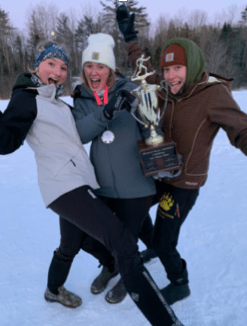
Fast forward. As seniors, the girls got the ultimate taste of success. It seemed that their hard work, determination, and humility had all paid off. The Winthrop girls were awarded the trophy for being the 2020 MVC winners for Nordic skiing!
Their smiles as they held the conference trophy spoke of a sense of accomplishment and pride.
Then, 48 hours later came the news that there was a scoring error and that the team had actually come in 2nd place, not 1st. The trophy was not theirs to claim. Their moment evaporated almost as quickly as it had been captured.
Trophies and titles can be handed off, but what can’t be taken away from these girls are the skills acquired and the feeling of accomplishment from new learning.
Just like when kids learn to read, it can never be taken away. It’s not the trophies that we win or championships seized, rather it’s the skills we acquire with new learning that stay with us for a lifetime. New learning is forever ours to keep.
JenniferAllen is a literacy specialist in Waterville, Maine. She has worked in education for the last twenty-five years. Jennifer started as a classroom teacher in the primary grades and has been working in this position as a literacy/specialist coach for the last sixteen years. She is the author of Becoming a Literacy Leader and A Sense of Belonging, both published by Stenhouse.
I have the pleasure of working in many schools across the country. The schools I serve are unique in their own ways. Size of schools and classrooms vary. Start and end times vary. Mandated curricular materials, initiatives, special projects, and school culture often vary. Number of preps, number of meetings, number of students with diverse needs…all vary.
Schools are unique, there’s no doubt. Sometimes, however, the ongoing problems of practice have similarities across states, districts, and schools. For example, there’s never enough time to get everything done. The school day is not getting any longer, yet the curricular demands continue to increase. There’s no such thing as a NO VACANCY sign above our classroom doors in the public sector (thank goodness!). Yet, it’s our job to meet the needs of individual students. In addition, a common occurs when competing opportunities and initiatives make it hard for stakeholders to know what’s most important, yet it’s our job to champion the goals.
What are the problems of practice that show up in your school/district? Jot them down.
While problems of practice can seem daunting at times, they often have silver linings tucked inside that help us find our way. Once we name the problem of practice, we can figure out how solve it, making the system better. School folks (administrators, teachers, support staff, parent volunteers, etc.) working with students regularly have a unique opportunity to make high-leverage moves withand for all individual students. Sure, these high leverage moves can look, sound, and feel different depending on the time of year, grade level, and individual classrooms because kids are dynamic. But, high leverage moves become easier and more personalized when we know the students we serve. Proximity helps us get to know students and then, in turn, use that intel to plan curriculum, instruction and assessment. Take a look at 3 high leverage moves that solve problems of practice by maximizing learning time, addressing students’ talents, needs, as well as creating clarity and focus.
High Leverage Move #1: Use the reading workshop model to capitalize on small group learning.
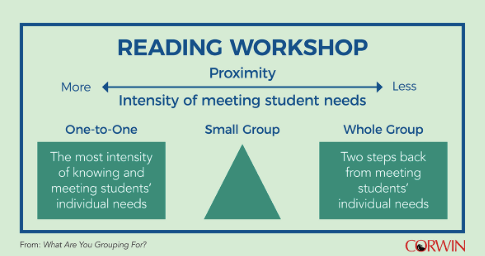
Getting to know and meet students’ needs is a challenge when schools or classrooms lean too heavily on whole group. This happens when small groups feel unmanageable. The workshop structure pictured in the graphic below makes small group learning possible because of the increased amount of time dedicated to student work time. Work time is where students have opportunities to read and work independently AND where small groups can meet. Whether you teach in an elementary or secondary setting, you might consider looping workshop across 2 days as pictured on the right. Doing so maximizes students’ work time while connecting learning from one day to the next.
The first step is to take stock of your reading workshop structure by mapping out how much time is dedicated to student work time. Take stock by listing the total minutes you have during workshop and then add up the minutes that are dedicated to work time. Kids deserve ⅔ of the total number of minutes during workshop time to do the work of learning. Handing that time over to them, regularly and consistently, is important. If you’d like to take stock of how much time readers are really working, download this template.
We know proximity matters. The closer we get to students’ conversations, interactions, and their work, the more we will meet their needs. As the next graphic suggests, small group is a sweet spot during reading workshop because proximity creates greater chances for knowing and meeting students’ individual needs,
Big Take-away: There is never enough time, but when we use the workshop model we have a better chance of maximizing student work time and meeting students’ individual needs.
High Leverage Move #2: Kidwatch to get to know students’ interests, curiosities, habits, and needs.
Educators have been studying students since the one-room schoolhouse. Yetta Goodman and Gretchen Owocki’s work helped give definition to the term kidwatching (Heinemann, 1994). My co-author and I studied kidwatching while writing our book, What Are You Grouping For? by Wright & Hoonan (Corwin, 2019). We use the term Kidwatching 2.0 because kids, and the world around us, are constantly changing, requiring us to fine-tune our observation skills. We kidwatch because it’s the purest form of student data and significantly impacts our decision-making. Kidwatching helps us know what students know and what they can do, as well as inform us about what they need next. Kidwatching helps us capture students’ strengths and areas needing a lift.
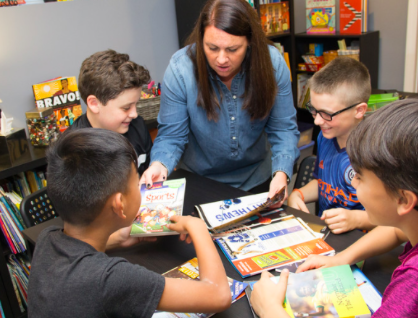
Take a look at the picture below. What do you notice? Take a look at facial expressions, seating arrangements, materials, and so on. Make a jot list in your head or on scratch paper.
Or, you might consider using the note catcher below. Here you would note what you see (since it’s a picture), why what you see matters to student learning, and any wonderings or questions you have.
What do I see/hear?
Why does it matter to student learning?
Wonderings
This group of 5th grade boys are digging into several texts– picture books, biographies, sports joke books, a trivia calendar, and more–focused on sports. This small group previewed and oriented to the texts before choosing one to read. You may have guessed that they excitedly grabbed the Sports Illustrated for Kids because they wanted to see which all-star player was featured in the center fold out. If you are kidwatching in the classroom, your notes would also include what you hear. Student talk is really important because it gives a clearer, richer picture of student thinking.
Kidwatching notes often lead to teacher and student conversations which lead to more kidwatching. Intentional kidwatching almost always feeds new inquiries and new interactions because it’s a recursive process. If you’d like an electronic version, download this Kidwatching 2.0 template.
Big Take-away: When we get to know students’ interests, curiosities, habits and needs through kidwatching, we have a better chance of meeting students’ individual and collective needs.
High Leverage Move #3: Curate to inspire students to be connoisseurs of text.
Think about all of the things you learn about students by observing, listening, interacting, and studying their work. We must use all that we know about our students to curate texts for them to read. As teachers, we curate to meet students social and emotional needs. We gather texts that we think will stoke students’ personal interests and passions. Sometimes we curate texts to nurture students’ knowledge development and/or conceptual understandings. And, of course, we collect and use different texts to address curricular demands and to differentiate instruction to respond to students’ individual needs. Inviting students to curate texts for themselves and others is important too because doing so,
Fosters student independence,
Invites student choice and voice to selecting reading materials,
Increases reading volume,
Develops skills and habits that carry over into adulthood.
Take a look at the tub in the picture below filled with texts focused on women who have influenced and/or made contributions to our world.
The teacher read aloud the book, Separate is Never Equal: Sylvia Mendez and Her Familys Fight for Desegregation. Students were surprised by the lasting impact that Sylvia Mendez and her family had on changing California desegregation laws. This story sparked interest which resulted in a small group of 6th graders diving into different texts focused on women who made significant contributions to the world. Some of these texts were curated by the teacher, while others were curated by the students. When students curate texts for themselves and others, it promotes autonomy, student independence, and an increased desire to read. As you might imagine, the number of texts in the bucket increased over several days and the number of texts that students explored and read consequently increased. Teacher and student curation provides opportunities to increase reading volume, student choice, and independence. If you are interested in curating texts based on students’ individual needs, consider using the A Little Bit About or Tell Us Your Thoughts.
Big Take-away: When we curate texts for students, and invite students into the curation process, we are prioritizing increased reading volume, student choice and independence.
Which high leverage moves will you use to solve your problems of practice? Consider using the reading workshop model to capitalize on using small groups to increase proximity and maximize student learning time. Use kidwatchingin order to get to know students’ interests, curiosities, habits, and needs so that you have a better chance of meeting students’ individual and collective needs. Curate texts that inspire students to be connoisseurs of text so that the priority becomes increasing reading volume, student choice and independence.
References
Clinton, C. (2017) She Persisted: 13 American Women Who Changed the World. New York, NY: Penguin Books.
Owocki, G. & Goodman, Y. (1994) Kidwatching: Documenting Children’s Literacy Development. Portsmouth, NH: Heinemann.
Schatz, K. (2015) Rad American Women A-Z: Rebels, Trailblazers, and Visionaries who Shaped Our History . . . and Our Future!. San Francisco, CA: City Lights Books.
Thimmesh. C. (2002) Girls Think of Everything: Stories of Ingenious Inventions by Women. New York, NY: Houghton Mifflin Books.
Tonatiuh. D. (2014) Separate Is Never Equal: Sylvia Mendez and Her Familys Fight for Desegregation. New York, NY: Abrams.
Wright, J. & Hoonan, B. (2019) What Are You Grouping For? How to Guide Small Groups Based on Readers–Not the Book. Thousand Oaks, CA: Corwin.
Julie Wright is a teacher, instructional coach, and educational consultant with over twenty-five years of experience in rural, suburban, and urban education settings. She holds National Board Certification as well as a B.S. in Education, M.A. in Language Arts and Reading, a K-12 Reading Endorsement, and extensive school leadership post-graduate work, including a pre-K through grade 9 principal license from The Ohio State University. Julie serves as an Adjunct Faculty Member at Ashland University and is the co-author of What Are You Grouping For? How to Guide Small Groups Based on Readers–Not the Book (Wright & Hoonan, 2019). Follow Julie on Twitter @juliewright4444 or for more information on how she can support your efforts, visit www.juliewrightconsulting.com.
This is the question I am asked most often as I work side by side with teachers and kids in writing workshops. And while I appreciate the unspoken implication that the instructional move that prompted the question is remarkable in some way, it typically isn’t.
My ability to respond so naturally to writers in the moment comes from deep content knowledge I have built over many years—nothing magical about it.
Awesome, you’re probably thinking. Is that all?
Yes, and. . . Underneath that original question is another, more important question, at least from my point of view as an instructional coach: How DO we build the deep content knowledge we need as teachers of writers?
Teaching writers is complex. It can seem overwhelming to contemplate the expertise necessary to teach writers effectively. The more we learn, the more we realize we have to learn. . . And yet, we all start somewhere. (Even Ralph Fletcher started somewhere, or so I tell myself when I’m feeling a little overwhelmed.) We all make intentional decisions to invest in ourselves as learners, as well as to the writing lives of the young writers in our class(es).
Penny Kittle describes the impact a skilled teacher has on young writers in her book, Write Beside Them:
“I’ve been fascinated by the teaching of writing for years. I’ve read many books and listened to many brilliant people, but sometimes I feel I’ve learned only one thing: If you want better writers, all of the power lies within you. It’s all about teaching. In study after study when researchers took all of the factors that can impact student achievement—from parental income to school resources to parental support to per pupil spending in a school district—the factor that had a greater impact than all of the others combined was the effectiveness of the classroom teacher. By saying that, I do not discount the impact those other factors do have on our classrooms and our students, but simply to remind you that your skills and expertise are more powerful” (Kittle, 2008, p. 2-3).
There are no shortcuts. It does take time and effort to build those powerful skills and expertise. But there are ways to be strategic in how we build content knowledge, so that we can see evidence of our learning on student writing as soon as possible. As we know, it is seeing evidence of growth that motivates learners of all ages to continue learning.
It is an investment to seek out content knowledge, and it is a choice. And as much as it is true that we learn by doing, we also learn by reading. In this busy world, it can be tempting to say things like, “I don’t have time to read.” When I hear this, I cringe—I can’t help it. We are professionals, and professionals read. As George Couros said at #CCIRA20, “Learning is [our] job. It is literally [our] job.”
That said, there are a myriad of options for how we might read. We can read professional books, blogs, and articles. We can listen to podcasts. We can tap into eduTwitter, where links to reading material are right there on our phones. It’s not about reading everything cover to cover—there’s way too much out there for that to be possible. But we should know the work of the foundational leaders in our field as well as the leaders and practitioners who are adding new thinking to the research. We will never be able to stay in the loop with everything, but our young writers are depending on us to try.
In addition to the wealth of professional resources available, building reading lives that extend beyond professional reading supports our developing content knowledge as well. If our writing workshops reflect the kinds of writing that exist in the real world, then we need to be well versed in the kinds of writing that are out there: the fiction and nonfiction that our kids are reading, literature and informational text that tap into our own passions, examples of real people (of all ages) communicating for authentic purposes. . . We need to be noticers and collectors, seeking out examples of different forms and genres that our writers might find relevant.
One recent example for me came from a traveling exhibit in Denver this fall called the Empathy Museum. A colleague visited it with her son, and as we discussed what made it such a powerful experience for them, the connections to possibilities for writing were immediate. (If you watch the linked video, you’ll be able to envision what we’re envisioning. . .) It is through “reading the world,” feeling the impact that different forms of communication have on us as we encounter them out in the wild, that we discover authentic reasons to read and write.
Beyond reading, we seek out opportunities to learn more. We take classes and attend conferences. Every year at the CCIRA Conference, I’m in multiple writing sessions that knock me off my feet in the best possible way, challenging me to think differently or to dig more deeply into the way I teach writers. This year it was Matt Glover and Colleen Cruz, both of whom are making similar, innovative connections between reading and writing instruction with writers of very different ages. Being open to new thinking creates opportunities to continually connect to and refine what we understand about writing instruction.
#2: We can write.
I know this one makes some educators uncomfortable. . . but it really is the key to developing deep content knowledge in writing. There is something about doing the work we are asking our students to do that builds a bridge. Being writers ourselves allows us to shift our stance—to move from being “the teacher” to being a fellow writer, side by side in the workshop.
Kids are much more likely to take the feedback or strategies we offer when they are coming from our experience, rather than just our curriculum. It’s similar to how kids can tell if we really read the books that they are reading or if we just pretend to. . . They’re super savvy—they can smell authenticity.
Ralph Fletcher is right on when he says, “Our classrooms are filled with students desperate for adults who care about writing and books as much as they do” (Fletcher, 2013, p. 10). When we (read and) write, we become those mentors for kids. We also develop empathy for the work of writers that is challenging. We begin to anticipate those challenges, which impacts the ways in which we plan for writing instruction.
Katie Wood Ray describes this shift from writing teacher to teacher who writes in Study Driven:
“Teachers who have empathy for the work of a writer are able to teach more than just process; they can help students understand what it’s like to be a writer engaged in the process, and that’s so different. For example, it’s one thing to know, in an intellectual sort of way, that people who write often have to rewrite and rework a draft over and over to get it right. It’s quite another thing to understand, in an emotional sort of way, how hard it is to actually do that. When what you know about ‘people who write’ becomes what you know ‘as a person who writes,’ what you know changes” (Ray, 2006, p. 32).
When we bring our own writing into the workshop, it opens a window into the thinking work of a writer for kids. We can be transparent about what makes writing complex and how we work through it. This way, student writers expect to encounter obstacles, and they have mindsets and tools for solving problems.
Most importantly, as long as we are side by side, genuinely engaging writer-to-writer, we don’t have to be the experts. In an inquiry-based writing workshop, we can study great writing together, noticing and naming what makes the writing work. If we position ourselves as the experts, then the learning our writers do will be limited by what we know. When we adjust our stance, positioning ourselves as writers right in the work with kids, we are fellow learners—we are authentically seeking understanding. This stance opens us up to the kind of learning that builds content knowledge.
#3: We can collaborate with other teachers of writers.
As John Dewey said, “We don’t learn from experience. We learn from reflecting on experience.” It is essential for teachers of all content areas to have structures in place to support deep collaboration. When teachers have regular opportunities to share and to reflect on instructional practices (especially with student work on the table), content knowledge deepens and instruction is strengthened. Making space for this type of conversation—where we can dig into the nuance of the teaching, not simply skate over the surface—this is how we get better for our writers.
Building relationships with colleagues where it is safe to take risks and reflect in this way takes commitment. There is so much we can learn from each other when we trust each other enough to describe instructional moves in detail, comparing our intentions with the outcomes of actual student work. Investing in instructional collaboration is a powerful way to accelerate the building of content knowledge. In my experience, teams who prioritize time for this complex work grow their skills more quickly and create a long-lasting support system.
#4: We can recognize that we will never be “finished” learning how to teach writing.
Wait! Before you close your laptop in frustration, thinking, “That is not at ALL where I thought she was going with this,” consider these words from Katie Wood Ray:
“Writers have to manage so, so many different decisions to get writing done. That’s one of the most fundamental things about writing—making all these little decisions along the way. Anyone who doesn’t understand that writing is a complex, recursive, ever-shifting kind of thing you have to decide about, hasn’t written very much or hasn’t listened very well when writers have explained how they do what they do” (Ray, 2001, p. 90).
I would argue (and I’m certain Katie would agree) that this is equally true about the teaching of writing. The power lies in all the little decisions we make along the way in response to our writers, and there is no recipe to follow. As teachers who understand the thinking work of writers, we must draw on both deep content knowledge as well as writing experience. We must embrace the complexity, never pretending to have (or believing anyone who claims to have) the magic formula for teaching writing. Instead we read, we seek new learning, we write, we collaborate with others, and we maintain an inquiry stance.
We have been trusted with making decisions that lead to powerful writing experiences for kids. It will always be a little messy, and there will always be more to learn as we grow alongside our writers. Letting go of that elusive finish line (that does not exist) might help us to revel in our own learning experience along the way.
Bibliography
Fletcher, Ralph. (2013). What a Writer Needs. Portsmouth, NH: Heinemann.
Ray, Katie Wood. (2006). Study Driven. Portsmouth, NH: Heinemann.
Ray, Katie Wood. (2001). The Writing Workshop: Working Through the Hard Parts (And They’re All Hard Parts). Urbana, IL: National Council of Teachers of English.
Amy Ellerman is an Instructional Coach at Maple Grove Elementary in Golden, Colorado. She is a Teacher Consultant with Colorado Writing Project and a Contributing Writer with Two Writing Teachers Blog. Amy blogs at Running to School (amyellerman.blog) and can be found on Twitter @sanderling12. Amy currently serves as Immediate Past President of CCIRA.
Reading good-fit books is essential if students are to progress as readers. Children must spend the majority of their independent reading time engaged in books which they can decode and comprehend at very high levels.
We need to teach children to choose books that are a good fit for them; books they enjoy. Regie Routman (2003) says, “A just-right book seems custom-made for the child— that is, the student can confidently read and understand a text he finds interesting, with minimal assistance. These are books that make students stretch—but just a little bit—so that they have the opportunity to apply the strategies we’ve been demonstrating (and they’ve been learning), as well as become familiar with new vocabulary, genres, and writing styles” (93).
Allowing student to choose their reading leads students to engage with reading, increase comprehension, and build capacity for encountering complex texts (Guthrie & Klauda, 2014). The real challenge is teaching children how to do this. We teach children the simple method of I PICK when choosing books, so that each time they go to the library, bookstore, or classroom book area they are empowered to overcome that difficult statement, “I can’t find a good book.”
I – I choose a book.
P – Purpose. Why do I want to read this book? (Learn something new, pleasure, try a new genre, explore a specific author . . . )
I – Interest. Does it interest me? One aspect we must not overlook when helping children select good-fit books is their own interest level. The extensive focus on choosing the correct readability level frequently engulfs our thinking and teaching. Often we forget that children, like adults, need to be interested in what they are reading. A high level of interest allows children to engage in reading the volume of material necessary to progress from being a survival reader to becoming a life-long reader.
C – Comprehension. Do I understand what I am reading? The goal of reading is to derive meaning. Without comprehension, readers are just following words on a page without meaning. After reading a small piece of text, the reader should check for understanding to help determine if it is a good fit.
K – Know the words. Do I know most of the words? To gain meaning, readers must be able to read the words. When selecting a book, readers view a sample to check if they can read most, if not all, of the words they come across.
If the answer to any of these questions is no, it is likely not a good-fit book and the reader should select another book and ask the questions again. If the answer to all questions are yes, then it is a good-fit book.
It is crucial that we teach students how to make their own reading choices and empower them to do so. The ability to choose a good-fit book equips readers with the lifelong tool to enjoy, understand, and learn in any environment at any time.
Guthrie, J. T., & Klauda, S. L. (2014). Effects of classroom practices on reading comprehension, engagement, and motivations for adolescents. Reading Research Quarterly,49(4), 387-416.
Routman, R. (2003). Reading essentials: The specifics you need to teach reading well. Portsmouth, NH: Heinemann.
Recently, my husband Don and I went back to our old neighborhood to eat lunch at our favorite Tex-Mex place. After lunch, we spent two hours wandering around Half Price Books. We couldn’t recall the last time we had roamed a bookstore; we had forgotten how much we enjoyed it. We ambled down every aisle—taking our time. We pulled books off shelves for a closer look or commented on beloved favorites we recognized. We chatted with other readers—sharing reading memories and swapping recommendations.
On the way home, we discussed a few books we bought—Pachinko by Min Jin Lee, which I bought because several friends recommended it and a copy of America’s Test Kitchen: Cooking for Two Don found for his already overflowing cookbook shelf. We talked about the joy of lingering in the stacks—holding books, looking at covers, reading dust jackets, skimming chapter headings and back matter, dipping in to read a few pages or examine an illustration.
Thinking about our bookstore trip later, Don and I realized that our book selection behaviors have changed dramatically in the past ten years. Gone are the days when we entertained our daughters with afternoons in the public library or flipped through crates of new releases at the comic book store.
We still read a lot of books, but we discover, evaluate, select, borrow, and buy them almost completely online now. I read reviews and critiques from publications like School Library Journal and The ALAN Review. I trade recommendations with colleagues on social media. I discover books on lists like NCTE’s #BuildAStack or the ALA Youth Media Awards. I keep track of books I have read (or want to read) using Goodreads. Readers can research almost anything about authors and their books online these days. I appreciate the benefits of online resources and platforms that have opened up the world of books and reading to so many, but I don’t think these tools can fully replace the gift of time to browse through shelves of books—at your own pace and for your own purposes—driven only by your own interests and desires. It reminds me of a former student, Hailey, who told me once after a visit to the library, “I don’t find the books, Mrs. Miller. They find me!” I understand what Hailey means—the delicious feeling of discovering a book you didn’t know you wanted to read.
Thinking about my students over the years, I know that many have never wandered a bookstore or a library for any length of time. In some cases, they lack access to bookstores or libraries in their communities. Even when students can access well-stocked school and classroom libraries, we often don’t give them enough time to preview, share, and talk about books they might read. According to Scholastic’s bi-annual, Kids and Family Reading Report, a national survey of thousands of school-age children (ages 6-17) and their caregiving adults, kids consistently report that their parents and teachers underestimate how hard it is for them to find books to read. We presume a fourth grader knows how to find a book in the library. Not always. We presume an eighth grader knows. Not always.
Truly independent readers can successfully self-select books for themselves (Miller, 2013). I imagine most adult readers feel reasonably confident that we could walk into a library or a bookstore and find something that we could read with some level of comprehension and would be interested in reading. We didn’t pick up these skills overnight. Book selection skills come from years of examining, evaluating, selecting and reading books.
Students with wide reading experiences show more confidence and success with their book selection abilities. Students who frequently abandon books or seem disengaged may not possess the book selection skills they need to identify and evaluate books they might read. Kids need encouragement and support for their book choices and lots of low-risk opportunities to explore and self-select reading materials. Take any group of readers, and you will find a variety of methods for selecting books. How can we value what our students know and can do while determining what book selection skills and resources they still need?
When students choose books to read during library visits and classroom book shopping opportunities, they want to talk with their classmates about the new books they’ve discovered and picked to read. Set aside a few minutes before you leave the library or when returning to class. Invite students to share the books they found and also share how they settled on that book instead of others.
I recently led this discussion with a class of eighth graders in Long Island. After selecting library books, Ms. Jones, their teacher, and I invited kids to chat with each other about their book choices and how they picked their books.
I begin with my own example, “Folks, I just finished reading How Long ’til Black Future Month? by N.K. Jemisin. The author is a multiple award winner for best fantasy and science fiction, and I have read some of her other work and liked it. I heard about this book of short stories on Twitter. I would say I picked this book because of its author.” I write “Ways to Find and Choose a Book” on the white board, and scrawl “author” as the first bullet. “You may have chosen your book today because of its author, too. You may have chosen it because of some other reason. Spend a few minutes talking with your table groups about the books you picked today. How did you learn about the book or discover it? How did you decide you wanted to read it?”
After students talk for five minutes or so, Ms. Jones and I invite students to create a list of the resources and skills they used to find books in the library. You will recognize many of their ideas from your own browsing history.
Ways to Find and Choose a Book
Author/Ilustrator
Recommendations (online and in person)
Cover
Title
Genre
TV Shows and Movies
Series
Awards and Lists
Topic
Length
Mood
Reading the blurb or jacket copy
Reading a few pages
Skimming the book (looking at chapter headings, illustrations, back matter)
Most adult readers have used all of these resources or strategies at some point in our reading lives! Students with fewer reading experiences and practice self-selecting books may depend on one or two strategies for finding books and use them again and again—relying on covers or a quick skim to lead them successfully to a good book. Sometimes it works. Sometimes it doesn’t.
After creating and discussing students’ suggestions, you can fill in any resources they may have missed by referring to other books you know they have liked or resources you have shared like library databases. Elementary students may have a less-extensive list more appropriate for their age and reading experiences. Revisit your chart with students before your next library visit and use this list during conferences to support students who struggle with book selection. Challenge students to seek out recommendations, read a few pages, or read outside of their genre preferences. As students practice different methods for finding books to read, their book choices will become more consistently successful and personal.
Donalyn Miller has taught fourth, fifth, and sixth grade English and Social Studies in Northeast Texas. She is the author or co-author of several books about encouraging students to read and creating successful reading communities at school and home including, The Book Whisperer (Jossey-Bass, 2009), Reading in the Wild (Jossey-Bass, 2013), and Game Changer! Book Access for All Kids (Scholastic, 2018). Donalyn launched the annual Twitter summer and holiday reading initiative, #bookaday. You can find her on Twitter @donalynbooks.