When I was a newer author I dreamed of writing a great novel. A great picture book. I dreamed of getting positive reviews, maybe even awards, and meeting readers who had been moved by my words. I think a lot of writers begin in this head space. We want to make something great so we can feel like worthy creators. Like worthy humans. It’s natural. We have read many wonderful books, and we want to affix our names to something wonderful, too. But over time I have discovered the true value of a good book – even a great one. It’s a vehicle for conversation. Nothing more. At the same time, I believe book-induced conversation can lead to seismic shifts, both internally and externally. These conversations can take many shapes. They can be made up of a parent and a child. Or a teacher and a student. Or two friends. Some of the most profound take place inside the head of a single person. Why? Because great stories are usually complex. Right and wrong isn’t so easy to define. Moral lines are drawn in surprising places. The point is, physical books – the words and the pages that hold the words – do not come alive until humans enter the equation. And contrary to what I once believed, the most ideal position of the author in this equation is on the back of a milk carton. True literature isn’t about the writer. It’s about the reader. It’s about readers.
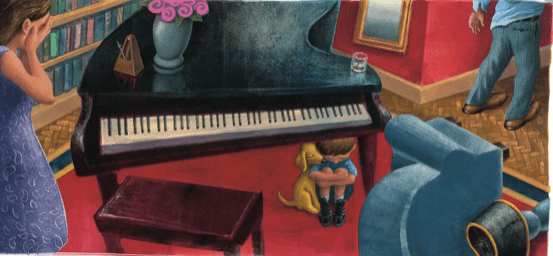
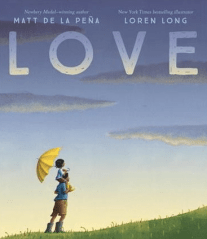
In one of the spreads of my picture book LOVE (illustrated by Loren Long), an anxious boy hides under a piano, huddled with his dog, while his parents argue in the foreground. The simple text reads: “But it’s not only stars that flame out, you discover. It’s summers, too. And friendships. And people.” Loren and I have heard from so many educators around the country who, after reading LOVE aloud to the class, are approached by a student after class, privately, who points to that very spread, saying, “That’s me.” In all of these cases, the book may have prompted the young person to reach out in this way. But after the initial gesture it’s all about that kid and that teacher. And the conversation that follows.
People often ask me why I write for young people and not adults. Though I mostly just shrug off this question, the answer is pretty simple. Adults mostly read to reinforce their own ideologies. Conservative-leaning readers seek out conservative-leaning books. Progressive-leaning readers seek out prog
ressive-leaning books. Young people are different. They’re still building their ideologies. As a result, they’re more open minded as readers. Young readers treat books as tools. Too often we adults treat books as a pat on the back.
A translanguaging pedagogy is when teachers create classrooms that welcome and plan for the complex language practices of bilinguals. The two images below are examples of translanguaging in a community setting:
Translanguaging shows the fluidity of language practices where bilinguals use all linguistic resources including named languages (i.e., Spanish, English), formal and informal registers, images, body language, and intonation to comprehend the world and express meaning.
Adopting a translanguaging pedagogy can be an act of resistance. This pedagogy challenges the imperative of English in schools and rejects racist and anti-immigrant ideologies. A translanguaging pedagogy also challenges deficit views, allowing bilingual students to shine and show their brilliance when they bring all their linguistic resources to school.
There are many ways to create a classroom which welcomes translanguaging. (See this free Translanguaging Guide from CUNY-NYSIEB). For the past four years, I have focused on one way: Collecting, studying and using translanguaging children’s literature in classrooms. To do this, I have worked with teachers and students using an inquiry lens to ask:
Why do authors use translanguaging?
What effect does translanguaging have on an audience?
How do language conventions work with translanguaging texts?
Let’s look at some examples to get the idea.
There once was a niña who lived near the woods.
She like to wear colorful capas with hoods.
“Roja” called Mom from her telenovelas.
“go through the woods till you get to Abuela’s.”
(Elya, 2014)
Translanguaging with a Fairy Tale:
Teachers and students notice many interesting points about translanguaging with regards to author purpose and conventions with this example. Teachers and students said that the author used translanguaging to:
Show how bilinguals really talk and tell stories
Make the story more Mexican
Show off her Spanish
Play with the rhymes and rhythms in both languages
Monolingual English speakers noted that they were able to infer the meaning of the Spanish words by using context. They also asked their Spanish speaking classmates for help which gives the bilingual speakers the role of the expert with translanguaging texts.
In terms of conventions, using a possessive apostrophe with Abuela’s also leads to rich discussions around language. In Spanish, possession would be expressed by saying la casa de abuela. The author of this text chooses to use the English construction of possession with a Spanish word. Furthermore, in this book, there is not a glossary or pronunciation guide. Noticing the conventions and text features used in translanguaging texts is important as students will need to make choices as to which conventions to incorporate into their own writing when they begin to create translanguaging texts.
Translanguaging in a Poem:
Spanish and English are the most common languages in translanguaging children’s literature, but I have found examples with Arabic, Nuahtal, Chinese, Haitian Creole and several Native American languages. The poem below was written by a 16-year-old Oglala from the Pine Ridge Reservation.
To introduce this poem, we read it aloud chorally with the group reading the refrain “Pine Ridge.” In this case, there are two instances of translanguaging, when the author says Ma Lakhóta! and signs the poem with his name in Lakota (Cokata Aupi). The cry of Ma Lakhóta! at the end of the poem shows how translanguaging works to reclaim and assert the cultural heritage of the author even amidst the oppression of Pine Ridge. It can be powerful when only one or two words are in a language other than English.
Translanguaging with Realistic Fiction:
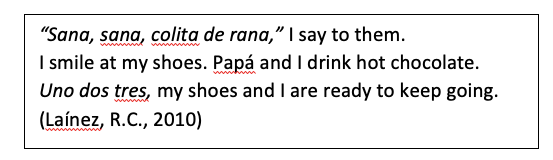
In My Shoes and I, by RenéColato Laínez, a young boy accompanied by his father make the journey by bus and by foot from El Salvador to the United State to join his mom. His Mamáhas sent him a new pair of shoes from the United States which carry him through the journey.
The boy and father encounter many challenges and his brand new shoes become muddy, scuffed, torn and wet. After each encounter, the boy talks to his shoes:
“Sana, sana, colita de rana” is part of a nursery rhyme which family members say to comfort a child when he or she is hurt. It literally translates to “Heal, heal, little frog tail.” When asked why the author chose to preserve the nursery rhyme in Spanish, teachers and students say:
It feels like it is carrying the comfort from home when it is in Spanish.
It would be too weird to say it in English. You only say it in Spanish.
Preserving dichos in home languages provides authenticity in writing, as many sayings lose their meaning and emotion when translated. It is also common for authors to include translanguaging in conversations between family members, as the fluidity of languages is the natural way that communication occurs in bilingual families.
Inviting your Students to the Translanguaging Conversation:
What happens when you invite your students to examine texts that use translanguaging? I have seen students develop a metalinguistic awareness, where they naturally notice how people use multiple languages and approaches to tell stories, write poems and sing songs. These conversations position bilingual learners as experts which is a welcome role in schools for many. Monolingual English speakers begin to see the world as multilingual and are intrigued to learn more. Some bilingual writers begin to use the examples as mentor texts, and incorporate translanguaging in a way that feels natural for them.
However, as you can imagine, teachers have also encountered bumps along the way. Sometimes, bilingual students resist using or acknowledging their home languages in the classroom. It can be challenging to find resources in all the languages of your students. (See Bibliography ofTranslanguaging Texts for Classrooms). It can be intimidating if you are a monolingual English teacher and do not know what the texts are saying. These challenges are real, but I hope that they do not stop you from joining us in this important work. A translanguaging pedagogy elevates the status of bilingualism in schools, honors the diverse, multilingual world in which we live, and allows your bilingual students to shine.
Elya, S. M. (2014). Little Roja Riding Hood.New York: G. P. Putnam’s Sons.
Laínez, R. C. (2010). My shoes and I.Honesdale, PA:Boyds Mills Press.
National Museum of the American Indian, 1999. When the Rain Sings: Poems by Young Native Americans. New York, NY. Simon & Schuster Books for Young Readers.
Liz Mahon is an Assistant Clinical Professor in Culturally and Linguistically Diverse Education at the University of Colorado Denver. She was a school counselor and English Language Development teacher for 20 years in K-12 public schools in North Carolina and Colorado. Contact her with questions or comments at elizabeth.mahon@ucdenver.edu
I believe that professional development should be done by teachers, not done tothem. It works best when PD comes from the inside out, not from the top down. This idea is not new, and it is well-supported in research. However, I’ve noticed that teachers’ professional development is often provided, rather than supported. Why is this?
There seems to be a belief that “outside experts” have the silver bullet for improved instruction and student achievement. Billions of dollars have been spent on professional development in the United States, with a trend toward less-effective, shorter-duration trainings of the “sit and get” variety. But externally-imposed professional development is not “powerful enough, specific enough, or sustained enough” to effect lasting change (Fullan, 2007).
Does this ring true for you? Have you noticed that real changes in instruction and student learning come when professional development is focused at the classroom level? As suggested by Thomas Guskey (2005), “The hard lesson we have gleaned from analyzing various waves of education reform is that it doesn’t matter what happens at the national, state, or even district level. Unless change takes place at the building and classroom levels, improvement is unlikely” (p. 40). No matter the grand imperatives and high-level planning, it is in the classroom where changes in teaching and learning can actually occur. So it makes sense to start there.
This is why professional learning communities (PLCs) matter. When PLCs are truly learning communities that regard teachers as professionals, professional development happens.
What is professional development? Let’s take a look at each of the words making up that phrase. Professionalmeans being connected to a profession. A profession requires prolonged preparation and formal qualification. Because teachers have earned their teaching credentials, they are licensed professionals and should be regarded as such. This implies acknowledgement and respect for their knowledge and expertise about teaching. Professional development should regard teachers as professionals.
A close look at the idea of development is also enlightening. The root word, develop, has meanings with differing connotations that are worth considering. Something can develop or it can be developed. It’s important to think about who is doing the work. Is something developing from within or being developed from an outside source? Piaget and Vygotsky had ideas about child development that might shed some light. Piaget saw development as a natural unfolding. Vygotsky saw development as supported by tools and by “more knowledgeable others.” Professional development can occur through a blend of these ideas, a supported unfolding. This is the purpose of providing structures for professional learning communities. One such structure is collaborative Lesson Study.
In contrast to top-down reforms, Lesson Study is professional development that empowers teachers to drive improvement as they determine new ideas and methods to incorporate into their teaching. This job-embedded professional learning process has the potential to improve student achievement by looking closely at classroom practice.
Lesson Study is as straightforward as it sounds: the study of a lesson. However, Catherine Lewis, who learned about Lesson Study in Japan and has been instrumental in spreading its use in the United States, points out that during Lesson Study teachers improve lessons not as an end unto itself, “but as a way to deepen their own content knowledge, their knowledge of student thinking, their understanding of teaching and learning, and their commitment to improvement of their own practice and that of colleagues” (Lewis & Hurd, 2011, p. 24).
Lesson Study is not just about improving a single lesson; it is about improving the overall teaching/learning process in ways that are both generic and sensitive to the unique needs of students and their teachers. Through Lesson Study, teachers identify techniques that can be used in many situations.
In addition to elevating effective practices, research lessons also provide a window for considering students’ progress toward long-term learning goals. Teachers look closely at what students are learning, identify their misconceptions, and design ways to address them. Attention to individual students improves learning for all students. Lesson Study supports improvement that is adapted to individual students and local contexts while increasing teachers’ pedagogical and content knowledge, developing professional learning communities, and increasing teachers’ motivation and efficacy.
My first encounter with Lesson Study was over a decade ago, when I was working in Ft. Collilns. It was an amazing, impactful experience! Since then, I’ve worked with teachers across the country on collaborative Lesson Study, and I’ve seen dramatic results in teacher learning and student achievement. Here’s the model I use for Lesson Study:
Pretty simple, right? However, although teachers often plan and reflect together, they don’t often observe together a lesson they have collaboratively planned. And I truly believe the observation piece is key. It takes forethought and creativity to make it happen. But it is worth the effort!
As Angela Duckworth points out in her book, Grit: Passion, Perseverance, and the Science of Success, “There are no shortcuts to excellence. Developing real expertise, figuring out really hard problems, it all takes time” (Duckworth, 2016, p. 54). Lesson Study is not a quick fix. It is a structure that supports authentic, productive professional development, a cycle for instructional improvement that pays ongoing dividends.
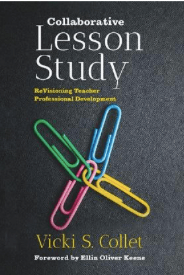
Vicki Collet is a past president of CCIRA and an associate professor of Curriculum and
Instruction at the University of Arkansas whose previous experiences include classroom teaching, intervention, instructional coaching, and district leadership in Colorado. Vicki’s new book, Collaborative Lesson Study, describes her experiences with Lesson Study and
shares insights about how to increase the effectiveness of professional learning communities (PLCs). Look for her session on Lesson Study at the CCIRA Conference next February!
Mentor texts are the perfect scaffold for young writers. Mentor texts are always available. They do not care how often they are used for support. They don’t over-scaffold or rescue. They are great with wait-time. They are open-ended and allow the writer to use craft moves purposefully in his/her own writing. Research demonstrates that it takes 10,000 hours to become deliberate in any field – that’s a lot of hours. Mentor texts provide choice, allow students to have agency, and create space for students to practice again and again.
The sooner we start inviting our writers to use mentor texts the sooner they will start reading like a writer. There are no limits to how we can use mentor texts to support our young writers. I worry that too often we only use mentor texts in our lessons to model or to study a particular author/genre. Sometimes we over scaffold students’ experiences with mentor texts by telling them which craft moves to use and how to use them. I have been trying to broaden how mentor texts are used by always making them an option for students when they are writing. Once we show them how to use a mentor text, students can be in control of when and how they use them.
This past spring, I had the privilege of joining two first grade classrooms for writing workshop. The students were studying traditional tales. They were in the process of drafting and revising their own traditional tales. When we analyzed the student writing we noticed the students were using dialogue, strong feelings, and thoughts to elaborate their stories. They were ready to learn how to stretch out the most important part by telling it scene by scene. We noticed an opportunity to teach them how to add action in order to stretch out these scenes. Whenever I invite elementary students to try a new craft move or an elaboration strategy, I typically show how to apply it in both the illustrations and the words. This provides multiple entry points into understanding how a particular craft move impacts the writing.
These students had recently participated in March Book Madnessand fell in love with two texts: Drawn Togetherby Min Lê and Dan Santat and The Fieldby Baptiste Paul and Jacqueline Alcántara. These texts were perfect for the instructional focus we identified, and the students knew them so well they were primed to be mentors. Even though these texts are not traditional tales we decided to use them to model using action to stretch out the scenes and tell the most important part of the story step by step. Both texts showed how these craft moves can be used in the illustrations and the words.
I modeled a quick lesson showing how I would use these texts as mentors. I identified the moment in my story and showed how I would stretch it out using panels or a series of pictures across two pages. I also added the text to model how I would elaborate in words using strong verbs. In one classroom I used Drawn Togetherand in the other, I used The Field. I then placed copies of the text around the room and invited these young writers to use it as a mentor. I did not assign the students a task or make everyone use the text as a mentor. It was simply an invitation. I sent them off and then asked the adults in the room to resist teaching so we could observe how and if the students used the texts as mentors.
Here are some samples of the students’ work inspired by studying Drawn Together:
The students using The Fieldfocused immediately on the strong verbs and action in the illustrations. Several students identified the moment in their story that needed to be stretched out scene by scene and found a mentor page to guide them.
As we observed the students using these mentor texts to scaffold their revision process, we noticed another pattern emerging. Students started studying each other’s writing. Explaining to each other the craft moves they tried and why they tried them in that moment of the story. It was powerful to watch them confer purposefully with each other and look to each other as mentors.
I believe there needs to be more fluidity between our reading and writing workshops. If a student notices something that is perfect for her writing during reading workshop, I want her to get up and get her writing to capture this idea. If a student is stuck during writing workshop, I want him to get up and head to the classroom library. When the going gets rough, writers get up and read. Our students need to know this, and we need to give them the opportunity to move between reading and writing as needed. This is the process authentically used by readers and writers. It also encourages our students to look within and develop agency in their writing process. Using mentor texts is a strategy that will last a lifetime.
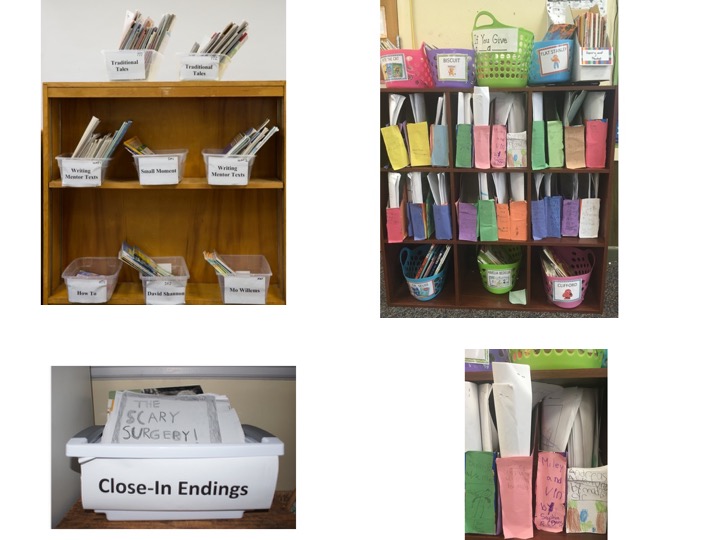
It is important to remember that, “the learning environment is ‘the third teacher’ that can either enhance the kind of learning that optimizes our students’ potential to respond creatively and meaningfully to future challenges or detract from it” (Fraser, 2012; Helm et al., 2007; OWP/P Architects et al., 2010). In my most recent book co-authored with Tammy Mulligan, It’s All About the Books, we suggest having a section in the classroom library that is dedicated to mentor texts, so students know there is a place to go when they are looking for a particular type of mentor text. The classroom library can be the third teacher if it is designed to support our writers.
I also love including student writing in this section of the classroom library. There is no better way to say, “You are a writer,” than to include a student’s writing in the classroom library. It gives them an authentic audience and it gives classmates another mentor text to study and use in their own writing. I also include teacher writing in this section of the classroom library. It is helpful for students to have time to truly study the writing their peers and teachers share. They can also easily access the author to ask questions since they are members of the classroom community.
There is a lot of space for approximation between teacher modeling and student application. “Mentor texts empower students to become independent, which is crucial because they will not always have you as their writing teacher. If students develop an understanding of how to tap into the power of mentor texts, they will be able to seek out their own mentors in the future” (Ayres and Shubitz, Day by Day, 2010). The process of revision should be active, playful, and meaningful. We need to get out of our students’ way and let them give it go. The more they try things out and look to authors – professional, teacher, and student authors – as mentors, the more they will embrace and find joy in the revision process.
Clare Landrigan is a staff developer who is still a teacher at heart. She began her work as an educator over twenty years ago, teaching in an integrated first- and second-grade classroom at the Eliot Pearson Children’s School in Medford, MA. She now leads a private staff development business and spends her days partnering with school systems to help them implement best practices in the field of literacy. Clare is the coauthor of the book, It’s All About the Books: How to Create Bookrooms and Classroom Libraries That Inspire Readers. She believes that effective professional development includes side-by-side teaching, analysis of student work, mutual trust, respect, and a good dose of laughter. You can find Clare online at Twitter, and at her website, where she blogs about books and the art of teaching.
She tells us that she is not smart. That school is not a place she wants to go to because that’s where all the smart kids go. The ones who can read. The ones who can do things so much easier than her.
She shows us that she is trying. That every word that sits in front of her is a mountain to be climbed, seemingly no matter how many times she has seen it before, the climb is still there. The doubt is still there. The wanting to give up, because “This so hard, Mommy..” and we tell her to sound it out, to try again, to see the letters, even as they move and squiggle and run away from her eyes as she tries once again. Everything taking twice as long as her twin brother. Everything coming at a price of time that seemingly no other child has to give up because to them it just comes easy.
So we search for answers, for teachers who see the girl before they see the problem, for others who like us, sit with a child where reading does not come easy. Where reading is not a magical adventure but instead dreaded work that doesn’t bring happiness but only affirmation of her supposed lack of can. And we get the doctors involved and they tell us their diagnosis and I cry in the meeting because wouldn’t it have been nice if it wasn’t a specific learning disorder but instead just something that hadn’t clicked? Wouldn’t it have been nice if we had it all wrong and she had us all fooled? Wouldn’t it have been nice?
So we sit down with our little girl, who really isn’t so little anymore, and tell her that we did get answers and as we thought it turns out her brain just learns differently. That reading is, indeed, hard to figure out but not impossible. That now that we know more, we can do more, we can get help, we can get support, and we can go in the right direction rather than searching in the dark hoping for something to help us. We can tell she doesn’t believe us, not yet, anyway.
And as summer unfolds, we hope that having this time can give us the time we need to build her back up, not because anyone tore her down, but because this mountain of reading has been telling her for too long that she is not as good as she thought she was. And once those whispers started they were awfully hard to drown out when the proof is right there in front of her on the page.
And I think of how the systems of school play into this self-evaluation. How the grades and the labels so often harm. How we, as educators, sometimes confuse good grades with dedication, as if a child who is failing a class isn’t dedicated? As if all a child needs is to just work harder, or hard enough because then the learning will surely come, and how for some of our kids, that is simply not true. That I can see my child work hard. That I can see my child stay at the table longer. That I can see my child give her best every single day. That I can see my child get extra teaching, tutoring outside of school, and yet the results don’t come because it turns out that hard work doesn’t always equal results.
And these kids, our kids, who are behind are often the ones working the hardest if we really had to compare.
And these kids, our kids, who are behind are often the ones pulled out of recess and fun activities in order to go work more.
And these kids, our kids, who are behind are often the ones given fewer opportunity for choice because it turns out that when you need extra support we have to cut something out of your schedule.
And these kids, our kids, sit with the same kids year after year, traveling as a group because the only thing we have identified them by is their lack of ability.
And these kids, our kids, slowly start to take on the new identities we have created for them in our data meetings, in our hallway conversations, in our quick meetups when we make our lists, where we make our groups, where we share the stories that we think define these kids.
And these kids, our kids, are honored for their efforts by being given new names; struggling readers, lower level learners, behind, and you wonder how they lose themselves in the process.
And you wonder why one day, despite our best intentions, they tell us that they don’t think they are smart and that they don’t want to go to school.
So as my family once again adjusts itself in our pursuit of learning for all. As we celebrate the answers we have been given this week while nurturing the child who is at the center of it all, I ask you to please consider this. My child, our daughter, is not a struggling reader, she is a reader. Period. To tell her otherwise would break her heart.
And so these kids, our kids, deserve to be fully spoken about, to be fully known. For us to start a conversation asking how they see themselves and if it is through a negative lens we actively fight against that. And we tell them we see their effort, we tell them we see their progress. We tell them we see they are smart, and we stop with the labels, and the assumptions, and we see the kid for who they are rather than what the data tells us.
Because this kid, my kid, doesn’t think that reading will ever be something she can do, and I need, she needs, everyone that works with her to believe otherwise and loudly, because my voice is not enough.
Please.
Pernille Ripp is an expert in literacy and technology integration and dedicates her research and practice to developing engaged and empowered students and communities.
She is a teacher, speaker, author, blogger, and passionate advocate for education. She is a Skype Master Teacher; recipient of the 2015 WEMTA Making IT Happen Award; and the 2015 ISTE Award for Innovation in Global Collaboration. Pernillesripp.com