
Growth and Loss: Black Children’s Literature Post-George Floyd 

by Jamilah Thompkins-Bigelow, 2023 CCIRA Author/Presenter

Educators… you should know… there have been whispers. In my private messages, in subtweets, in texts, and in quiet conversations amongst children book authors, I am hearing a sad admission: “The ‘George Floyd Effect’ on publishing is fading.” 

The George Floyd Effect. 

What do we do with that phrase? A phrase that comes from the wrongful loss of a life? An internet search would show you two meanings for it: one that speaks to the way that institutions like schools and publishing and even corporate coffee chains scrambled in the aftermath of Floyd’s murder to reflect upon and address their racism and a second meaning focused on blaming the deceased for criminality and lawlessness (we’ll ignore that one). That first usage of the phrasing impacted what books became available for our classrooms and library shelves. It meant that publishers made extra efforts to employ Black talent and publish Black creatives. It meant more Black children’s books were coming and more schools were prioritizing getting them. 

Because these books were “needed.”

In July 2020, my second book Your Name is a Song had unexpectedly sold out its first printing on the first day of release. I was told books like mine were needed in the aftermath of brutality. And I watched many books about race become bestsellers. Meanwhile, at the request of my editor, I had been working for days on end to add back matter for Hold Them Close, a book that seeks to help Black kids make sense of racism. I sat in a hotel room in Center City Philadelphia when protests broke out in the streets, working to mold historical facts of racial violence into short and accessible sentences for youth. I pushed through  when I wanted to run into the streets too. To scream, to cry, to mourn. To stop and reflect even on my feelings about  senseless death being necessary for people to see the worthiness of our books. But I pushed through because of the repeated refrain that these books were so needed in that moment.

They’ve always been needed though. They continue to be.

There is article upon article about the importance of Black representation for Black children in developing their self worth. Many of us are aware of Rudine Sims Bishop’s work of describing books as “mirrors” or  stories where we see ourselves and are affirmed therein; and as “windows” when we see others and truly empathize with them and possibly even enter the “sliding glass doors” of their worlds. Additionally, in our context where racism persists, we know sources that teach about racism and its history honestly are necessary for change. In the aftermath of George Floyd, Black authors ploughed on as we always do to create texts of joy and of pain, of fun and of importance, of our authentic stories. However, I believe many of us hoped that this moment for change would be something more. We understood it required more than a moment. Our kids needed it to be longer than a moment.

But the George Floyd effect is fading.

Recent research by WordsRated has suggested that the boom in bestselling children’s books with Black characters was fleeting. By 2021, the number of bestselling children’s books with Black characters had decreased by 23%. Gone is that brief moment in time when Black character books and their authors were in demand. Gone are big publishing’s promises as they now dismantle Black imprints and rid themselves of staff unceremoniously. Gone are the promises of big bookstore retailers to support diverse books. As such, educators are now  left to contend not only with the old status quo of options for their students but also a new pressure…

Backlash.

 The backlash to antiracism, the backlash to more stories giving our kids new perspectives and opportunities for empathy, and the backlash to people simply caring about Black life has been book banning. The response has been to stamp out the literary existence of Black people and their history from schools. I watched books like mine–ones that were “so needed” the year before– get banned in a few districts while Black bestsellers of 2020  became banned in countless U.S.  school districts and library systems. Additionally, because anti-Blackness seems to be the gateway to all kinds of bigotry in our societal context it meant that the bans then extended to literature about indigenous peoples, POC,  and in particular, LGBTQ communities. At the root, yet and still, is this nation’s historical commitment to denying the humanity of Black people. 

So what do we do?

How do we  ensure that our kids have access to diverse stories at all times, not just in tragic moments and also in spite of those who see that access is threatening. I suggest:

  • Audit your bookshelves for diverse and equitable representation every year. Do a deeper dive after the audit.
  • Discuss  representation in books with students and what books get banned. Spark conversations and new ways of thinking.
  • Proactively develop the language to argue against  bans. Here are talking points.
  • Develop an awareness of lesser known Black book creators (and those from other marginalized communities). Request their books in your schools and libraries to continue communicating the demand to the industry that we need many voices.
  • Organize at the local level. Get to know who makes these decisions and organize around their elections.
  • If you experience a ban, organize on social media and reach out to authors who are banned. They and others may amplify your efforts as in the case of this campaign.

Jamilah Thompkins-Bigelow is  is a Philadelphia-based, award-winning children’s book author. A former English teacher, she educated children and teens in traditional and alternative learning settings for more than 15 years. Her picture books and middle grade fiction, which feature young Black and Muslim protagonists, have been recognized as the best in children’s literature by Time Magazine, Read Across America, NCTE, and NPR, and she is a 2021 Irma Black Award Honor author. In addition to producing children’s literature, she invests her time in the mentorship of aspiring children’s book authors through multiple programs including We Need Diverse Books and the Muslim Storytellers Fellowship of the Highlights Foundation where she is also a program committee member.
Mentoring and Coaching to Support Colleagues

By Vicki Collet, CCIRA Past President

As lifelong learners, teachers are always working to improve instruction.  In addition to focusing on your own classroom, are you also supporting other teachers in improving their practice?

Whether you are a student-teaching supervisor, a mentor for an early-career teacher, a team leader or department head, or an administrator or instructional coach working with veteran teachers, you offer support to improve instruction, and you are taking a coaching role. Even if you don’t have an officially-assigned role as a coach, you probably offer up your own teaching ideas from time to time in an effort to help someone else. The Gradually Increase of Responsibility (GIR) Model can make you more intentional about this work. 

The GIR Model for Mentoring & Coaching is a research-developed approach to differentiate the support we offer our colleagues. Just like our students, teachers are at different places in their learning, and they grow in different ways. They’ll benefit most from coaching that meets them where they are, addressing their unique needs. 

Five Moves

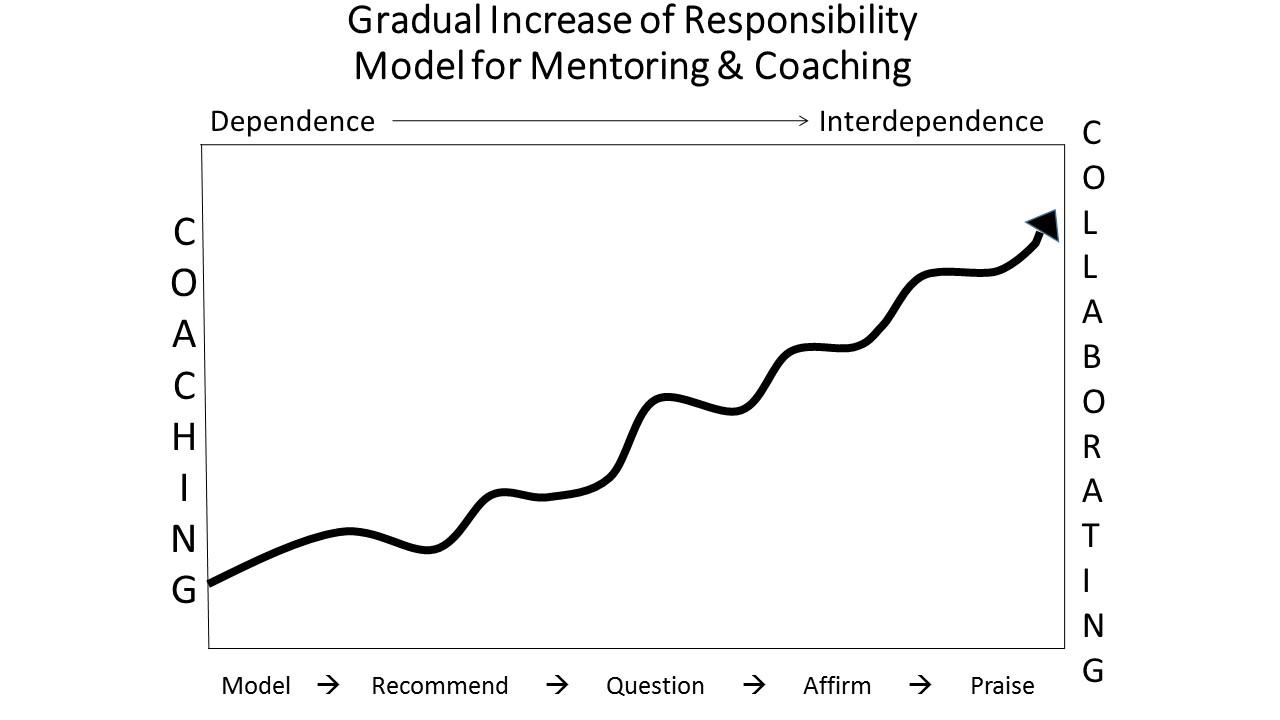
The five coaching moves in the GIR model are: modeling, recommending, asking questions, affirming, and praising. Being purposeful about how you choose and change these moves while working with a colleague will make your support more effective. I’ve listed the moves in order from most-supportive to least supportive, as illustrated in the model below:

Chart, line chart

Description automatically generated

Changing Support

The GIR Model flips the popular Gradual Release of Responsibility Model* on its head, looking at support from the learner’s point of view. But, just like our students don’t all need a model for every new concept, the teacher we are supporting may not need the most supportive move. We choose and use the move that matches the need, and we change our support over time, because teachers grow as they go. 

Think of a teacher you are working with. Think of a challenge they are facing. Now think of which of the 5 coaching moves might be most helpful. Here’s a quick list of those 5 moves and when they might be called for:

MoveWhen to Use
ModelTeacher lacks experience with a particular content or practice
RecommendTeacher has requests or questions, or a limited teaching repertoire
QuestionTo prompt planning, problem-solving, and reflection
AffirmGood things are happening, but teacher is looking for confirmation
PraiseTeacher no longer looks to coach for confirmation

Tools for the Work

The 5 coaching moves are tools you can use; you choose based on the current context – the teacher and the situation. 

When I was meeting with a group of coaches, one of them, who was new to the position, felt a bit shaky about her skills. We’d talked about the GIR Model, and she said, “I want to make sure I’m doing this right! Can you tell me what I should be doing right now?”

Coaches from the group who were experienced with the Model chimed in. “The thing about it,” one said, “is that every teacher is different.” Another said, “What you do for one may not be what another teacher needs. It’s different every time!” I nodded my head and emphasized, “When we meet as coaches, I make suggestions about what coaching move you might consider based on where you are in the coaching cycle, but it’s always about what your teachers need.” I went on to describe how they might consider each of the 5 coaching moves and think about which could be most effective at that time. That would be the move they’d emphasize…but not to the complete exclusion of the others. 

Although your coaching will generally move from more supportive to less supportive, the path is not a linear one. Your insight, observation, and careful listening will help you choose your move. 

A Continuum of Support

The 5 coaching moves are useful for supporting teachers at any point along the continuum of experience and expertise. The need for these moves differs among teachers and across time. For example, modeling (the most supportive move) occurs when a preservice teacher has her first practicum experience, visiting a school to observe a teacher in action. Even a very experienced teacher, however, may benefit from modeling; for example, a new technology application could be demonstrated, or an approach to whole-class discussion might be modeled if that is a focus area. If you are mentoring a first-year teacher into the profession, recommendations about available resources might be warranted. For some, asking questions to support reflection about potential changes will provide enough support. An elementary school teacher might request recommendations for improving her math instruction but benefit from simply hearing affirmations about her already-solid instruction during guided reading.

When I talked to a mentor who was working with a student-teaching intern, she described how the GIR model guided her. “She really needed the modeling,” she said, “and at first even that wasn’t working. She didn’t know what to pay attention to. Modeling started working better once I gave her very specific things to watch for.” Then they moved into recommending – a phase that lasted a long, long time! Questioning became the dominant move (even though recommending lingered) much later. And the mentor felt they never made it to praising when she commended the intern’s work; it still felt more like affirming, because the intern seemed to be looking for validation.

A coach who was working with an experienced teacher to implement close reading said, “She really didn’t need the modeling, or the recommending, either. I jumped right in with questioning. That helped support her thinking and reflection.”  But later, when the same teacher was working on differentiation – a complex teaching skill – modeling and recommending were included before moving to less-supportive coaching approaches. 

Successful coaches and mentors adjust based on the complexity and difficulty of the task, as well as teachers’ experience. The 5 coaching moves in the GIR model can be selected, as appropriate, as tools for the work. 

The Right Tool for the Task

The GIR coaching model can serve as a guide no matter who you are working with.  But where you begin and the way you move through it will change every time. Even though coaching conversations will include a healthy mix of recommending, questioning, and affirming, you can be intentional about which one you lean on most as you work with a teacher, focusing on the “bang-for-your-buck” coaching move.

My husband has a garage full of tools, so it amazes me when he “needs” to buy a new one. He explains, however, that having the right tool for the job means it gets done more efficiently and effectively. Similarly, using the right tool at the right time makes coaching more productive. As you think about how to support your colleagues in their efforts to improve instruction, having these 5 moves in your toolbelt will strengthen your work.

* Pearson, P. D., & Gallagher, M. C. (1983). The instruction of reading comprehension. Contemporary Educational Psychology, 8(3), 317-344.

———————————–

Vicki Collet is a past-president of CCIRA who has been attending and presenting at the conference for over 20 years. She is currently an associate professor in Teacher Education at the University of Arkansas. Read more about mentoring and coaching in her book, Differentiated Mentoring & Coaching in Education: From Preservice Teacher to Expert Practitioner, or on her blog: mycoachcescouch.blogspot.com. Follow Vicki on Facebook at facebook.com/mycoachescouch and Twitter and Instagram @vscollet. You can also find her at VickiCollet.com.

Combatting Aliteracy: Mentoring Today’s Students to Become Tomorrow’s Avid Readers

By Gravity Goldberg

According to a 2021 Pew Research study 23% of adults surveyed say they haven’t read a book in whole or in part in the past year, whether in print, electronic or audio form. When we look at the surveys of school age children we see reading volume begins to drop by age 9. Only 35%  of nine year olds report reading five to seven days a week compared to 57%  percent of eight year olds (Scholastic, 2019).  These two studies and many others point to a larger issue of aliteracy in this country. 

Aliteracy refers to people who can read but choose not to. While the national narrative has focused on those who are struggling to learn to decode the words (which of course also needs to be addressed), we cannot forget this other group who have not identified as readers and do not see the value of time spent reading. 

We have likely all sat around the dinner table and teacher’s room lamenting social media and smartphones as the cause of so much aliteracy, and of course books are competing for attention with our devices. But, since smartphones are likely not going anywhere, we must look at what we can control – how we frame reading instruction, how we mentor readers, and what we can do to make sure all students graduate understanding not just how to read the words but how to use reading to make lives better. 

Photo courtesy of Pan Xiaozhen via Unsplash

We know there is always a lag between culture and curriculum. Just because something changes in our current culture does not mean we immediately see a shift in what or how we teach. The summer is a great time to reflect and make an action plan for how we can bring our curricular approach up to date. How can we make our literacy approach relevant for our students today so they also become the avid adult readers of tomorrow?

Literacy Habits of Mind

What it means to be literate is always changing given the context we are living within. In Performative Literacy: The Habits of Mind of Highly Literate Readers, by Sheridan Blau (2003), he explains that reading is more than a set of skills. Blau lists the habits that readers must have to be highly literate which include

  • Willingness to suspend closure—to entertain problems rather than avoid them
  • Tolerance for failure—a willingness to re-read and re-read again
  • Tolerance for ambiguity, paradox, and uncertainty
  • Metacognitive awareness–capacity to monitor and direct one’s own reading process

If your current approach solely focuses on reading as a set of skills, consider how and where you can integrate the dispositions needed to be highly literate too.

Critical Digital Literacy 

With access to technology and a push for more interconnectedness, being literate also includes critical digital literacy practices. Reading and writing no longer simply include a book or article you can hold in your hands. Reading has broadened to include reading a video, podcast, infographic, and photos etc.

According Hinrichsen and Coombs (2014) successful literacy learners need to engage in four roles to be critically digital literate. They need to be:

  • Code Breakers– How do I crack this text? How does it work?
  • Meaning Makers– How do the ideas represented in the text string together? What are the cultural meanings and possible readings that can be constructed from this text?
  • Text Users–How do the users of this text shape its composition? What do I do with this text, here and now?
  • Text Analysts– What is this text trying to do to me? In whose interests?

If your current approach focuses mostly on finding the  messages “in the book” consider how you can include more multimodal texts and teach students to be more critical thinkers within and beyond the texts. 

Community and Advocacy 

Youth and adults today use the power of social media to form connections and become advocates for the causes they believe in. Being literate includes an interconnectedness to a community who uses language in nuanced and purposeful ways. Readers need to understand the implicit meanings and tone as well as the perspectives that the community holds. They also need to use information to create narratives that inspire change using a variety of mediums. When students understand that reading and writing are powerful tools that allow them to impact others they begin to see their larger value.

Being a member of a literacy community means:Becoming an advocate means:
I bring my full identity with me.I curate the texts I consume.I choose the conversations I want to join.I set goals for myself.I ask for feedback.I see my role in the communities I am a part of.I know and name challenges my communities face.I use texts to understand, empathize, and problem solve.I contribute through listening, speaking, writing, and doing.

If your current approach does not explicitly set all students up to be contributors within a community, think about who and what is being centered so you can make a different set of choices.

Am I Teaching Students to Be Literate Today? 

If we are serious about combating aliteracy we need to teach students that reading is relevant right now. It can bring joy, create connection, and answer questions. Reading cannot simply be about reading levels, test scores, and standards. Students must see the value and purpose of reading within and beyond school if they grow up to be adults who choose to read.

Take some time this summer and fall to reflect in a community around the following questions and then make an action plan for how you will contextualize reading differently this school year. What follows are a few ideas to get you started. 

Reflection QuestionsAction Plan
What are the literacy habits of mind that readers will develop this year?Add literacy habits of mind into curriculum maps Model these literacy habits such as navigating ambiguity, rereading, and leaning into problems by making your own reading process more visible Confer with students regularly and ask them to share their process and habits with you
How will you support students in becoming critical consumers and producers of a variety of texts?Create digital text sets for and with studentsStudy mentor texts that include audio, video and print and discuss the norms of eachModel and coach students inVerifying the accuracy of informationUnderstanding the author’s worldview and perspectiveComparing information across sourcesSynthesizing information from multiple textsMoving between different text types and modalities 
How will the curriculum create space and mentorship for students to be contributors in their communities? Make sure students have access to texts that include positive representative of all identities and communitiesAsk for and center students’ questions that they want to studyIntegrate community-based learning into unitsModel how you use reading and writing to make your communities a better place Include more student work in data meetings that contextualize and humanize students beyond numbers

I can’t help but think of the current humanitarian, political, environmental, and health related crises we are facing. Most days I wake up overwhelmed and some days even hopeless. But then I remember I am a literacy educator and there is much I can do.  None of today’s global or local challenges can be solved without having these literacy dispositions because being literate is not only about the books in our hands, but the ways we think and act. No matter what this next school year brings, please remember, our goal is not simply to create better readers. Our goal is to help students use reading to make their worlds better. 

Dr. Gravity Goldberg is an educational consultant, author and founder of Gravity Goldberg, LLC. While based in the New York / New Jersey metro area, Gravity supports school districts across the country. She specializes in literacy, special education, curriculum, assessment, and learning with technology. Her work ranges from demonstrating lessons and leading workshops on balanced literacy to working with administrators developing curriculum and customizing professional development programs. She works in classrooms from pre-kindergarten through college and in a variety of settings, both urban and suburban. Contact her at Gravity@Drgravitygoldberg.com.

THE PORTALS OF POETRY

by Nikki Grimes, 2023 CCIRA Conference Speaker

The subject most on my mind these days is banned books.  A banned book is not the stuff of romance, nor is it a badge of courage, as some imagine.  When a book is banned, it means that your readers no longer have access to the story you have poured your heart and soul into, the story you have lived, and breathed, and likely bled over for years.  That book is no longer available to the audience you intended it for.  In other words, a banned book is not a dream, but a nightmare.

The first of my books to land on a list for removal was Ordinary Hazards, my memoir in verse. One of the primary themes of this book is the power of words on paper, most especially the power of poetry.  This is a theme that I come back to again, and again, with good reason.

I was fortunate to learn, as a child, that releasing my thoughts and feelings through poetry created space for me to breathe, and allowed me the perspective I needed to journey through childhood trauma and come out on the other side whole.  Poetry is healing, both for the writer and the reader, and it is a powerful tool to put in the hands of a young person.  I have often spoken of reading and writing as my survival tools, and poetry was central to that survival.

Over the last few years, COVID-19 and the virus of social injustice have added a new level of stress to the lives of children and young adults, and they need a healthy way to let those feelings out.  Poetry can be that avenue.  Writing an angry poem is certainly preferable to putting one’s fist through a wall, isn’t it?  And the poem won’t land the student in the principal’s office!  The only real question is, how do you introduce poetry to young readers and encourage them to write poetry of their own?

We are fortunate that today’s market is rich with poetry and novels in verse.  You only need to start where your students are.  If, for instance, they’re interested in sports, you can find collections featuring soccer, basketball, baseball, or track and field poems, for starters.  If biographies are more their speed, try a variety of biographies in verse.  If science is their jam, you’ll find collections on that topic.  If you’ve been trying to entice readers to get through a novel, try a novel in verse.  Once they see all that white space, they’ll be intrigued to give it a try.  They’ll assume fewer words on the page means the story is less complex.  They’ll be wrong, but by the time they figure that out, they’ll already be hooked.  And once they’re hooked, it’s easy to challenge them to write a poem, possibly using the author’s poems as templates for their own.

I’ve heard from teachers who have taught Bronx Masquerade, who went on to have their students use the book as a template for a collection of poetry about their own school.  Others use the seed of the book’s Open Mic Friday’s to hold open mic readings in their classrooms or assemblies.  Once students are given the tools to express themselves, it’s hard to get them to stop!  That’s a good problem to have.

Poetry Form

I’ve found that students respond especially well to poetry forms that give them somewhere to begin, forms like haiku, tanka, and golden shovel.  One Last Word and Legacy:Women Poets of the Harlem Renaissance are two collections I created using the golden shovel format.  The idea is to take a short poem in its entirety, or a line from the poem, called a striking line, and to create a new poem using the words from the original.  Say you decide to use a single line: you would arrange that line, word by word, in the right margin.  

in 

the

right

margin.

Then, you would write a new poem, with each line ending in one of these words.  In the example above, that would mean the first line of the new poem would end in the word “in”, the second line would end in the word “the”, and so on.  

I wake and shake off the morning as Mom tiptoes in.

“Rise and shine”, she whispers, always the

same old song.  “Get up.  Right

now!”  I groan on cue, but she gives me no margin.

Here are a few more examples:

This line is taken from the poem, “A Light and Diplomatic Bird” by Gwendolyn Brooks.  This is the first Golden Shovel poem I ever attempted.

Lashed With Riot Red and Black

Yesterday, God skipped thunder like stones, lashed

the land with pellets of H2O, each illumined with

scissored bits of lightning—a riot

of sight and sound, sharp as red,

sudden as death.  Watch for grayed skies and

grief remembered.  Both, for a moment, paint the world black.

Peace Be Still

Trayvon’s mom watched injustice kick peace

down the road, like a tin can.  But she’ll be

retrieving it once her son is able to rest quiet, still.

One of the things I love about this format is that you can apply it to a favorite lyric, or a stunning line from a newspaper article, or even a favorite line from a book of prose.  No matter where writers begin, there’s lots of room for them to pour out their own thoughts and feelings, and thereby learn for themselves the awesome power of poetry.  Give this a try! 

Nikki Grimes is the recipient of the 2022 CSK Virginia Hamilton Lifetime Achievement Award, the 2020 ALAN Award for significant contributions to young adult literature, the 2017 Children’s Literature Legacy Medal for contributions to literature for children, the 2016 Virginia Hamilton Literary Award, and the 2006 NCTE Award for Excellence in Poetry for Children. The author of Coretta Scott King Author Award-winner Bronx Masquerade, and
recipient of five Coretta Scott King Author Honors, her most recent titles
include the YALSA Best Fiction for Young Adults title Between the Lines,
companion to Bronx Masquerade, NCTE Notable Book Words With
Wings, the 2018 Lee Bennett Hopkins Poetry Award Honor Book
Garvey’s Choice, Boston Globe-Horn Book Honor One Last Word, Printz
Honor and Sibert Honor Ordinary Hazards, a memoir in verse, ALA
Notable Legacy:Women Poets of the Harlem Renaissance, ALA Notable
Southwest Sunrise, Kirkus Best Book Bedtime for Sweet Creatures, and
IMAGE Award Nominee Kamala Harris:Rooted in Justice. Ms. Grimes
lives in Corona, California.

Why We Need LGBTQ+ Literature for Children and Youth

By Lester Laminack

As a child in the 1960’s I knew I was attracted to other boys
long before I heard words like queer, homo, pansy, fag, fairy, or
gay. When finally, I did hear those words, they were used to
inflict humiliation or harm to boys like me.

The most common word I heard spoken about me was, “sissy.”
Early on it was more a whisper between adults. As I grew and
became more conscious of the venomous potential of those
words, it became louder. Those words were spoken about me as
I stood just on the edge of earshot. They were spoken to me by
those intending to demean and humiliate me as they attempted
to buoy themselves, to make themselves feel bigger and more
powerful.


Those words attacked my soul, leaving sores that festered into
self-doubt and self-loathing. As a youth I was deeply involved
in my church and avoided, at all costs, disappointing my
community, my teachers, or my family. Everything I heard,
directly and indirectly, made it clear that what was truest and
most natural to me was considered abhorrent, weak, and sinful.
So, did I search for LBGTQ+ characters in the library or in the
literature we were assigned in school? No, I did not lament the
absence of characters who shared my feelings and longings
because I was consumed by denying those longings and trying
desperately to be what the world expects a boy to be. To be
honest I never expected anyone to write about a person like me,
after all people like me were not considered worth writing
about.


In my youth I didn’t know a single LGBTQ+ person. Not one.
Not in my family, my circle of friends, or in my community.
Not on TV. Not in the movies I saw. Not in the news. So why
would I expect to see them in books at the school library?
Imagine your existence neither valued nor acknowledged.
Instead, everything you see and hear makes it clear that people
like you are not only devalued, but also abhorred. Imagine that
the person you know yourself to be, your truest, most natural
self, is something the world proclaims immoral and/or illegal.
Imagine you see reports on television and in newspapers
declaring that your identity is punishable by imprisonment,
even death in some parts of the world. And in your own country
you see religious groups gathering to protest your right to work
in certain professions, and your right to marry or raise children.
You see those groups organize rallies promoting legal
protection of anyone who would deny you services because
your existence offends their beliefs.


If this is what you witness as a young person, how willingly
would you reveal your most inner truth? How likely would you
be to deny and fear your own natural self instead? How likely
would you be to seek out someone like you in a book, a poem,
an article, a movie, or a song? Why would you? Especially
when the whole world proclaims that you, and those like you,
have no right to be who you truly are. So why would you
bother?

Even if I had bothered to search, I would not have found myself
in any book in the school library or the public library. Instead, I
hid and studied men who fit the stereotype of masculinity. I
watched them walk. I watched how they sat down and stood up.
I watched what they did with their hands while they talked. I
listened to how they spoke. Why? I lived in fear that I would be
found out, and I wanted so badly to “pass”. I firmly believed
that if my fear became a reality, it would destroy everything and
everyone that I held dear. So, I did everything to squelch that
part of me, to deny that I had a right to feel what I felt, the right
to be my truest self.

Teachers, literature could have been a validation reflecting my
humanity back to me; it could have been my mentor to help me
understand what I knew about myself. Stories, poems, memoirs
could have held my hand and given me guidance at a time when
the most natural part of me felt dirty, immoral, frightened, and
profoundly ashamed.

The larger culture perpetuated my feelings. There were jokes
and insults about people like me. I heard them among adults I
trusted and honored. I heard them among my schoolmates.

I heard them on TV. If anyone was even suspected of being LGBTQ+, there was nothing complimentary or honorable ever spoken about them.

By the time I was twelve I had a crush on a boy, and I felt all the feelings I had heard other boys feel about girls and and all the feelings I heard girls feel about boys. But I could share my feelings with neither my male friends, nor my female friends. None of them would have been a safe option. I had no guidance on how to share my truth, to claim my being. I had no mentors who could assure me that what I felt, what I feared, what I longed for were all normal human feelings. No one was there to pull me aside and say, “Everyone, yes EVERYone, feels what you are feeling and isn’t it glorious?” So, I hid it. I felt sinful and weak. I felt shame that I had somehow failed to be enough, failed to embrace my faith fully, failed to resist those thoughts and feelings.


Teachers, librarians, administrators, parents, school board
members, what if I had found even one book where a boy like
me was the main character? What if that character had a crush
on another boy in his school? What if that character told a
friend what he was feeling? What if that friend had celebrated
those feelings and acknowledged them as normal human
emotions? What if that character’s world didn’t fall apart, even
if the results were less than stellar, but that character endured,
and his friends and his family didn’t abandon him? And what if
those books were read and discussed by cisgender heterosexual
students? How would that experience humanize the LGBTQ+
classmates they know? How would those books lead to
conversations and insight that could help students focus on
what they have in common? What if literature became the salve
to heal the hurt and guide the heart and mind?

Friends is there any wonder why the suicide rate is three times
higher among LGBTQ+ youth than it is among cisgender
heterosexual youth? Read the statistics for yourself.

Some young people see no way to cope, no way to exist. I
believe that we owe those young people. We owe them
portrayals that move beyond stereotypes and simplifications
and gross exaggerations of their identities. We owe them
mirrors that reflect their full humanity, as well as windows
(Bishop, 1990 https://scenicregional.org/wp-
content/uploads/2017/08/Mirrors-Windows-and-Sliding-Glass-
Doors.pdf
) that open the world for cisgender heterosexual
youth to see LGBTQ+ students as equally human and worthy
with amazing potential for contributing to this world.

Why do we need LGBTQ+ literature?
Literature is a tremendous equalizing force that has the
potential to validate our existence and broaden our
understanding of what it means to be human. It allows us to
safely step outside the boundaries of our confined experience. It
allows personal, intimate interactions with characters with
whom we can identify and with others who are different from
us. In fact, stepping into a book and walking with a character
may be the one experience in which a student’s personal
feelings, fears, wishes, and dreams are shared and acceptable.
Literature provides our children and youth an opportunity to
broaden their visions of what it is like to share their deepest
truth, to face their greatest fear, and to live through the
aftermath of that experience. It is equally important to read
nonfiction that reveals the truths about Stonewall, state and
federal laws, the role of the Supreme Court in Obergfell v
Hodges, and the contributions of LGBTQ+ Americans to
culture and economy, invention and creation, art and sports and
entertainment.

When I was a young person there would have been nothing in
the library to give me guidance, but that is not true today. In
fact, there is a wealth of developmentally appropriate fiction
and nonfiction written specifically for children and youth
including story, essay, memoir, biography, historical fiction,
and poetry. For a list of titles to get you started, check the link
in the resources for a list gathered by CCIRA. Have a look and
read a few. Get to know what is available so you can be an
advocate for the young people who look to you for guidance
and support. Know what is available so you can participate in
an informed conversation with adults who seek to ban or censor
or limit access to all young people.


We must embrace and advocate for all our young people. We
must embrace our common humanity, all that goes deeper than
the language of our tongues, deeper than the cultural traditions
that guide us, deeper than the spiritual practice we engage in,
deeper than the color of our skin, deeper than who we are wired
to love. Perhaps one of our greatest gifts as human beings is our
ability to see beyond our differences and into our common
humanity. It is our responsibility as human beings to lift one
another, to celebrate all that makes us one diverse and
magnificent family.

And yet…
As I write this in the sixth month of the year 2022, I am an
adult who has come through six decades of this, yet I am
hesitant to save and hit send. Even at this age I pause with a
tinge of fear, the same sort of fear that many LGBTQ+ people
live with each day because of the policies and laws being
passed to limit what can be read and what can be said. But I
want to be the adult I wish I had known as a young person, so I
take a deep breath and press send hoping that this will give you
the insight, strength, and resolve to be the adult all children
need.

And now, my friends, I ask you to do the same. Take a deep
breath and step up. Make a commitment to read at least 10
books from the CCIRA list this summer. Inform yourself
enough to be an advocate for your students this fall and create a
concrete plan for how you will do that. Decide how you will create
a classroom community where every student is physically and
emotionally safe to be who they are. Pledge to stand up and
speak out, you may well save the life of a child.

Resources to help you support LGBTQ youth:


HRC (Human Rights Campaign)—glossary of LGBTQ+ terms

GLSEN

The Trevor Project

Safe Schools Coalition

Youth Pride Association

Five Ways to Support LGBTQ Youth

GLAAD

Centers for Disease Control and Prevention (Lesbian, Gay,
Bisexual, and Transgender Health/Youth Resources)


Partnership to End Addiction (LGBTQ+, Family & Substance Abuse

Lester L. Laminack is Professor Emeritus at Western Carolina University where he received two awards for excellence in teaching. Lester is now a full-time writer and consultant working with schools throughout the United States. Lester has coauthored a number of professional books including Writers ARE Readers: Flipping Reading Instruction into Writing OpportunitiesLearning Under the Influence of Language and LiteratureReading Aloud Across the Curriculum; The Ultimate Read-Aloud Resource, Cracking Open the Author’s Craft and Bullying Hurts. In addition he has several articles published in journals such as The Reading TeacherScience and ChildrenLanguage ArtsPrimary Voices; and Young Children. Lester is also the author of seven children’s books.  Three Hens, A Peacock, and the Enormous Egg (a sequel to Three Hens and a Peacock) will be released in February 2023, and A Cat Like That is under contract. Connect with him on @lester_laminack.