Writing on Behalf of our Friend and Teacher, History

By Sara K. Ahmed

With excerpts from Being the Change: Lessons and Strategies to Teach Social Comprehension, Heinemann Publishing, 2018

Ta-Nehisi Coates (author of Between the World and Me and Marvel’s new-era Black Panther books) took the stage in an auditorium full of revering educators at the National Council for Teachers of English in November of 2016. With palpable energy around the recent Presidential Election, he was asked how he felt about the outcome.

Coates was quick to say that he is not surprised. “Look, if you know the history of this country. If you understand the period of time during and after the Reconstruction (an era Coates describes in his 2014 essay, The Case for Reparations, where Terrorism carried the day) you’re not surprised at the outcome of this election.”

In synthesizing his words and my own knowledge of American history, Coates offered the audience a confronting truth: Our new Administration ran on a campaign of bigotry and oppression–and won.

Screen Shot 2018-12-04 at 1.31.31 AM
Photo credit: Ricardo Franz

That has stayed with me as a valuable lesson of 2016: To slow down my emotional response to any news and turn towards the importance of knowing our history, then facing it with full candor and shame to make sense of the present. So, rather than quickly posting to social media how I am shocked or appalled that this isn’t America, I turn to history.

As we round out the last month of 2018, I can’t help but reflect on where we are exactly two years after that conversation. The headline content that continues to cycle across my various medias looks something like this:

Migrant children still separated from their parents or put in camps.

Native Americans fighting to defend their lands.

Targeted mass shootings in schools and places of worship.

Swastikas tagged in the personal and public spaces of schools, offices, and places of worship.

Individuals being denied basic rights and visibility based on their gender identification.

Women’s bodies governed by legislation.  

Women of Color break barriers and elected to Congress.

Shooting of another black American by a police officer.

European leaders at odds on the migrant crisis.

Tear-gassed families searching for the safety of asylum.

Public schools, unresourced and unsanitary for learning.

Marine animals victimized by human plastic consumption.

The Press being denied their right to report freely without fear of tyranny and harm.

Hurricanes and Wildfires.

Certainly not an exhaustive list but enough to burst with fury into threads on social media, tossed around in polarized echo chambers, and left for fodder until the next headline makes it way into cycle. The dispirited, social media-scrolling-me laments; Another news cycle. Another post claiming shock: “This isn’t America.” The spirited-me turns to history; inquires into patterns, constants, truths and opportunities for human connection in an ever-changing world of 24/7 media reporting.

Some truths that continue to rise to the top of my inquiry:

  • Hate crimes and Nationalism are on the rise across America (and Canada and Europe).
  • Bigotry and oppression continue to cycle from the highest office to the classroom next door, unchecked.
  • History teaches us that this, with all of its progressive democratic beauty, discourse and idealism, is very much America.  

In the chapter Finding Humanity in Ourselves and in Others, of my newest book, Being the Change, I turn to history to help us all make sense of how our everyday lives and actions implicate larger systems in society. In the beginning of the chapter, I list The Ten Stages of Genocide as defined by Gregory H. Stanton:

  1. Classification– dividing society into “us” and “them,” stripping citizenship of targeted groups.
  2. Symbolization-naming or imposing symbols on classification (Jews, Tutsi, stars)
  3. Discrimination– using legal or cultural power to exclude groups from full civil rights.
  4. Dehumanization– portraying targeted groups as subhuman (vermin, diseases, traitors, criminals, infidels, terrorists)
  5. Organization– organizing, training, and arming hate groups, armies, and militias
  6. Polarization-arresting moderate opponents as traitors, propaganda against “enemies of the people”
  7. Preparation-planning, identification of victims, training of arming killers
  8. Persecution– expropriation, forced displacement to ghettos, concentration camps
  9. Extermination-physical killing, torture, mass rape, social and cultural destruction
  10. Denial– minimizing statistics, blaming victims or war or famine, denying “intent”

Reprinted in Being the Change permission by the author Gregory H. Stanton, Founding Chairman of Genocide Watch.

If genocide feels like an extreme leap to you from what we see in the headlines, we can start with our daily lives-our most immediate history. Consider where you send your kids to school, the distance you travel to buy fresh groceries, the homes in your neighborhood, the people in your most trusted circles. Consider if you identify with the perpetrators, victims, bystanders, or upstanders of the above headlines.

The human condition is built around membership, belonging to a group. Thanks to our bias, we respond better to those who look like us. We covet sameness. For anyone outside of what we center as dominant norms, we may only have partial information due to lack of experience, interaction, and exposure. Here begins the slippery slope of action towards those we “other”: we classify entire groups (us and them), dehumanize (terrorists, criminals), polarize (“enemy of the people”). Anyone who has an understanding of the The Holocaust, Rwandan or Armenian genocide knows that these stages are not necessarily linear. That they all can operate throughout the process and that everyone’s identity is at stake and we all have a role. The dispositions that are foundational to atrocities are at work in our lives every single day.

Genocide is preceded by hate rhetoric, by complicity, by bystanders living in an “ignorance is bliss” state. I argue in Being the Change that ignorance is not bliss. Ignorance is a luxury of the privileged and a barrier to the unnoticed and underserved. And we simply can’t afford the generational ignorance that is on the rise about our national and global history. Too often we teach atrocities and watershed moments (The Holocaust, Slavery, The Civil Rights Movement, Japanese Internment) as though they are a chapter that has been closed, that has ended with our syllabi.

When our students come into class with current headlines, we can support their thinking by listening, supporting their questions, and turning to the intersections of history and identity: Where have we seen this before? Where do I see myself in this story? What are the gaps in my understanding? Where are connections to the present? What does the arc of history teach us about where we are today? Who holds power? Whose voices are missing? Who are the upstanders of history that stood up in the face of oppression and questioned power? Who was complicit? How do the voices of the past inform us and teach us to make meaning of the stories we create today?

Educators are tasked with the enormous feat of helping students make sense of a complex world. We go in and do our very best for them every single day. Because kids already bring an incredible sense of empathy and justice to this world, we need to join them in putting in the work ourselves. Because as I shared earlier this summer with #NerdCampMI and again at #ILA18 in a podcast later recorded by Heinemann Publishing:

Let’s transition from only posting our shock and disbelief in the state of the world to taking action to understand how we got here.

It’s time to face our history, America.

A few readings & podcasts that have helped shape my personal historical inquiries and teaching:

A Young People’s History of the United States, Howard Zinn

Just Mercy: A Story of Justice and Redemption (Adapted for Young Adults), Bryan Stevenson

Library Talks, The New York Public Library

The work of investigative reporter Nikole Hannah-Jones
Sara K. Ahmed is currently a literacy coach at NIST International School in Bangkok, Thailand. She has taught in urban, suburban, public, independent, and international schools, where her classrooms were designed to help students consider their own identities and see the humanity in others. Sara is the author of Being the Change: Lessons and Strategies to Teach Social Comprehension and coauthor with Harvey “Smokey” Daniels of Upstanders: How to Engage Middle School Hearts and Minds with Inquiry. She has served on the teacher leadership team for Facing History and Ourselves, an international organization devoted to developing critical thinking and empathy for others. You can find her on Twitter @SaraKAhmed.
Lifting Up Literacy

By Brent Gilson

This past week I had the opportunity to attend the NCTE 2018 conference. I learned from so many other teachers and leaders in the literacy community. As I sit down and reflect on both this experience and my classroom I can’t help but wonder if the things I am doing are really promoting lifelong readers.

Screen Shot 2018-11-27 at 11.42.20 AM.png

We hear a lot about the need for independent reading, students need time, time with books of their choice, unassigned and free from “activities”. They need the opportunity to read authentically and that is not going to come with a series of activities in a workbook attached to a book they have been assigned because “we know what is best”.  At a session with the Bowtie Boys and their teacher, Jason Augustowski, he said, “Students really reading their books is 1000% better than fake reading ours.” I am a firm believer in this statement and the evidence of it is alive in my classroom.

My classroom structure is set at 70 minutes 4 times a week with an additional LA period of 50 minutes once a week. I know I am pretty spoiled but with adjustments, I think that my setup could work for any time table.

We begin every class with either a 20 minute independent reading time or writing time. For independent reading, it is PRIMARILY choice but at times that choice reading is impacted a bit. I like to run book clubs and whole class novels at different times throughout the year. Lots of kids in my grade level (7&8) are not keen on or not strong enough readers to be focusing on multiple texts. In those times where we are doing book clubs or whole class novels, they might choose to only focus on the book club or whole class title in that 20 minute time rather than having homeworking reading (I don’t assign homework aside from reading if they have not met the group set goals). After our 20 minutes of reading time, we reflect in our journals and then move on to a mini-lesson taught with mentor text that I read. It is a great opportunity to work on skills and be bathed in awesome picture books. That is the basic reading block.

Screen Shot 2018-11-27 at 11.43.25 AM

Reflection is assisted with different strategies such as Notice and Note, Book-Head-Heart Framework both discussed in Kylene Beer and Robert Probst books, “Notice and Note Strategies for Close Reading” and “DIsrupting Thinking”. A handful of strategies that are discussed by Cris Tovani in her book, “I Read it but Still Don’t Get it” and Kelly Gallaghers Thought Log Stems. A PDF version of what I give my students as an insert for their journals can be found on my blog. We have recently started looking at TQE that was brought to my attention by the fantastic Marisa Thompson, a process of discussion where groups look at and discuss their thoughts, questions and epiphanies about the reading. While most effective for discussions around same text I could see the strategy being used with multiple different texts around common themes as well.

Screen Shot 2018-11-27 at 11.44.58 AM

Book Clubs and Whole class novels are another way that I help develop a culture of reading in my classroom. We start the year with independent self-selected reading and about 6 weeks in we start our first novel as a class. This becomes an opportunity to teach concepts such as theme, conflict and character attributes using the same text. We also model what book clubs will look like as we transition to a more choice oriented discussion around those shared texts. The question is often asked what do you have them do when you teach the book? Let me first quote my friend Kylene Beers,

Screen Shot 2018-11-27 at 11.50.31 AM

I don’t teach books, I use great books to help my students activate a text. To help them better understand the contents within and apply them to curricular outcomes. I don’t do this work with worksheets, quizzes or Teacher Pay Teachers (garbage) canned assignments. I do this with authentic conversation and reflective responses. We just finished reading Restart as a class in grade 7. Students were given a selection of different prompts to respond to. They focused around theme, opinion writing and elements of importance in the story. Students were not required to name what page a certain coat was worn or how many times a character did something. They were asked to discuss theme with support, they were asked to state an opinion with support. They are doing a great job using Notice and Note in some cases and in others just finding the evidence to support their stance. THey follow up with some other free choice “fun” piece. They are making movie posters, board games, collages, movies really anything to go along with the book. It is a celebration of the achievement of reading a great book, no prizes, no points just fun. Book clubs will be much of the same but I am turning over responsibility to them. They will set reading goals and discussion points I will provide some general questions.  It works for us.

I am still working on making my classroom a reading centred space. Years of destructive programs like Accelerated Reader and Teachers Pay Teachers Novel Studies with 100 questions have most certainly impacted my young readers and now we rebuild from the rubble but we are building.

Penny Kittle was discussing what her independent reading time looks like while speaking at NCTE. It was simple, “My kids read in class, I confer with them. It isn’t hard”. We have a responsibility to our readers to build them up, to provide authentic reading experiences and to honour them as the growing readers they will become. I don’t have all the answers but it is a start.

Brent Gilson teaches in a junior high setting in Canada. He enjoys reading MS and YA literature so he can share it with his students.  Brent’s teaching life was changed after attending professional development with Kylene Beers and he continues to strive to improve his practice and student access to texts of all forms. Follow him on Twitter @mrbgilson and read his blog ThingsMrGSays

Learning From a Residency

by Molly Bang, 2019 CCIRA Featured Author

A few years ago I did a year-long residency in a third grade classroom. Every Friday for the last two hours of school, I worked with third graders making pictures.

I gave them each a 10”x12” notebook and told them that this was not only for their pictures, but also for comments they would make about them. I’d read and answer their comments once a month on a rotating basis.

The third grade is the year when children almost always decide which of their classmates is an ‘artist’, and the rest are not. If a child determine he/she is not, that’s often the end of future possibilities for visual expression: “I’m not good at art.” I was determined that every child would feel capable by the end of the year.Screen Shot 2018-11-20 at 6.45.24 AM

We first talked about animals and the qualities we associate with them, then I asked them to think of an animal they’d like to be or that they identified with and what characteristics they admired in that animal and felt they either represented themselves or wanted to have those characteristics.

We looked at pictures I’d brought in of Tlingit totem poles and Tlingit weaving and talked about what we could understand from them, how they showed the different animals. I then asked the students to make a picture of ‘their’ animal in Tlingit form. I chose these very abstract forms as I didn’t want the children to get caught up in whether they could or could not make a creature look ‘real’, which implied that they were a ‘good artist’. I wanted to begin with all the students on as even a level as I could. The discussion lasted a good 20 minutes.

Each child chose two colors of magic marker – which meant they had two colors plus white – which they could use as a color or as empty space.

As this was the first project, and the Tlingit forms were strange to the children and difficult to decipher, they had a tough time – at first. After about 5 minutes, I had all the children put their beginning pictures on the floor, no names of the artist showing. They then chose 5 of the pictures they thought were ‘working’, and we talked about why. I then asked if anyone had no idea what to do with their own picture, and several volunteered. The class looked at each one with the same three questions:

  1. What animals are you representing?
  2. What are the main features of that animal?
  3. How might you represent those features?

The other children helped the artist with ideas. Afterwards, they all went back to their desks and either finished their first beginning or began another version. Some children decided to choose a different animal.

At the end of each session, I gave them ten minutes to write about what they found challenging about the project and what characteristics they admired or wanted to develop in themselves.

For the remainder of the year, we followed essentially the same process:

  1. Define the project for the day (And as the year went along the students chose more of the projects themselves.)
  2. Work for 5-7 minutes
  3. Spread the pictures out on the floor. Be sure NOT to have the artist’s name showing.
  4. Have the students choose 4-5 pictures they think are ‘working’.
  5. Have them say why/how they are working. I required that they not use terms like ‘pretty’ or ‘interesting’ but instead talk about curves or spikes or dark, light, fat lines, bright colors, space, use of the whole page, going off the page, placement on the page . . .
  6. Find something you admire about 3 pictures.
  7. Find something that you want to use in your own picture
  8. If you don’t have any idea of what to do to make your picture work better, ask classmates for suggestions. (These discussions could take up to half an hour! They were very, very important and involved a lot of looking and thinking and vocabulary development.)
  9. Go back and revise or begin again.
  10. Work for another 20 minutes to half an hour.
  11. Write in your notebook across from or on the back of your picture what you thought about and what you learned. Include questions if you have any.

The projects I most remember were

  1. Making ‘together pictures: working with one, sometimes two partners, NOT friends, more often a boy and a girl. Each chose a color of magic marker. One would make a line or design, for about 10 seconds. The partner would then do something to make that design ‘more wonderful’. This went back and forth until they both felt the picture was done. Rules: No crossing the other person’s line or design but can fill it in. See how much you can use white as a color. After a few minutes, choose a third color. (Again, as with the other exercises, we stopped after the first 5 minutes or less to look and discuss. )
  2. Cubes and spheres. I brought in oranges and square blocks, had one of each on each table, had the class draw them large, with the shadows. Notice how the shadows fade, how some sides are darker than others, make the lines underneath the object a bit darker than the others and see what effect that has.
  3. Same exercise but using crayons as well, oranges with colored boxes. Notice if the shadows have colors, if so, what. We looked at the objects, then closed our eyes to see what colors we saw immediately with our eyes closed. Discussion of color chart with complementary colors.
  4. Drawing roses or lilies: I brought in enough flowers so there could be one or two for each table of 5-6 children. We looked at the flowers and described the parts: stem, thorns, how the leaves grew from the stem, how the leaves grew across from each other alternately or exactly opposite, shape of the leaves and outer edge of leaves, veins, sepals, petals, etc., then the children drew the flowers with pencil, no erasing, from whatever angle they could see them from, back or front, side. Make the flower take up as much of the page as possible.
  5. Same exercise but this time using crayons and magic markers, could use pencils as well. Be sure to notice shading of the of the leaves and flowers, check the changes of color within the whole petal or leaf.
  6. Same exercise but I put the flowers on colorful prints. This took two full sessions.
  7. Same exercise but with vegetables: broccoli, carrots, onions and zucchini. All vegetables were placed on white plates or plates of one color.

At the end of the year, we had a show for the parents. The children described to them what we had done. The parents were all blown away (as were the children). Many parents recalled being discouraged from doing anything with art when they were in grade school, remembering how a teacher had told them their picture was wrong or inadequate or had made some remark that convinced them that they couldn’t do it or weren’t going to be good at it.

I think what most impressed me was how often the children talked about how good somebody else’s picture was, and what they had learned from other students.

Molly Garrett Bang is an award-winning author and illustrator.  She is most noted for the series of books about Sophie.  For her illustration of children’s books she has been a runner-up for the American Caldecott Medal three times and for the British Greenaway Medal once. Announced June 2015, her 1996 picture book Goose is the 2016 Phoenix Picture Book Award winner, 20 years after it was published. 

Musings of a Writing Teacher

By Fran McVeigh

The room is quiet. Yet there is a “rustle in the air” this Monday. I quickly survey the room. Typically writing workshop starts out quietly until a writer hits a tough spot and wants to talk it out with their partner.  

Everyone at the first table is writing, writing, writing. At table two, Joey . . . Joey is not writing. Joey is sitting there. He had an idea when he left our group, but he’s not writing. Table three has writing by all. Susie, at table four has her head down. And Les by her is almost lying down on the floor. No writing there. Table five has writing.  

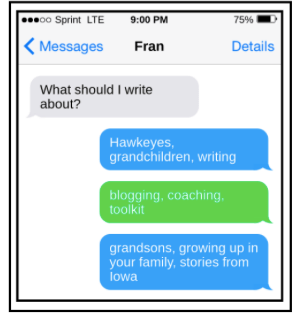
What’s a writing teacher to do?  Quick conferences with Joey, Susie, and Les. Are they stuck on “what to write” or is it too much Monday-itis? A frequent issue during writing time even in writing workshop is the dreaded, “What Should I Write About?” It may come as a question. It may be delivered with a bit of a whine. Or, even worse, it may be a silent telepathic message from a student with their head down on a desk or fidgeting with something inside the desk.

Writer’s Block or “I Don’t Know What to Write About?”

What are some steps to cure the “What do I write about blues?”Here are five ideas for you to try out in your writing and then pass on to your students..

  1.  Make a list.


The first two pages after the Table of Contents in my Writer’s Notebook is a list of topics titled “I can write about . . .” We generated lists that covered two or three pages of chart paper. I recorded a few that appealed to me. I tried to avoid writing too many because I know that looking at a long list makes me anxious. When I am stuck, I pull one or two words off the list, check and see if I want to make them broader?  Or maybe narrower. Here’s my list.

I can write about . . .
Presents / Traditions

Holiday plans

A’Marek’N Girls Cruise

Grandsons

Kids

Fur babies

PD Planning

#NCTE18

Process vs. Product

Triangle – Assessment, Instruction, Curriculum

Family Stories – Sharing a Hamburger, Ferry

For today, I’m going to combine two.  I’m going to write about traditions with the grandsons.  I’m going to describe some current ones and then I’m going to add in some “possibles” – practicing for the family talk.

Screen Shot 2018-11-12 at 11.23.32 PM

   2.   Make a heart map.


The idea for heart maps comes from Georgia Heard and her book Heart Maps. Here’s a link to her website. A teacher sample of a “Wish Heart Map” is at Margaret Simon’s blog complete with a student example linked here. I began with a simple heart and then began adding topic ideas.


  3.  Make a neighborhood map.


I first heard about this idea from Jack Gantos at a keynote at Teachers College,

Columbia. He says you can create a house map or a neighborhood map.  

Drawing a map helps you remember details that may be important to the story.  

But better yet, those details can get you unstuck and back to writing.  A sample

neighborhood map that Jack used for one of his books is linked here. Part of

the farm I grew up on is pictured here in my map.

Screen Shot 2018-11-12 at 11.29.13 PM

4.  Jumpstart Writing.  

I demonstrate this with students. I write for three minutes. When the timer goes off, I reread my writing and highlight three words that are interesting and that I think I can write about. I choose one of those three and write again for three minutes.  I then quickly reread again, highlighting three more words, of which I choose one and write again for three minutes. I read highlighting three words. I now decide. Choose anything I’ve started or any of the circled words and I draft from there.

Jumpstart Writing Example
It was a cold, crispy night before Homecoming. Go to the parade or not?  Stand in the cold or not? How would I decide? Loyalty, Determination, or Compliance. Which would win out? It would be easier to get ready for the game if I didn’t go. But if I did, I would know how to dress for the weather for the following
Compliance is the bane of my life. So many days the requirement is just to bite my tongue and do my job. Hired to think. Hired to be a leader. And, yet, now expected to be a puppet. What to do? When do I get to make the decision? Is this due to loyalty to my team? Is this due to really liking my job? What are my options? Any real choices? Or just pseudo-choices?
Puppets would be a source of entertainment for our holiday. The kids could pretend to have a concert, dig for dinosaurs, and anything else that their hearts desired. Something new. Something that they could talk about. What would we need? People, animals, and/or some type of backdrop. Better make sure there are some dogs and cats included so our fur families are represented. A short time to practice? Then a video presentation to preserve the memory for anyone not there? Who knows?  Maybe we will start a new tradition.
We have many interesting traditions in our family. One of my favorites began when I  (and continue writing)


5. Text 3 friends.


Ask three friends to give you two topics each that they think you might write about. Don’t get them in trouble by talking, texting, or emailing when you all are supposed to be writing! Respectfully, courteously, and if possible, ask in advance. “We start writing about something we are experts at tomorrow. Can you help me out?  What do you think I’m an expert at doing?” Three friends with two answers each means six answers. With any luck, one of those friends may give you more than two answers which will increase the likelihood that you will have something to write about. Here are the nine answers that I received from three friends and you can see that some answers overlapped.

Screen Shot 2018-11-12 at 11.31.33 PM

Writing is hard but the best advice for “stuck writers” is to write every day. When writing is a daily habit, you can stop in the middle of a sentence and the next day pick up exactly where you left off.  When you only write once a week or once a month, it’s tough to remember what you were thinking unless you left yourself a note. Write. Write. Write. Soon a confident writer you will be! And you will be writing paragraphs, not sentences!

What works for you when you can’t think of what to write about?  How do you get unstuck?

What might you try after reading this post?

Resources:

Gantos, J. (2018). WRITING RADAR: Using your journal to snoop out and craft great stories. S.l.: Faber and Faber.

Heard, G. (2016). Heart maps: Helping students create and craft authentic writing. Portsmouth, NH: Heinemann.

Fran McVeigh is an Assistant Academic Coordinator for Morningside College as well as a Literacy Consultant in Iowa. Previously she has been an elementary teacher, a special education teacher, principal, district curriculum and professional development coordinator and a regional literacy consultant for multiple school districts. Fran is also a co-moderator of the #G2Great chat, can be found on twitter @franmcveigh, and on her blog “Resource-Full”.


Teach Like an Expert: Using the EMPOWER model

By Adam Fachler and Jeffrey D. Wilhelm, Professor of English Education at Boise State University; Director of the Boise State Writing Project, featured speakers at the CCIRA Conference in February 

Previously on this blog, literacy powerhouse Dr. Mary Howard wrote:

“…we are so busy filling our schools with programs, packages, quick fixes and magic bullets that we forgot to ‘fill the heads of our teachers with the body of knowledge’ that would make those programs null and void and help us realize just how stupid many of their suggestions are.”

This specialized body of knowledge has a name, pedagogical content knowledge, and it’s the hallmark of teacher expertise. It’s what enables a teacher to know:

  • how to apprentice novice learners into expertise with a given strategy or problem-solving task
  • the best ways to represent a particular concept or strategy (e.g. through analogies, examples/non-examples, demonstrations, etc.) and to help learners develop a mental model for understanding and using what they’ve learned
  • How to help learners navigate the productive struggle that inevitably arises when learning how to do a new complex task, like reading a new genre or using a new reading or composing strategy.

Here’s the big takeaway: without pedagogical content knowledge, we will lack the mindful capacity to guide learners to develop and apply deep and transferable expertise.

So, how do teachers actually develop and use expertise?

One way to develop this specialized understanding of pedagogical content knowledge (knowing how to teach learners how to do something) is to use a planning format that mirrors and reinforces the moves of highly effective teachers.

If you peruse curriculum sources like publishers’ websites, Teachers Pay Teachers, blogs, and Pinterest, then you will observe the nearly limitless variability of teacher planning templates. While we are all for open-endedness and creativity, very few of these planning formats actually meet the high bar of the correspondence concept in that they do not correspond with how effective teachers plan nor how successful learners learn in the real-world contexts of college and career.

Just as artists practice their craft and create anew on canvas, educators, too, need a space where they can practice their craft, move towards expertise, and design the highest quality instructional experiences possible.

Introducing EMPOWER

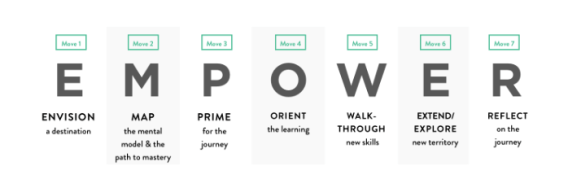
EMPOWER is a seven step process for teaching anyone anything. It is based on research from human development, cognitive science, the development of expertise and other fields.  It organizes the seven “must make moves” that expert educators enact in designing effective instruction into a convenient, powerful model for learning design. Further, EMPOWER is the kind of mental model and map that guides expertise of any kind (Ericsson & Poole, 2016). It is an example of the kind of mental model that we must help students to understand and use to guide them when they read or compose an argument of judgment, a story with a twist, an ironic monologue or any other kind of genre that is new to them:

Screen Shot 2018-11-06 at 6.25.58 AM

Unlike more “schoolish” formats, EMPOWER draws from real-world teaching-learning situations and organizes them into a powerful story:

First, educators ENVISION a future destination for learners and MAP out a proven path to achieving that outcome. Then they PRIME learners for the journey ahead by tapping into background knowledge and interests, and ORIENT the learning by pointing towards the destination, the purpose and payoff of reaching it, and laying out a plan for getting there. They then WALKTHROUGH a new strategy—modeling a new way of thinking about or solving a problem or task that can become a mental model or map to guide future use—and EXTEND learners’ expertise in that strategy through deliberate practice, fading as learners’ skills develop. Ultimately, the educator offers—or helps the learners find—a “call to action” that challenges them to EXPLORE new territory. Throughout the journey, the educator invites learners to REFLECT on progress and process.

The framework naturally organizes into two categories, behind-the-scenes big picture planning and student-facing instructional planning.

Screen Shot 2018-11-06 at 6.28.13 AM

Rather than having you reinvent the wheel, EMPOWER probably links to much of the brainstorming you are doing anyway, but does so in a consistent pattern that reflects what is known about effective teaching and learning:

Screen Shot 2018-11-06 at 6.29.36 AM.png

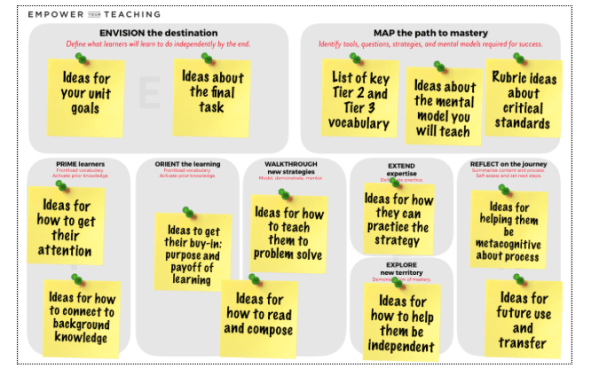
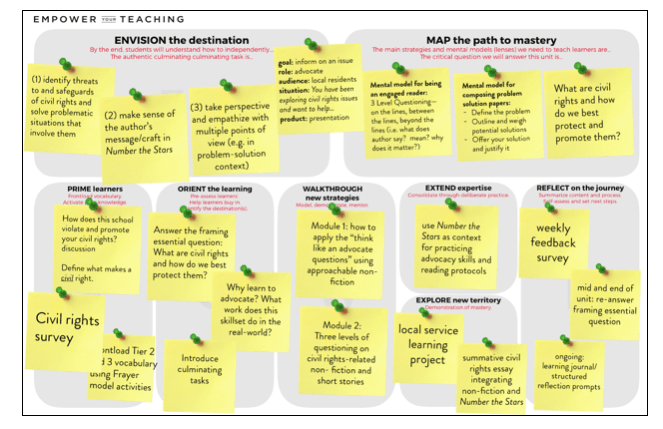
Educators who wish to build a new canvas work through each stage of the framework, populating it with ideas that can be captured via sticky notes or shorthand.  For example, when designing a unit on civil rights, a first pass at the EMPOWER canvas might look something like this:

Screen Shot 2018-11-06 at 6.30.26 AM

On a finished canvas like the one above, each sticky note serves as a “placeholder” for what will become a more evolved instructional activity or plan. (Want a FREE blank EMPOWER canvas? Click here.) For example, the “Civil Rights survey” and vocabulary sticky notes are shown in “expanded form” below:

EMPOWER-ing your curriculum at every level

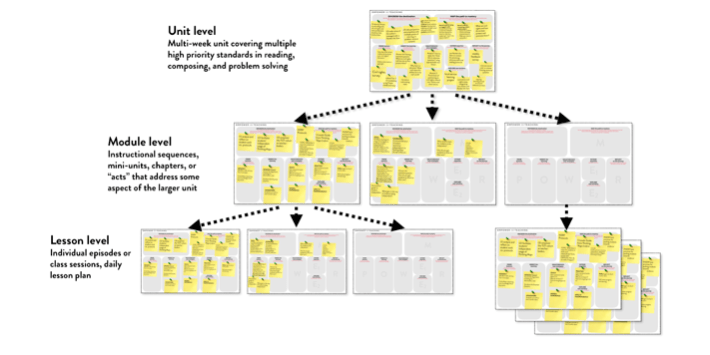
While most designs for learning only allow you to design at one level–either the unit or the lesson–EMPOWER works at every level of the instructional design process because of its grounding in generative principles about all teaching and learning. Educators who EMPOWER their curriculum infuse research-based principles, design thinking, and thoughtful strategy throughout each level of their planning as more macro-level unit canvases inform modules and instructional sequences that inform individual lessons.  This develops curricular coherence, an important feature of instruction that most assists the most struggling learners.

Screen Shot 2018-11-06 at 6.32.50 AM

In our session at the upcoming CCIRA conference as well as in our forthcoming book, EMPOWER Your Teaching (Spring 2019, Corwin Press), we will provide you with ideas for planning powerful units and lessons that will move you from your goals to concrete teaching strategies that will help learners meet those goals. Our intention in this blog is to help you internalize our big picture thinking around the unit level (what’s captured on sticky notes) before circling back to explore each strategy (and lesson-level canvases) of cognitively apprenticing learners towards expertise as readers, composers and problem-solvers.

Getting to your first draft

When you (a) have extremely clear targets for what each must-make move of your unit plan should contain, and  (b) can write these out in shorthand, creatively constricted by the confines of a sticky note, your planning efforts will be highly focused, effective, and productive.

Like a painter who obsesses over every brush stroke of a new painting, educators engaged in the nitty gritty work of curriculum design can find it taking days and weeks to truly nail down their learning plans. But in an environment where we often need our curricular solutions done yesterday, this process can be inefficient.

Therefore, we recommend the following tips:

  1. Sketch a canvas in one sitting. While a unit plan can take weeks or months to write, your initial canvas should be sketched quickly. Yes, you read that right. Set a timer and get your first draft down in the space of one prep period. You are going to come back to the document anyway, and as the saying goes “1>0”; having most of the canvas boxes completed with 50% detail beats one complete, thoroughly detailed box any day.  It can also be very productive and fun to work with a colleague to draft out a unit or lesson plan with EMPOWER. Screen Shot 2018-11-06 at 6.33.39 AM2. It’s okay to leave sections incomplete… Rather than trying to research or debate the “right” answers, put something down quickly or leave it blank and come back to it later. Some elements like your unit’s mental models of expertise may take time to figure out. The canvas is meant to be an organic document that evolves over time. It’s okay to say “I don’t know” right now.
    3. …but not the first two sections. Remember: if you’re adopting a learning-centric approach, your learning designs will be less about what you will teach and more about what students will learn to do to independence. If you skip Envisioning and Mapping, you have no chance of successfully POWER-ing the rest of your unit. We advocate flexibility but starting with [E] and [M] is a must.

Conclusion: We cannot defy gravity

Whether we “believe” in it or not, we are still subject to the inescapable effects of gravity. We feel similarly about EMPOWER. Whether or not educators acknowledge that the EMPOWER pattern underlies the most effective teaching-learning situations, we (and by extension, our learners) are still subject to its effects.

An immediate example: imagine a teacher who does not Envision their students’ learning outcomes in sufficient enough detail and the resulting aimlessness that teacher’s students are likely to feel. After all, if the educator does not know the direction of the unit, how can students?

Screen Shot 2018-11-06 at 6.34.34 AM

Similarly, if an educator fails to Map out the unit into digestible pieces, it can lead to learners feeling overwhelmed at the depth or breadth of the content; and if that same educator chooses not to Prime or Orient students at the beginning of the unit, then those students may feel too disconnected or unmotivated to pursue the energy-intensive act of learning.

Suffice it to say that we cannot defy gravity anymore than we can defy the  “science laws” (as determined by the sciences of human development and cognition!) embodied in a principled paradigm like EMPOWER. In fact, once we started using EMPOWER, we started noticing missed opportunities in even our most successful lessons and units and steps we were tempted to skip in the instructional design process that would have come back to haunt us later.

With the “must make moves” embedded into our toolkit, we are guided to include all the essential elements of sound pedagogy, and we are deepening pedagogical content knowledge every single day.

If you are interested in a free copy of our canvas tool prior to our CCIRA session, get a blank EMPOWER canvas here (By the bye, our session is: 169. EMPOWER YOUR TEACHING! Teaching with Inquiry!) Our website provides other resources for using EMPOWER and how to enact pedagogical moves aligned to each of these principles of effective teaching and learning.

Ericcson, A. & Poole, R. (2016). Peak: Secrets from the new science of expertise. New York: Houghton-Mifflin.

Adam Fachler, Education Consultant, Creator of the EMPOWER Method. Adam worked as an educator, coach, and interim principal at the Bronx School for Young Leaders, a public middle school. Adam completed the NYCDOE’s Leaders in Education Apprenticeship Program in 2014. In 2015, he co-authored the proposal for the School in the Square Public Charter School, a Washington Heights middle school, now open and in its second year.

Jeffrey D. Wilhelm is an internationally-known teacher, author, and presenter. He is driven by a desire to help teachers to help their students to more powerful literacy and compassionate, democratic living. A classroom teacher for fifteen years, Jeff is currently Professor of English Education at Boise State University. He works in local schools as part of a Virtual Professional Development Site Network sponsored by the Boise State Writing Project, and regularly teaches middle and high school students.  He is the founding director of the Maine Writing Project and the Boise State Writing Project. Wilhelm co-authored numerous books and articles, most notably, Reading Don’t Fix No Chevys.