Writing Our Way Out

by Stevi Quate

I wrote my way out
When the world turned its back on me
I was up against the wall
I had no foundation
No friends and no family to catch my fall
Running on empty, with nothing left in me but doubt
I picked up a pen
And wrote my way out (I wrote my way out)

Linn Manuel-Miranda, Aloe Blacc & Dave East

As a teenager struggling with an elusive mother and a father living thousands of miles away, I picked up a pen and wrote and wrote and wrote. As a wife in a troubled marriage when I felt like the world had turned its back on me, I opened my journal and wrote my way out of the confusion. As a newly divorced woman, I opened my computer and pounded away on the keyboard, working to understand the new world I found myself in.

Writing was therapy but so much more. Those journal rants led to new understandings; confusion found its way into poems; and writing a short story became a way to navigate a world that I controlled. I wrote my way out of traumatic times and wrote my way into a life of tranquility.

chuttersnap-165289-unsplashPhoto by chuttersnap on Unsplash

But I also wrote my way out of some not so smart teaching moves. Through writing, I reflected on my classroom practices, and through the writing, I discovered gaps between my beliefs and my actions. Through the writing, I came to understand.

I wrote my way out personally, professionally time and time again.

In my professional development world, we talk about parallel pedagogy: using the pedagogy with teachers that we would hope they would use with their
students. And so I use that concept of parallel writing pedagogy to think about students. Do they get that opportunity to write their way out of anything? Do they get that chance to use writing to ponder an event, to celebrate a moment, to question an action, to discover and to find joy? Do we invite them to use writing to explore, to meander, to deviate from the expected? Do we invite them to pick up a pen or open their computer and write their way out? Do they know that “when the world turns its back on me” or when you’re “running on empty” and “nothing is left in me” that they can pick up a pen and write their way out?

Stevi Quate consults locally and internationally.   She is a former middle and high school teacher, codirector of the Colorado Writing Project, President of the CLAS and CCIRA and state literacy coordinator for the Colorado Department of Education. Find her on Twitter at @steviq.

Project Based Learning

By Catherine Shaw

Project Based Learning (PBL) is the latest trend in teaching. You may be new to teaching or a veteran teacher but chances are you have heard of this method. Since we are striving toward meaningful, engaging and relevant learning, PBL offers an exciting path.

I am not an expert, but when exposed to this way of teaching, I was excited.  I have always tried to encompass many subjects into a unit of study. Seeing the big picture and wrapping the learning around a central idea was easy for me to grasp. It just made sense since in the real world people have jobs and they perform many different, yet related tasks to master that job. They write reports, read documents, apply skills, report to a boss, work on a team and produce a product. To me it just seemed obvious that this is a terrific way to set students up in a real world scenario.

As our school really began to dig into PBL, we had to learn the difference between Problem Based Learning and Project Based Learning. This was a huge Aha moment for many of our staff.

A combination of ideas works for Second Grade, which we have explored for a number of years now.  One thing we discovered was having a good Driving Question will make all the difference in the world. Just taking an Essential Question is not enough to drive the learning and motivation. When students have an excitement about the question and gather ideas about how to answer that question, they are more willing to engage in the process. Another idea is to have the question impact a community in and around the school. Here are few of the PBL Driving questions we have had: “How can we inform new families to the school what kind of severe weather to expect and how to stay safe?” (Weather unit) “How can we explain to someone how to get to our house from the airport?” (Geography unit with How to writing-landmarks) “How can we convince our parents that we would like something?” (Economics unit) How can we explain to students what goes in the Recycle Bin? (Earth Day).Screen Shot 2018-06-19 at 7.03.17 AM

Over the years, we have had different members of the community come in to ask the questions or lead the kickoff. This was very authentic as they charged the students with the learning and were part of the outside community. They had a deadline to meet just like the real world.

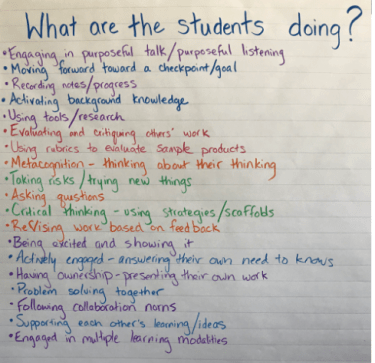
The learning starts with a kickoff. The “Guest” asks them to provide them with a product for their use. The Guest can be someone from the community, another teacher from another school, a professional in the community or a parent from the school. Teachers can write a script for the “Guest” in order to help them facilitate the Driving Question. Next, students dialogue about what they know, what they may need to know and pose questions about the subject, and how they are going to learn about the topic in order to answer the question. Categorizing the questions and areas they see that would go together organizes the work. Students can work in groups, setting agendas and checkpoints for their learning.

The Buck Institute for Education has a multitude of Rubrics www.bie.org/resources along with suggestions for ways to get started. This is authentic learning at its best. The whole day is used for learning instead of dividing learning into compartmentalized subjects. All disciplines are woven into the design of a PBL unit. The best part about PBL is that students learn beyond the standards. Students learn life skills like collaboration, respect, responsibility, perseverance and critical thinking. The teacher sets checkpoints along the way help to monitor work and hold students accountable for work.Screen Shot 2018-06-19 at 7.03.32 AM

Writing time includes working on notes, collecting information, gathering materials. Reading has much more interest when it is student driven. Math is used
along the way as students may have to calculate the cost and needs of
materials and put together proposals for funds.

Students have a feeling of pride and accomplishment when the work is completed. They have made something for the community, or school. Their work is not lost as just another assignment and they have seen a meaningful and challenging task to completion.  Presentations are shared with community members or parents.

If you have not tried creating a unit using Project-Based Learning, I would highly encourage it.  I have found a new energy and love for teaching as I have explored this methodology. You may have to let go and let students take charge of their learning with help along the way. Isn’t that what all educators hope for?

Euler, Grant., Cole, Lindsey., Lin-Jeffrey, Sharon. (2017) Project-Base Learning
Progression Workshop, Jefferson County School District.

Catherine Shaw is currently a Second Grade Teacher at Bradford K-8
South in Littleton, CO and is a board member of JCIRA. She has
been teaching since 1992 starting as a Paraprofessional and then as a Licensed
Colorado educator. Shaw earned her master’s degree is Reading and
Literacy in 2008.  From the time she was in fifth grade, Shaw knew she wanted to be a teacher and has been living that dream for the last 20 plus years.  Catherine.Shaw@jeffco.k12.co.us

Blogging as Professional Learning

By Amy Ellerman

Writing is a tool for thinking. This is something we tell students, but I wonder how often it is something we actually do.

When I think about the learning experiences that have challenged me the most, the experiences that have led to the most significant growth, they have all involved writing in some way. For me as a learner, writing IS a tool for thinking.

When I craft a blog post, for example, I almost always work my way to a new understanding through the process of writing. I’ll have some ideas to start with, but my true aha doesn’t come until I’m deep in the muck of drafting. When I blog in this way—to explore or grow an idea rather than to “explain” a fully formed idea to others, my own learning happens through the act of organizing words on the page.

As a learner, I’m making choices about what’s most compelling to explore. The motivation is internal—I’m trying to figure something out. Usually, I’m in pursuit of a question or challenge, something I’m wrestling with in my work with students or teachers. I seek out resources to support me in this quest—blogs, books, podcasts. This research is relevant. Necessary.

Having an authentic reason to articulate what I understand (or am trying to understand) challenges me to question, clarify, support, and reflect on my ideas. Making this thinking public, by publishing it on a blog, is a way to add my voice to the larger conversation. Ideally, I can get feedback from fellow educators. But even if I share a post and no one comments, I’m still contributing; I’m authentically participating in a kind of learning and collaboration that didn’t exist a decade ago.

A decade ago, I might have read a professional book and been inspired to talk about it with a teammate. I might have attended a class or conference and then tried out some new practices or strategies. There is something different about blogging as professional learning—because that is the best way I have found to describe what this process is: blogging as professional learning.

If you’re reading this, you are undoubtedly wise to the wide array of professional blogs on the internet, a plethora of resources for today’s educator. We all consume content on professional blogs; we know how valuable it can be to find an educator thinking and writing about what we’re trying to learn. But—and here’s what I’m trying to think through in this post—how many of us also regularly produce content? What might we learn if we did? What might we be able to contribute, and how might the act of contributing shift the energy we get from professional learning?

Screen Shot 2018-06-12 at 12.19.04 AM

There are so many amazing examples of this type of blogging-to-learn available. Morgan Davis at itsaboutmakingspace.wordpress.com is a colleague and long-time mentor for me in this department; she blogs about instructional coaching and about her writing life. Sarah Zerwin at thepapergraders.org is someone I’ve only recently discovered; her series on a high school writing teacher’s journey to stop grading is fascinating and so authentic. Sometimes, like in the case of George Couros and his The Principal of Change blog, this type of blogging leads to the publication of a book; his spectacular Innovator’s Mindset came out in the past year. However, I would be curious to find out from these bloggers if a traditional book was ever the point. My guess would be that their need to take their thinking public was more about their own learning process than any specific end goal.

At a recent workshop, Scott McLeod, co-author of Different Schools for a Different World, said something that I can’t stop thinking about. He quoted Mitch Resnick, Director of the Lifelong Kindergarten group at the MIT Media Lab: “We wouldn’t consider someone literate if they could read but couldn’t write. Are we literate if we consume content online but don’t produce?” This is such a compelling way to think about how we define literacy in this digital age. It’s such a different mindset from expecting all creators to be “experts,” tapped by the publishing gods as worthy of being produced. It’s not the way the world works anymore.

With access to today’s tech tools, we can all be producers and collaborators. All voices matter—and that is so empowering. Producers learn from the process of creation. It’s not about learning something to some perfect level of mastery and then sharing it; it’s about leveraging the authentic process of writing to understand and collaborate as a vehicle for learning even more deeply. It’s about the thinking work that happens while we create; that’s where the magic happens.

Our students are natural producers, because the tools to create and share have always been at their fingertips. Their definition of “authentic” is quite different from our own. Students today expect to collaborate; they demand relevance. I would argue that this is something adult learners crave as well. Our traditional models and systems of professional learning just haven’t always tapped into this very human need.

We (all too often) expect to be “trained” or have learning that is provided for us. We attend classes where the role of learner is relatively passive. Sure, there might be turn and talks and small group discussions, but ultimately, participants aren’t in the lead of their own learning. As a result, there is a fair amount of compliance, as opposed to pure engagement.

This should ring familiar when we consider how learning experiences for students have often looked in the past—teacher designed, teacher controlled, with students as compliant participants.

We all know this has been changing.

Today’s educators have been challenged to up the ante for our students. We are shifting the cognitive load, designing learning experiences that are more relevant, rigorous, and engaging. Hopefully, by this point, we have seen evidence of the power of the shift in our our students’ learning. We have embraced the call for authentic learning because our young learners deserve it, to use an expression echoing through the Twitterverse, thanks to leaders like Todd Nesloney and Adam Welcome. (If you have not yet checked out their new book, Kids Deserve It! Pushing Boundaries and Challenging Conventional Thinking, you should add it to your TBR list.)

The question I would pose is: Isn’t authentic, compelling, relevant learning something teachers deserve as well? And if this is not the kind of professional learning being “provided” for us in our schools, what are some ways we might seek it out for ourselves?

I know when I’m deep in a blog post and I reach that place where I can see the sun, where my questions and ideas are coming together into an insight that’s clear and ready to share, it is so motivating. When it’s an understanding I’ve worked hard to reach, it feels different from simply finding and taking in information from another source. There is something electric about doing the thinking work of questioning, analyzing, synthesizing, reflecting. . . For me, engaging in this higher level thinking work is energy-giving. This is the kind of learning I’m desperate to talk and think about with my colleagues (and PLN)—not because I’m an expert who has figured it all out, but because I know the questions they will ask or the feedback they will share will continue to push me forward.

So, again, I would make a comparison to our students. Consider the palpable change in the energy in the room when our students are invested in something relevant and compelling. . . As we are challenging our students to engage in inquiry-based learning models that require higher levels of self-direction and proactivity, it makes sense for us to jump in beside them so we can understand what’s so hard about it. We need to experience this shift in learner ownership for ourselves. What might we learn from these students who crave taking the lead? What might we need to learn from these students in order to reach them? These shifts in how our students think and learn should inspire us to shift the ways we think and learn as adults.

Blogging as professional learning is just one of many ways for educators to take the lead of our own learning. I would argue that if we are going to shift to (or maintain) a side-by-side stance with our students, we need to understand what it feels like to be creators. We need to have empathy for the vulnerability it requires to put ideas out into the world for authentic audiences and to collaborate outside our own classrooms and buildings. Just like a teacher of writers should be a writer him or herself, a teacher of young people today should be engaged in professional conversation/learning in similar ways that we are expecting our students to engage.

I’m challenging myself in the coming year to engage in more blogging as professional learning. What might you challenge yourself to try?

Amy Ellerman is an Instructional Coach at Maple Grove Elementary in Golden, Colorado. She is passionate about teaching and learning in a workshop model—any content, but if she’s being honest, Writing Workshop will always be her favorite. Exploring authentic and innovative models of professional learning is another area of intense study at the moment. Amy blogs at www.smallwritersthinkingbig.blogspot.com and can be found on Twitter @sanderling12. Amy chaired the 2018 CCIRA Conference (Literacy Renaissance: Invention, Intention, and Close Study) and is currently President of CCIRA.


Classroom Vocabulary Assessment: What’s YOUR Plan?

By Brenda Overturf

Assessment for learning is part of any solid classroom design. But there is no doubt about it—planning for classroom vocabulary assessment can be tricky. Books and articles about vocabulary development often conclude with a “need for research” when it comes to assessment. However, vocabulary instruction would just be a collection of activities if we didn’t pay close attention to how our students are progressing and adjust accordingly.

So how can we assess vocabulary learning? Formal published vocabulary tests are prohibitively expensive. They are usually reserved for higher stakes assessment, and don’t test your students’ classroom learning. Commercial reading programs often lack vocabulary assessments or are based on words that are not right for your students. When it comes to formative and summative assessments to evaluate word learning, you may find yourself designing your own.

Screen Shot 2018-06-04 at 11.04.00 PMI have had the immense privilege of spending a lot of time in vocabulary-focused K-8 classrooms and thought I would share four tips for planning vocabulary assessment some great teachers have shared with me.

1. Plan formative and summative assessments that build from instruction.
Instead of teaching students words from a generic vocabulary list, Beck, McKeown, and Kucan (2013) suggest reviewing materials to decide how to plan for instruction. These researchers talk about Tier One words (words that students already know), Tier Two words (more challenging words that students will encounter across texts), and Tier Three words (words that are part of content instruction). Their recommendation for elementary students is to select Tier Two words that students will see in in a particular text or hear in a read-aloud, and introduce Tier Three words when engaging students in content area instruction.

Margot and Leslie are intermediate teachers in a high-poverty school. When planning for instruction, they review possible vocabulary words in their reading program and content area lessons. They then select five to seven Tier Two and Tier Three words (total) to emphasize, choosing words they think will be helpful to students for comprehension and that students will see in other texts in the future—what they call “bang for your buck” words. They introduce these words in context and add two synonyms and two antonyms for each word to help students build semantic networks. They then engage students in a number of active and fun activities with vocabulary.

Leslie and Margot use formative assessment techniques to gauge their students’ word learning during vocabulary activities as a natural part of instruction. Formative assessment can take the form of posing questions and inviting students to indicate “thumbs up” or “thumbs down,” asking students to write answers on white boards and hold them up in the air, or leading students to create their own questions for other students and then observing how they use the words. On a summative assessment that will be used for a grade, Margot and Leslie usually create a multiple-choice format that mimics the standardized assessment that students will take. In addition to expecting students to select definitions, they also include questions in which students choose synonyms or antonyms associated with the word. They intentionally add questions about vocabulary words from earlier in the year so learning will stay active.

Heather, a first-grade teacher, created a scaled-down version of this plan for her students. In her class, children learn one synonym and one antonym for a few Tier Two words she has selected from the shared reading text. Her students practice the words, the definitions, and their synonyms and antonyms in whole group games and literacy center activities. One section of Heather’s first-grade reading assessment is always devoted to vocabulary. Early in the year, students indicate definitions through pictures and simple sentences. Later in the year, students choose definitions or synonyms and antonyms that match the vocabulary words.

2. Teach students to use word-learning strategies, and then expect students to use those strategies on assessments.
There are three word-learning strategies we want to teach students so they will be able to figure out the meaning of an unfamiliar word: use of context, meanings of common word parts (affixes and roots), and use of reference materials (Graves, 2016).

Leslie and Margot intentionally teach their intermediate students to use these three word-learning strategies as part of their classroom vocabulary plan. When designing vocabulary assessments, they emphasize use of context. This makes sense, since their state reading assessment often requires a student to select the definition of a word in context. These teachers design part of their vocabulary assessment using a one-page multiparagraph format with blanks where the vocabulary words should go. They write the paragraphs about something that has happened in school so all students are familiar with the background of the text. The vocabulary words (five to seven for each two-week period) are listed in a word bank at the top of the assessment. This format requires the students to use context to decide which word goes into each blank. They also ask students to indicate context clues that provided evidence for their choices. As Margot tells her students, “Test makers try to trip you up. You really have to use your context clues to figure out the right word.”

3. Teach students words they are likely to see in more formal assessment situations.
All the teachers I have worked with, including middle school ELA teachers and interdisciplinary teams, understand the need for teaching students to interpret words that will be used on more formal high-stakes assessments.

Beth and Deshay’s kindergarten students don’t take the state assessment but they are required to participate in the progress-monitoring tool their district uses and they want their students to feel confident when answering the questions. Although the computer-based assessment has a read-aloud feature so that young students can hear the directions, Deshay and Beth have realized there are a number of words their students don’t know or understand. If children can’t comprehend the directions, they can’t follow the directions! These teachers make sure to embed words into their daily instruction that students may hear on progress-monitoring assessments, such as label, information, and word parts. Then Beth and Deshay use informal assessment techniques, such as observation and notes, to judge whether students understand these words and can follow directions using the words.

4. Work with other teachers to share vocabulary assessment ideas.
The vocabulary-focused teachers I know try to collaborate with other educators to create an effective vocabulary plan. Sometimes the team includes all the teachers in a particular grade, sometimes it is an interdisciplinary or small group team, and sometimes it is made up of an individual teacher with a literacy coach. Teams work together to select words, plan instruction and active practice, and design and analyze assessments to make professional decisions about further instruction. Participating in collaborative discussions can be a gold mine of ideas about assessment and student learning.
And Now for The Test!

Performance-based assessment, a method used extensively in the 1990’s, is making a comeback (Hilliard, 2015). In performance-based assessment, the assessor expects students to perform a real-life task. We know students have really learned vocabulary when we observe them using new words in speaking and writing.

Yes, assessment can be tricky, but it is an essential part of a well-designed vocabulary plan. So here is a performance-based assessment task for you: How can you assess vocabulary learning in your own school or classroom?

References:
Beck, I., McKeown, M., and Kucan, L. (2013). Bringing Words to Life: Robust Vocabulary Instruction, Second Edition. New York: Guilford Press.

Graves, M. (2016). The Vocabulary Book: Learning and Instruction, Second Edition. New York: Teachers College Press.

Hilliard, P. (2015). Performance-based assessment: Reviewing the basics.

Edutopia.org. https://www.edutopia.org/blog/performance-based-assessment-reviewing-basics-patricia-hilliard

Dr. Brenda Overturf is currently a full-time author, speaker, and consultant. She is a career educator as a former teacher, district administrator for reading curriculum and assessment, and chair of the literacy program at the University of Louisville. Brenda’s books on vocabulary include Word Nerds: Teaching All Students to Learn and Love Vocabulary and Vocabularians: Integrated Word Study in the Middle Grades. She is currently working on a new book about K-1 vocabulary. When Brenda is not writing or speaking, she loves to read, create art, travel, and listen to her husband’s 60’s band.

Cultivating Our Own Wonder

Winding down. The year that seems like it only started a minute ago or perhaps feels like it has been moving at the pace of a snail, is quickly coming to an end.  We approach that last day of school with excitement and sometimes tears as we see those students who we have spent the year pouring our energies into waving goodbye and disappearing into the sweet summer sun.  The sun sets and rises again and we realize that a new dawn has really risen. One in which we don’t have to eat our lunch in five minutes or time our bathroom breaks by when the students have recess or another class.  Winding down, we take a deeper breath, perhaps even noticing that the grass has turned green and flowers are popping up all around us.

As you melt into your summer routine, I hope you take the opportunity to reignite your sense of wonder.  Wonder is such a magical thing and it is not just for the young.  Wonder is something that keeps all of us young and curious! I don’t mean the kind of wonder like, “I wonder when I should clean my house?” or “I wonder what we should have for dinner after the baseball game?” But, the mind-growing wonder of living a life that is engaged in the mystery of the world around us.

Wind down and get outside — out of those walls that have held you captive for the last nine months and breathe in air that perhaps has skipped past a glacier or swirled over an ocean.  Allow your toes to sink into the soft green grass or even the goo of a mud-puddle. Open your mind to explore the natural world around you. Don’t take your cell phone. You can read the text later.  Just soak in the world outside that changes each minute and wonder.  Look closely, carefully, what do you observe?  What catches your eye? What new fragrance seeps into your nostrils?  What texture do your fingers or toes feel?

Screen Shot 2018-05-22 at 9.31.15 AM

Do you see the spider threading its way through the grass? Do you see the water droplets from the rain or your sprinkle bead up or spread out depending on the surface it lands on? Do you see the clouds and wonder why they form, where they form and how they create such unique shapes? Is the lightning splitting the sky and sending out its Screen Shot 2018-05-22 at 9.29.14 AMthunderous roar leaving you in awe and wondering how that happens? Did you travel to the mountains for a hike and open your bag of cocoa and see it spray all over your cup and wonder? Lean your head back on your lounger on the beach and feel the breeze coming off the ocean and wonder where the breeze is coming from and where will it go? Suddenly, curiosity takes roots in our minds and we begin to wonder.  Magically we find ourselves reaching for the nearest device to “Google” or grabbing a book or even a friend to find out more!

A few years ago at the CCIRA Conference on Literacy,  Ellen Oliver Keene said something that still resonates in my mind,  “Are your students engaged or are they being compliant?” As the summer winds down and the “teacher dreams” start up again, as you begin to envision your classroom and play around with new lessons, think about how to create a classroom full of students who wonder, students whose minds remain curious about the content that lines your walls and bookshelves. Whether it is wondering how words coming out of someone’s mouth can become written words on a page that can be read by someone else to wondering why Shakespeare wrote in the style that he did,  no matter what age level you teach, you can create an atmosphere that embraces curiosity that seeps through every desk, chair, and human being in your room.

Many of you have Word Walls in your classroom, which is a great resource.  Another one you might try is creating a Wonder Wall! In my classroom, we created a Wonder Wall.  Students came in each morning and would write their “wonderings” on sticky notes that would clutter our back wall.  When we were done with a lesson, students would add more “I wonders…” that swirled in their minds during a lesson but were not yet answered.  As a class, we would then work together to find and discover answers over the course of the week or unit. Some could be found quickly, while others took weeks to discover.  Students would use a variety of resources to discover and share answers. We were creating a classroom that was engaging and vibrant by allowing the students to realize that questions are amazing and that answers are fun to discover. It was a constant group effort! I wanted my students to want to learn and want to read.  I wanted to create in them a yearning to find out more about everything. I wanted them to know that even though we had just finished a lesson that all that there was to know about that topic had not been covered, there was still much more to find out! Students learned about “testable questions” and “researchable questions.”

As literacy teachers, we want our students to want to read and find out information.  Another helpful tool is something called the  “Admit Slip” from Janet Allen. Students analyzed an intriguing picture that related to what we were learning about that day. They wrote down three things they noticed, two ideas  and one thing that they wondered. We would then discuss their observations and wonderings. This was a way that I could assess their background knowledge, set the stage for the lesson, but most importantly create a sense of wonder. I loved it because it was never the same twice and the students always observed something that I had yet to notice. Janet Allen’s book Inside Words holds many other ideas that help create an atmosphere that entices a student to want to learn more.

The best way to create a sense of wonder in your classroom and to get them engaged in learning, is to be curious yourself.  As you enjoy your time away from students, whether you are attending PD sessions, vacationing, gardening, hiking, working, or wherever your summer takes you, take time to look around you and wonder!

Amy Nicholl is a Past President of CCIRA and serves as curriculum coordinator at Poudre Learning Center,  an outdoor learning facility. She is an adjunct professor at University of Northern Colorado, an is a consultant who facilitates professional development workshops in the areas of literacy, science and STEM education. Amy was a classroom teacher for thirty-four years in Windsor, Colorado.  Amy received multiple awards for teaching including two national awards: the Presidential Award for Excellence in Mathematics and Science Teaching and the Delta Award for Excellence in Inquiry-based Science Teaching.  Follow Amy on Twitter: @AmyNicholl16