
By Fran McVeigh
The room is quiet. Yet there is a “rustle in the air” this Monday. I quickly survey the room. Typically writing workshop starts out quietly until a writer hits a tough spot and wants to talk it out with their partner.
Everyone at the first table is writing, writing, writing. At table two, Joey . . . Joey is not writing. Joey is sitting there. He had an idea when he left our group, but he’s not writing. Table three has writing by all. Susie, at table four has her head down. And Les by her is almost lying down on the floor. No writing there. Table five has writing.
What’s a writing teacher to do? Quick conferences with Joey, Susie, and Les. Are they stuck on “what to write” or is it too much Monday-itis? A frequent issue during writing time even in writing workshop is the dreaded, “What Should I Write About?” It may come as a question. It may be delivered with a bit of a whine. Or, even worse, it may be a silent telepathic message from a student with their head down on a desk or fidgeting with something inside the desk.
Writer’s Block or “I Don’t Know What to Write About?”
What are some steps to cure the “What do I write about blues?”Here are five ideas for you to try out in your writing and then pass on to your students..
- Make a list.
The first two pages after the Table of Contents in my Writer’s Notebook is a list of topics titled “I can write about . . .” We generated lists that covered two or three pages of chart paper. I recorded a few that appealed to me. I tried to avoid writing too many because I know that looking at a long list makes me anxious. When I am stuck, I pull one or two words off the list, check and see if I want to make them broader? Or maybe narrower. Here’s my list.
| I can write about . . . |
| Presents / Traditions
Holiday plans A’Marek’N Girls Cruise Grandsons Kids Fur babies PD Planning #NCTE18 Process vs. Product Triangle – Assessment, Instruction, Curriculum Family Stories – Sharing a Hamburger, Ferry |
For today, I’m going to combine two. I’m going to write about traditions with the grandsons. I’m going to describe some current ones and then I’m going to add in some “possibles” – practicing for the family talk.

2. Make a heart map.
The idea for heart maps comes from Georgia Heard and her book Heart Maps. Here’s a link to her website. A teacher sample of a “Wish Heart Map” is at Margaret Simon’s blog complete with a student example linked here. I began with a simple heart and then began adding topic ideas.
3. Make a neighborhood map.
I first heard about this idea from Jack Gantos at a keynote at Teachers College,
Columbia. He says you can create a house map or a neighborhood map.
Drawing a map helps you remember details that may be important to the story.
But better yet, those details can get you unstuck and back to writing. A sample
neighborhood map that Jack used for one of his books is linked here. Part of
the farm I grew up on is pictured here in my map.

4. Jumpstart Writing.
I demonstrate this with students. I write for three minutes. When the timer goes off, I reread my writing and highlight three words that are interesting and that I think I can write about. I choose one of those three and write again for three minutes. I then quickly reread again, highlighting three more words, of which I choose one and write again for three minutes. I read highlighting three words. I now decide. Choose anything I’ve started or any of the circled words and I draft from there.
| Jumpstart Writing Example |
| It was a cold, crispy night before Homecoming. Go to the parade or not? Stand in the cold or not? How would I decide? Loyalty, Determination, or Compliance. Which would win out? It would be easier to get ready for the game if I didn’t go. But if I did, I would know how to dress for the weather for the following |
| Compliance is the bane of my life. So many days the requirement is just to bite my tongue and do my job. Hired to think. Hired to be a leader. And, yet, now expected to be a puppet. What to do? When do I get to make the decision? Is this due to loyalty to my team? Is this due to really liking my job? What are my options? Any real choices? Or just pseudo-choices? |
| Puppets would be a source of entertainment for our holiday. The kids could pretend to have a concert, dig for dinosaurs, and anything else that their hearts desired. Something new. Something that they could talk about. What would we need? People, animals, and/or some type of backdrop. Better make sure there are some dogs and cats included so our fur families are represented. A short time to practice? Then a video presentation to preserve the memory for anyone not there? Who knows? Maybe we will start a new tradition. |
| We have many interesting traditions in our family. One of my favorites began when I (and continue writing) |
5. Text 3 friends.
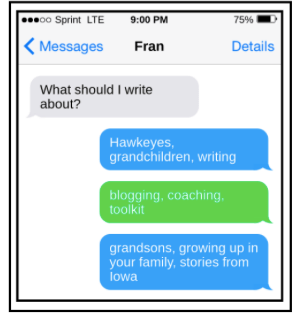
Ask three friends to give you two topics each that they think you might write about. Don’t get them in trouble by talking, texting, or emailing when you all are supposed to be writing! Respectfully, courteously, and if possible, ask in advance. “We start writing about something we are experts at tomorrow. Can you help me out? What do you think I’m an expert at doing?” Three friends with two answers each means six answers. With any luck, one of those friends may give you more than two answers which will increase the likelihood that you will have something to write about. Here are the nine answers that I received from three friends and you can see that some answers overlapped.
Writing is hard but the best advice for “stuck writers” is to write every day. When writing is a daily habit, you can stop in the middle of a sentence and the next day pick up exactly where you left off. When you only write once a week or once a month, it’s tough to remember what you were thinking unless you left yourself a note. Write. Write. Write. Soon a confident writer you will be! And you will be writing paragraphs, not sentences!
What works for you when you can’t think of what to write about? How do you get unstuck?
What might you try after reading this post?
Resources:
Gantos, J. (2018). WRITING RADAR: Using your journal to snoop out and craft great stories. S.l.: Faber and Faber.
Heard, G. (2016). Heart maps: Helping students create and craft authentic writing. Portsmouth, NH: Heinemann.
Fran McVeigh is an Assistant Academic Coordinator for Morningside College as well as a Literacy Consultant in Iowa. Previously she has been an elementary teacher, a special education teacher, principal, district curriculum and professional development coordinator and a regional literacy consultant for multiple school districts. Fran is also a co-moderator of the #G2Great chat, can be found on twitter @franmcveigh, and on her blog “Resource-Full”.


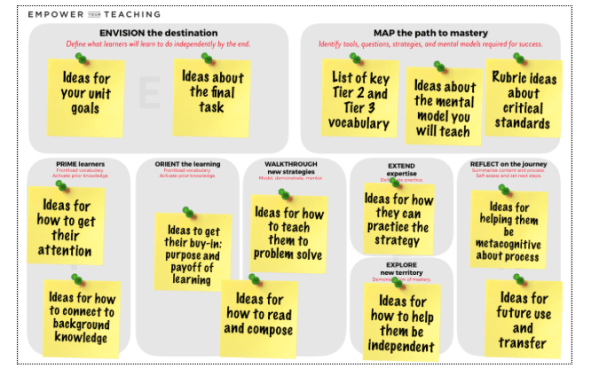
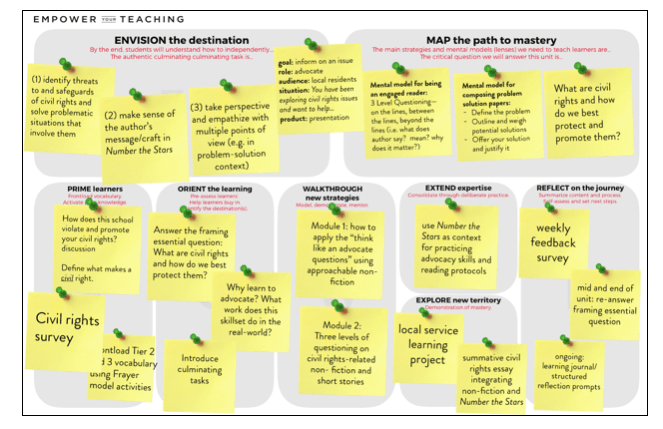


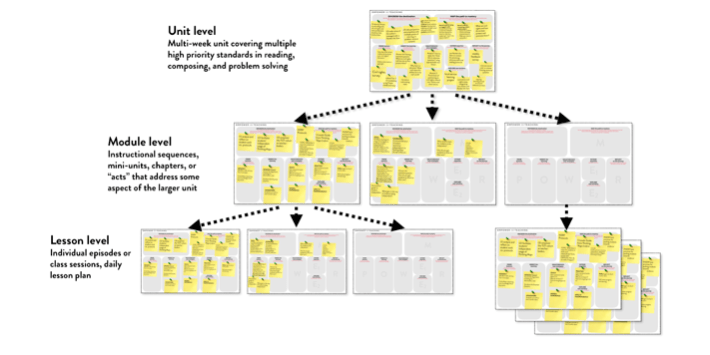



 At our training sessions, I began by asking our teachers these questions:


 professional model. I’m talking about teachers who are begging NOT to have those boxes or at the very least to have the right to use them as a resource or even (shock warning) not use them at all. Do you know how many brilliant, amazing and dedicated teachers we have in this country? Well I do but clearly those who are force feeding them boxed programs and then tethering them to someone else’s agenda surely don’t. And again, I’m well aware that there are teachers who either don’t want to do the work or truly need a reference to support their efforts. But why are we punishing every teacher by pushing these programs on those who don’t need a teacher’s guide to tell them what to say and do? I hate to tell you this astonishing news, but many teachers know what to say and do and they can do it far better than these boxes ever could. The box obviously doesn’t know the research that we hold dear and knowing this would make us walk the other way. Worse, the box doesn’t know the kids the iffy box is purportedly for. Teaching without agenda-driven research or knowledge of children isn’t teaching at all. And following a script is as far removed from student-learning teaching as one can get.
