Since 2019, CCIRA has supported educators through our professional blog. Each year there are favorites that are shared on social media and in professional settings. We are grateful for each post that is written by our network of literacy experts, national speakers and professional book authors and teachers.
Each year our blog gains more followers and becomes an even stronger voice for literacy teaching and learning. The posts this year have been some of the best. Below you will find the Top 5 Blog Posts of 2024, listed by order of popularity. We hope you will bookmark this post and come back to these gems when you need inspiration or another lens for reflection.
A well-chosen read-aloud can be the lifeblood of a language arts classroom. Teachers can do some heavy lifting in an efficient time frame to ground students in content and prime the pump for instruction. Read-alouds could be reading the entire book to your class. But it doesn’t have to be. We can also read a chapter, a section, or even a page aloud. The important thing is that we use the text as a connection point to both listening comprehension skills and language comprehension as we model how the text is supposed to sound when read aloud. Molly Ness explains this beautifully in her book, Read Alouds for All Learners (Solution Tree, 2023):
“Before students are fluent, independent readers, listening to an expert reader is the most efficient way to build the knowledge and vocabulary that are crucial to reading comprehension. It’s been found that children’s listening comprehension exceeds their reading comprehension through about age 13 on average. That means they can take in more sophisticated concepts and vocabulary through listening than through their own reading.”
We feel that it’s important to interact with the text, modeling the thinking that we do as readers during reading and invite our students to do some thinking with it as well. It’s not enough to just simply read it aloud.
With this being said, we’ve also found potential in using this experience as a jumping off point into other literacy instruction. We’d love to share with you some of the golden nuggets we’ve unearthed, so that you can put them into practice in your own classrooms. We’re going to discuss how we would extract all the amazing potential from a read-aloud we’ve recently done for the book Bugged: How Insects Changed History, by Sarah Albee, a book that highlights important historical connections between insects and humans, both good and bad.
Beyond the Read-Aloud: Grammar Instruction
Now that the text is familiar to students, we can leverage our time and instruction by using the text to teach craft moves through a grammar and conventions lens. For example, we may share this sentence with our students as an entry point into teaching how writers provide additional information with use of parentheses:
At some point in its life cycle, an insect has three parts to its body (head, thorax, abdomen) and six jointed legs.
Using the invitation process from our Patterns of Power series, we begin by asking our students what they notice about the author’s choices in this sentence. Through conversations with partners and then the whole group, students share their thoughts. They may discuss the punctuation such as the commas, or they may share the information the author is providing. No matter what they notice, we honor and name it, discussing why Albee chose to do what she did. There is a strong possibility that the writers will, in fact, notice the parentheses, especially since it’s not something they see in every sentence, therefore sticking out even more for them. We discuss the purpose of the parentheses, why Albee chose to use them and analyze information inside of them. Through this discourse, we discover that one way writers can add additional information is through the use of parentheses.
We may share or create a focus phrase together that can be posted in our classroom and orally repeated often to act as an anchor for our students as they add this move to their toolboxes: “I use parentheses to add information efficiently.”
To deepen the awareness and understanding of this craft move, we can then find or create another example where parentheses are used in the same way and invite our students to compare and contrast this new example with the sentence from our mentor, Sarah Albee.
After this discussion, we give our students a chance to write their own through imitation, beginning with the class writing one together and then writers composing one independently. They may or may not choose to begin their sentence with the opener, At some point…
Below are two examples students wrote independently.
At some point in my day, I have to do chores (clean my room, make my bed, take out the trash) before I get screen time.
My dogs (Millie, Kimber, Ginger) love to go on walks.
We take a moment to share and celebrate their imitations as this makes them feel confident enough to continue to use this move as needed in other writing they do throughout their day and year. For example, one class was writing research reports, and this child chose to add additional information for their reader about gorillas:
Because we started with a text that was familiar to students, our writers are now able to read text as writers and use some of the moves they discover in their own writing.
Beyond the Read-Aloud: Revision Instruction
Another element of writing instruction we can extract from this text post-read aloud is bolstering revision skills through sentence combining. Using a process from our series Patterns of Revision, here is an overview of a revision lesson connected to this text.
First, we would extract a short chunk of text from the read-aloud, preferably one that includes complex ideas mashed up together (like a compound sentence, a list of ideas, appositives renaming a noun, or compound subjects or predicates). Here’s one sentence with potential from Bugged:
Eight-legged spiders, ticks, and mites are not insects.
We like this sentence because there are multiple ideas being organized together into one sentence. Our work behind the scenes would then be to pull apart these ideas into separate, stand alone sentences:
Eight-legged spiders are not insects.
Ticks are not insects.
Mites are not insects.
After we’ve selected a sentence and separated out the ideas into their own stand alone sentences, we can bring these sentences back to our students to facilitate discussion about combining these ideas together. This is how the process would break down, using the acronym DRAFT:
We’d display the sentences for students and read them aloud.
We would discuss any repeated information students see being presented to decide what we could DELETE, allowing us to combine what is left.
Students would prompt us to do work in the moment to combine the ideas:
Eight-legged spiders are not insects.
Ticks are not insects.
Mites are not insects.
To combine what is left, we would consider how we could REARRANGE the words left over, what other words and punctuation we might ADD, and if we could do anything to FORM new verbs. Students TALK it out as they create a newly combined sentence.
Students might suggest something close to the author’s original when combining the ideas together. After we complete the sentence-combining work collaboratively as a class, we compare our work to the author’s original, reflect on any similarities or difference between our combination and the author’s, and discuss how this exercise could help us in our own writing.
We might then go back into a draft of writing we’ve previously created and try looking for ways we could combine our sentences or ideas in a similar way we did so with Sarah Albee’s work.
Concluding Thoughts
Studying grammar and supporting revision are two of the many lenses we could use to revisit part of the text we used for our whole-class read-aloud. We could follow a similar process of illuminating things like figurative language or text structure in a similar manner: by revisiting a manageable chunk of text, displaying that text for students, and asking them to discuss what they notice the author doing in this portion of the text.
We believe it is through this small shift in instruction, offering space for students to observe and discuss what they notice the author does in their work, that we are building students’ cognitive structures for learning. This shift will support them in strengthening this line of inquisitive thinking and observation in their future work as readers and writers in our classroom…and beyond it!
Whitney La Rocca has been a teacher, a literacy coach, and a consultant, working with children and teachers across grade levels, schools, and districts. With a deep knowledge of content, standards, and best practices, Whitney enjoys delivering professional development and coaching teachers to support children as they develop their identities in the world of literacy.
Travis Leech is a middle school instructional coach in Northside Independent School District in San Antonio, TX. He has thirteen years of experience in education, including teaching middle school English Language Arts and as a gifted and talented specialist. He has presented about engaging literacy practices and technology integration at the district, regional, and state levels.
Almost two years ago, another mom from my children’s school posted a simple question on Facebook: “Thinking about starting a book club. Anyone interested?”
It took approximately two seconds for me to reply with a (likely overeager) “ME!” And I wasn’t alone. By the next day, almost a dozen of us moms–most of us merely acquaintances who gave a polite nod to each other at school parties and social events–were on board. And thus, a book club was born. Since then, our little group has bonded over books about amazing women in historical fiction, unreliable narrators in suspense novels, and too-good-to-be-true love stories.
Why were we all so drawn to be in a book club together?
It wasn’t because we needed a push to read; each of us is a bookworm with a strong reading identity.
It wasn’t because we wanted to write about a book; we each have our own style of recording and reflecting on our reading.
And it wasn’t because we needed an excuse to gather; we all have friendships and social lives both in and out of this group.
It was because a book club was a space for us to grow together through our shared experiences with books. We could explore characters and relationships and the truths that run through our real lives and are reflected in the books we share.
As a former fourth- and fifth-grade teacher, then instructional coach, and now a literacy coordinator, I’ve been watching students navigate their way through book clubs for years. It’s often messy and unpredictable. It rarely goes well the first time (or even the second or the third). Some students struggle to keep up, while others have a difficult time not reading ahead for spoilers.
As I’ve seen an increase over the past few years in resources that teach reading skills through shorter excerpts of books, it’s affirmed my belief that it’s more important than ever for kids to have the opportunity to meet, discuss, and learn in book clubs. Like adults, kids thrive on the connections that are built through books.
It’s also critically important that we set students up for success. With limited time, a significant amount of material and standards to teach, and kids with a broad spectrum of needs, it’s essential to set students up with the skills and conditions for successful book clubs. To do that, we need to be clear and intentional in several areas:
Focus on what kids need to practice. Our days are filled with opportunities for students to refine their comprehension skills, write about reading, decode multisyllabic words, and learn new vocabulary. These are all certainly things kids can do–in small doses–in book clubs, but what is the true purpose of book clubs? When we set kids up to read and discuss a text, we are extending an invitation for them to construct knowledge in the most social of ways. We want them to come to the table with one idea about a character or plot twist and walk away with a deeper understanding or a shift in their thinking. Book clubs are the place for kids to practice talking about books in ways that push their thinking and engage them in healthy and respectful discourse with peers. All other skills should be secondary to this focus.
Teach conversational skills. We don’t expect kids to be natural writers or readers. Similarly, though we know they know how to talk and usually have plenty to say, they often haven’t ever been taught how to have the type of conversation that takes place at the level of a book club. They have to know how to share ideas, support them with evidence from the text, listen to one another, take turns, clarify their thinking, and be willing to shift their ideas and be open to new ones. All of these are skills we can teach through modeling, coaching, and using guided practice during whole group read alouds so that kids are ready to engage in thoughtful conversations during book clubs. These skills do take practice; we also need to remind ourselves to have realistic expectations and to slowly build them over time.
Keep it moving. Novels aren’t meant to take two months to read. Often, we slow down the pace of a book in the hopes that all students can “keep up,” but what actually happens is that we neglect to build a sense of excitement and urgency around the novel. While being mindful of the diverse needs of kids in our classrooms and the limited amount of in-class reading time we can provide, we need to set up a schedule of discussions that moves kids in and out of novels within the span of a few weeks.
Consider alternatives to clubs centered around one book. In Breathing New Life into Book Clubs (2019), Sonja Cherry-Paul and Dana Johansen lay out several types of book clubs that differ from the norm, pushing teachers to think about grouping kids by genre, author, historical event, identity, goal, or even podcast. Not only have these ideas pushed me to think about grouping kids differently, but they emphasize the ways in which book clubs encourage readers to make connections that are centered around much more than events in one book.
Seek opportunities for choice. Many times book clubs are established based on student reading abilities, the number of copies of a book that are available, or a system of voting. While the parameters of clubs are always up to teacher discretion, it is definitely worth it to loosen the reins and be very open to student ideas and choices. Giving kids the opportunity to practice selecting a book and a group will once more position them with the power to drive their own reading decisions.
Make it authentic. I have seen and–I will admit–even created many book club “packets” over the years. Why? My decisions were rooted in the need for grades and accountability. However, if anyone were to tell me that I couldn’t attend my adult book club without 3 questions and a summary written down, I would quickly abandon the idea of being part of the group. To stay true to the spirit of a book club, the work (and play) should be focused around talk and sharing ideas. When students have to complete paperwork as an admission ticket to even be part of the club, something natural and authentic is lost. Instead, try having students jot down a few ideas for things they might talk about before they meet, then follow up with a few ideas or new thinking when their conversation has ended. This will allow them to capture their ideas (and share some of their thinking with you) in a way that is not just another task.
Book clubs are, at their very core, a chance for us to hook kids on the social power of books. They bring reading to life in a new way and show our youngest reader that not all readers think and feel the same way about a book. In a time where programs are continually forcing classroom instruction to focus on short excerpts of text and conversational skills are often lost through a screen, what could be more important than allowing kids to connect through a rich conversation about a good book?
References and Recommended Reads:
Cherry-Paul, S. & Johansen, D. (2019) Breathing new life into book clubs: A practical guide for teachers. Portsmouth, NH: Heinemann.
Kugler, S. (2023). Better book clubs: Deepening comprehension and elevating conversation. Portsmouth, NH: Stenhouse Publishers.
Sarah Valter is the district Literacy Coordinator for Lindbergh Schools in St. Louis, MO. In her two decades in education, Sarah has taught in the primary and intermediate grades, mentored new teachers, coached at the building and district levels, and led professional development in literacy. She is also an adjunct instructor at St. Louis University, working with undergraduate and graduate students. Sarah is a wife and mother, spending most evenings driving from practice to practice and weekends cheering in audiences or on the sidelines. You can follow Sarah on X at @LitCoachValter.She believes strongly that all children and adults should not only have the skills to read and write, but also the motivation to live as lifelong readers and writers.
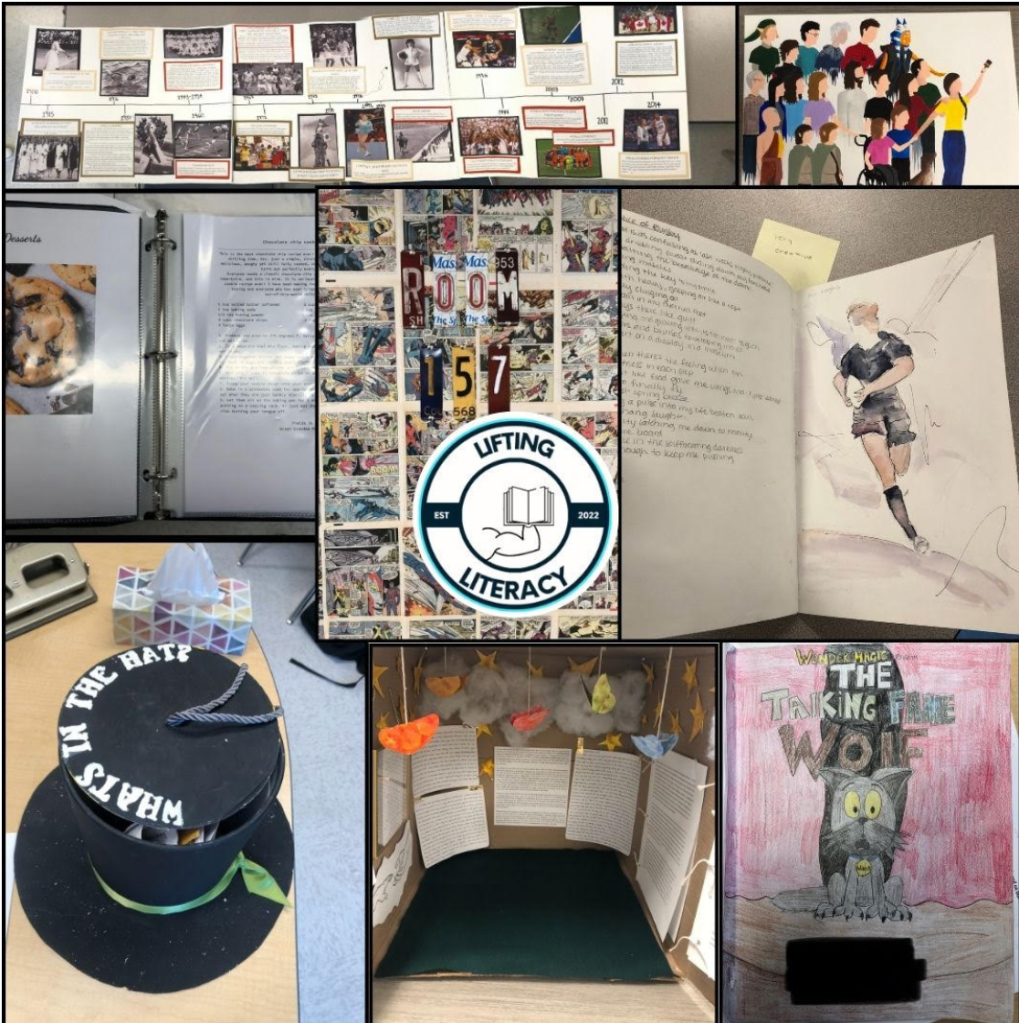
My early teaching years were in the elementary setting, where I discovered Project-Based Learning (PBL). I loved developing projects and other immersive opportunities for my students to learn and experience choice. Each year, as I moved into new grades, I could provide these opportunities until I found myself teaching Senior High English, and the pressures of standardized year-end exams started weighing down on all of us.
My first few months teaching the seniors were… boring. I was used to choice writing and exploring interests with my students, and I was stuck teaching them form and expectations based on rubrics for a test they would never use again but had a disproportionate impact on their grades. I wanted to find a balance, a way that student could explore their interests and learn the forms of writing required of them. My answer first started to form with a little (or a lot) of inspiration from the incredible Paul W. Hankins.
Paul and his students in the legendary room 407 brought the idea of multigenre projects and multimodal representation to life. They explored various types of writing and built incredible pieces around a theme, something my students needed to learn, and I had only been teaching most artificially. What Paul and his excellent students were creating felt so organic. After seeing some ex amples and getting some text suggestions from Paul, I dove right in. My first multigenre project was titled “Make Your Mark” a multigenre project exploring the theme of legacy.
In my first semester with the project, we had the unfortunate circumstance of COVID-19, which interrupted our time in the classroom. However, it did buy us a free pass from the tests, which were canceled. So, the project became our final. Students embraced the work at the end of the term. I had beautiful tributes written to loved ones and poems that explored the past and were hopeful for the future. Students crafted and recorded songs, built sculptures, and made movies. The creativity was off the charts. The next semester, the exams returned. I followed the same schedule, closing the year with our project, and assumed the students would be ready for their exams because of the volume of writing we were doing. That assumption was incorrect. Projects turned out amazing again, but the heavy focus on choice and joy did not translate as well as hoped to the stale exam format. I needed to make some changes.
I decided to adopt the idea of a term project in the literal sense. We would take time throughout the whole term to complete it. Introducing the project in the early days of the course, building a schedule with checkpoints, setting days throughout the course that would focus on the project, and ultimately having the project due at the end of the term. I asked the students how they felt about this process and if they felt it left them enough time to feel comfortable with their test materials while also being able to give sufficient attention to the project. The general feeling was yes, and the current form of Make Your Mark was born.
Photo collage courtesy of the author.
This year, I had a new class added to my schedule. The Grade 11 kids, or what I think my American friends would call Juniors? I wanted to incorporate a term project with these students as well, and this time, the answer came in the idea of Project Based Writing from Liz Prather. We started the year talking about the freedom to explore topics that interested them—things they would want to write about. We set up Fridays as our term project day. Something that will be protected so that students can better manage their time. Their first task was to develop a pitch; I explained this as a moment to share their topic, why they had chosen it, and what they envision as a final product so far. This past Friday, students shared ideas, some of the ideas included:
Basketball Coaching Handbook and Instructional Videos
A picture book about the life of a favorite singer
True crime podcast series
Field Guide on Animals of North America
Illustrated Review of MLB ballparks
A Food Network-type show
A Horror Movie
This is just a sample of the creativity. Each project will require written elements such as scripts or episode summaries. Some students will submit chapters of a book after researching different authors’ writing processes. Student inspiration varied from simple interest to spite (this one made us all laugh).
As we work through the term, we have days where students will share progress and get feedback from me and their peers. We will keep a close eye on how the project is going, culminating in a gallery walk where students will have their work available for peers to experience.
I have loved the energy that term projects bring into the classroom. They are a moment to breathe in a world of testing. Students get to write about what matters to them, share their hopes and dreams, or even just their creativity. Through choice students learn to share their voice and write with one. It might not be the perfect tool to prepare for exams, but we have time for that; it just can’t be all that English Language Arts is about. Writing is about telling our stories and sharing who we are. That is often lost when we only think of ourselves as numbers.
Brent Gilson is an English Teacher in Alberta, Canada. He is in his 14th year of teaching, having spent time in grades 3-12. When not teaching, planning, or marking, Brent can be found attending student sporting events with his wife, Julie, an Elementary Principal. Brent has had the opportunity to present at various conferences in Canada and the United States, namely NCTE and ELAC (Alberta’s NCTE equivalent). If you are looking for more of his work and thoughts, check out LiftingLiteracy.com
Think sequencing a STEM-based book and then removing an element from the sequence and discussing the cause/effect.
Credit: elementarylibrarian.com
Think segmenting, sorting, and categorizing words from the text.
By Elizabeth Everett, 2025 Conference Presenter
I used to think that integrating literacy meant starting my science units with a book while using my usual read-aloud routine of predicting, inferring, and questioning.
But integrating literacy during science can go well beyond this.
Let’s take a closer look at how these three literacy integration ideas might look within an early education classroom.
Imagine you are teaching a series of science lessons about the sun.
You read-aloud the book This Is the Sun (Everett, 2022), encouraging students to predict the next animal in the food chain.
Credit: sciencenaturally.com
You dive deeper into food chains by asking the following open-ended questions:
In this book, the fox is at the top of the food chain. What does it mean to be at the top of the food chain?
What does it mean to be at the bottom of the food chain?
During your discussion, you strengthen students’ listening and speaking skills with targeted teacher discourse moves designed to help students listen carefully and make their ideas public. (MacDonald, 2017)
Credit: wida.wisc.edu
As you continue discussing food chains, students sequence the story by cutting out paper strips and gluing them together to create a paper chain. (Albelbaisi et al., 2023)
You “break” the chain by tearing off the paper link for “tree”, discussing what might cause a tree to be removed (chopped down, fire, disease, etc.) and how its effect impacts the rest of the food chain.
Or maybe students sequence using this circular pattern to help them draw conclusions about the importance of the Sun to all living things. (Albelbaisi et al., 2023)
Credit: sciencenaturally.com
Students complete a word study identifying other “sun” words such as:
sunglasses
sunflower
sunrise
sunk
sung
tsunami
Students then sort and categorize the words:
compound words
nouns/verbs
number of syllables
Or maybe students sort and categorize words (or pictures) from the story, allowing for the organic discovery of rich, science vocabulary such as:
producer/consumer
herbivore/omnivore/carnivore
predator/prey
Credit: elizabetheverettbooks.com
These integration ideas can be used with the science books you already have, including traditional nonfiction texts—though you may find sequencing easier with narrative nonfiction books. Check out the National Science Teachers Association’s list of Best STEM Books 2024, where you’ll find a variety of fun, engaging formats for all grade levels, including biographies, narratives, and graphic novels. (Best STEM Books 2024, 2024)
Credit: nsta.org
For those of you who like technology, you may also like the website Wonderopolis which is full of high-interest, kid-friendly, questions and answers. For each answer, there are vocabulary words already identified and defined, as well as a word challenge and quiz. The site also offers an immersive reader option and can be shared with students via Google Classroom. (National Center for Families Learning, n.d.)
Credit: wonderopolis.org
Wherever you are in your literacy integration journey, I hope that something in this post resonates with you—whether it’s a different teaching approach to try in your classroom or a new STEM book to read to your students. Thank you for all that you do and may this be your BEST SCHOOL YEAR YET!
National Center for Families Learning. (n.d.). Who’s at the Top of the Food Chain? Wonderopolis. https://wonderopolis.org/
About the Author
Elizabeth Everett spent 16 years as a public school teacher in Maryland. She’s taught elementary school, middle school, high school, and at the collegiate level where she worked with aspiring teachers as part of an Urban Teachers Masters Program at Johns Hopkins University. She now homeschools her son and writes books for kids. She is the author of four STEM-based picture books and has several more picture books on the way. You can find her online at elizabetheverettbooks.com and on social media @elizabetheverettbooks.





 CCIRA Professional Development Blog