In Honor of Karen Hartman

In September, we lost Karen Hartman, a fierce advocate for Colorado teachers. Throughout her years at Thornton High School, in the secondary section at NCTE, as director of the Colorado Writing Project, and co-director of The Colorado Language Arts Society, Karen never gave up. Here, four friends pause to pay tribute. We all gathered at CCIRA with Karen regularly over the years, and hope this post will remind you of the power of teaching communities. We hope to see you this February in Denver. 

No recipes

by Penny Kittle

Karen and I stayed up late eating her layered carrot cake at her dining room table after the fall CLAS conference in 2023. What makes this frosting, rich and creamy, yet light? I asked. She snickered. Karen didn’t believe in recipes, only in cooks, in instinct, in practice. You cannot replicate someone else’s good work; you must learn to calibrate on your own. Watch the pots that boil. Add salt. If your baking didn’t produce what you’d hoped, adjust. You are better off examining your own moves than criticizing or blaming the raw materials. Sit beside a student and listen, nudge, support. Celebrate their creations. I will miss those conversations, her blue eyes centered on me, her easy laugh, her love of a good story. I will miss her stacks and stacks of books and her joy in sharing them. 

Karen had left her high school classroom when I met her; she was a teacher of teachers where she remained for decades. Karen helped me persist in writing through joy and challenge. Nothing is harder, she said, than composing your ideas, your stories, and your hopes. She wrote with teachers at every meeting, every conference, every opportunity. We both echoed Don Graves, You have stories to tell that no one can tell  but you. Once teachers realize how important those stories are to them, Karen believed, they’ll put time to write in every lesson plan. (You say you don’t have time? Some new bloated textbook adoption in your district tells you this? Karen would have a response for that and it might have exceeded her self-imposed 5-f*cks-a-day rule.) Karen knew the emptiness of teaching that centers curriculum instead of students. She had zero patience for anyone who dictated the moves of teachers in our complex work. And she’d tell you: blue eyes sparking, searching, fierce and kind at once.

Karen believed in CCIRA. Teaching can be isolating work. We need each other. Conferences put teachers in conversation, and this one in particular, has always centered teacher research and experience. Quality ingredients are essential in cooking well, and a conference composed of authenticity, spontaneity, gatherings at coffee stands and in small sessions to explore and think are key to community. CCIRA cooks. They invite speakers to remind us how large and diverse this work is—spread across countries and generations and innovations. We gather. We learn together. CCIRA simultaneously affirms our instincts about learning as it challenges them. I leave inspired every time. 

I know this: Karen Hartman’s love for teachers and their students will reverberate in my life always. I raise a glass to my friend; I raise it high. May we all live our lives with such courage, kindness, and generosity.

A Cherished Friend 

By Stevi Quate

Karen was my cherished friend and feisty colleague. Without her by my side, my writing – personal and professional – wouldn’t have been the same. The flights to conferences and evenings after the sessions wouldn’t have been the same. And the professional literature we studied together wouldn’t have had the same impact. She nudged me and others to do what was best for students and not to take short cuts, and when she saw practices that disengaged students, she spoke out. Her impact on me and on educators around the globe was robust.

Dave Wendelin, former CLAS President and Director for the National English Honor Society for Secondary Schools (http://www.nehs.us/), recognized the impact Karen had on, literally, thousands of educators: 

I doubt there has been a more dedicated teacher and student advocate than Karen Hartman. Strong in opinion and visionary, Karen has unpacked the work of thousands of educators across the country…She had little patience for any barriers that might limit the independent decision-making of teachers as they nurtured their students.

Along with teaching at the University of Colorado at Denver, presenting at numerous conferences including CCIRA, editing CLAS’ journal Statement and serving as English Department Chair at Thornton High School, Karen poured her energy into keeping Colorado Writing Project* fresh and relevant.  As the director for more than a quarter of a century, she mentored and modeled and encouraged – and fed us her famous chocolate chip cookies. 

A common theme from teachers in the summer workshops was gratitude. Here’s what Hayley, a teacher in one of her projects, said about Karen: 

I wanted to thank you for opening my eyes to a new and better way of teaching writing. With only two years of teaching under my belt, I am always looking for the best practices; however, no staff development or PLC has come close to the type of life-changing experience this has been. Thank you.

It wasn’t just new teachers who expressed their gratitude. For instance, Alice wrote:

Your mom was one of my most memorable professors in grad school and was a wonderful mentor to me for many years after. She got me involved and taught me what it meant to be a professional educator. Even now, 23 years into the profession, I draw upon all she taught me. Her legacy is a great one.

It wasn’t just Colorado educators who were impacted by her vision. Back in the early 90s, CCIRA invited several teachers from South Africa to the conference. After attending one of Karen’s sessions, they wanted to learn more, so Karen invited them to attend one of CWP’s two-week workshops.  Not only did Karen sponsor their visit, but she also housed and fed them and made them feel at home. At the end of the two weeks, those educators wanted to share the CWP experience with their colleagues back in the very poor township outside of Dundee, South Africa. So the next summer, Sheila Kaehny and I joined Karen for this adventure.

During those two weeks, we learned side by side with the teachers. Mornings would begin with gathering together in a large circle. Someone would begin a song and eventually everyone joined in. Often a few teachers would move into the circle center dancing to the impromptu singing. For the rest of the day, the writing project looked like what we did back in Colorado: teachers would study professional literature about teaching writing and write themselves. From the participants’ writing, Karen learned that one teacher needed to increase the number of cows he owned before we could woo his future wife. Karen weaved his story into a personal narrative that she shared back in Colorado, causing insight into a different culture. 

Just recently one of South African educators called Karen her “global mama” and mourned her loss:  

So sad to hear the news about the passing away of our dearest friend and mother, grandmother from ashore. May her spirit live long for generations to come. Karen will be dearly missed around the globe.

My cherished friend and feisty colleague created a legacy to be celebrated and will, indeed, be missed.

*To get an idea about CWP, watch this video (https://www.youtube.com/watch?v=8xFHjPm0qYI) made by one of the teachers who studied with her.

Going Online 

By Sarah Zerwin

On a series of sunny June days in 2020, I sat on my back deck with my Google Classroom screen shared with Karen via video chat. We worked together for hours to transition the Colorado Writing Project curriculum from a two-week in-person workshop to a four-week online experience with both synchronous and asynchronous elements. Like everything else in education during that time, CWP had to pivot on a dime from what it had always been to something we had never imagined it would need to be. But Karen was determined—determined to offer a meaningful experience for teachers, regardless of the restrictions and challenges imposed by the pandemic. 

And that was Karen. Determined to offer a meaningful professional development experience to teachers. For many summers, that’s exactly what she did with the Colorado Writing Project, for teachers all across Colorado (and then for teachers across the country once we had the online curriculum built out!). As CWP director for many years, Karen was keeper of the grail—the CWP curriculum. When I came on board around 2010 and found myself at Karen’s dining room table with the other teacher consultants during the annual spring retreat, I was amazed to learn that the curriculum document in the binder in front of me was about three decades old, built and revised by literal legends of the Colorado English Language Arts world. I didn’t feel worthy. 

Fueled by Karen’s chocolate chip cookies, bottomless bowls of chocolate, and both a breakfast and lunch buffet, we made our way through each day of the two week curriculum, updating as needed to adjust to the evolving needs of teaching writing. I worked madly to upload the intricately-woven document onto my brain, amazed to see the inner workings of the most meaningful professional learning experience I had ever done myself as a CWP participant. Would I ever be able to actually bring this curriculum document to life and honor the legacy it represented? 

But Karen’s confidence in me made it all possible. Karen saw capabilities in me that I didn’t see. Her encouragement and support are a huge reason I was able to persist through several years trying to get to what eventually became my first book for teachers. In every opportunity I have, I channel Karen’s dedication to serving up professional learning experiences that challenge teachers, honor them as professionals, and care for them as human beings. In every moment planning for what happens in my classroom, I channel Karen’s dedication to pedagogy that challenges my students, honors them as readers and writers, and cares for them as human beings. 

See it was all so clear to Karen. 

Karen put in the work because it mattered for teachers and their students and the authenticity of their experiences in the classroom. That was it. That was all. And that is everything. 

An Unsent Letter to My Mentor By Sheila Kaehny

Dear Karen,

I remember a chilly April morning at the Teen Lit Conference when we met at the Tivoli before our traditional “What’s New In Young Adult Lit” presentation. You were at a table in the back, with a thick stack of handouts (yellow for you, green for me) and your red tote bag filled with thick hardovers decorated with sticky notes marking passages for read-aloud. 

I remember your smile, your Diet Coke with lime, your etched silver earrings and matching necklace, and your perfect pink fingernails.  

You were always excited to present our new YA titles, to share books to get kids reading. In your earnest “this is what’s best for kids” voice, booktalking was your gift.  You were a natural teacher, and it came through in your carefully crafted presentations.  I saw it in your writing conferences with kids and adults and when you listened and coached, helping people find answers.  You loved it all.  Both teaching and teachers annoyed you every once in a while, too, but you loved it (and all of us) just the same.

You presented at CCIRA every year. In your world, continuous improvement was teachers gathering together at conferences like the Fall Writing and CLAS for professional development.  Do you remember how cranky I was about giving up my Saturday morning soccer to participate in a weekend conference?  “Sheila, dear,” you said to me, “you can play soccer next weekend. You need this right now.” And you were right.  No matter how exhausted I was after a long weekend of learning, I left each conference energized, buzzing with ideas. 

Because of you and all those years of CWP summer writing workshops, hundreds of teachers across Colorado set aside worksheets and five paragraph essays and replaced them with authentic, meaningful instruction.  

No one has had a greater impact on my life as a teacher than you, Karen. You picked me as your student teacher; you hired me at Thornton High School. I am grateful you kept me afloat with all those late night phone calls and words of encouragement whenever I lost faith in teaching.  You were my steadying force.  I wanted to be like you.  You eventually roped me into being your Program Chair for CLAS (multiple times), and you made me a consultant for CWP.  I loved teaching and going on safari with you in South Africa. 

And now, I know you’d like me to pay it forward, and you’d like for us all to speak up a little bit more. You’d want veteran teachers to encourage young teachers to give a little time outside of school to their professional learning, to engage in the community, and to find the joy in teaching.

You had so many more books to read and writer’s notebooks to fill, Karen. So much more advice to give and criticisms of the current state of the world to post on Facebook.  Your shoes are too big to fill.  You wanted to make everyone’s life better through reading and writing and teaching, and I believed you could do it.  Heck, I watched you do it.

Oh, how I miss you, my friend.

Love from your other daughter, Sheila

Digging Deeper with Sentence Level Instruction: Teaching the Reading and Writing Connection

 By: Aimee Buckner Haisten, 2026 CCIRA Featured Presenter

At the start of every school year, I felt both excitement and exhaustion. Those first weeks are filled with routines, resetting expectations, and getting a classroom community up and running again. Yet, they’re also invigorating—the chance to begin anew with fresh ideas, renewed energy, and a rekindled passion for teaching. As educators, we’re fortunate to have this cycle of continual reflection and growth embedded in our profession.

In recent years, I’ve applied this same mindset to my own practice, especially in teaching writing. I returned to the role of learner—reading research, exploring new perspectives, and reconnecting with core principles that help students develop their voice and clarity as writers. While I once focused on using notebooks to nurture student identities and launch writing projects (Stenhouse Publishers, 2005, 2009, 2013), my latest fascination has centered around the power of the sentence.

A sentence, after all, holds remarkable capacity. It can reveal a theme, capture a writer’s complex idea, or unlock deeper understanding for the reader. The research is clear – spending time on sentence level instruction – analysis and construction-is key to developing students’ writing skills (Anderson & LaRocca, 2017; Collins & Norris, 2017; Graham, 2020;  Graham & Alves, 2021; Graham & Harris 2015; Hochman & Wexler, 2017; Sedita, 2023). By embracing the reciprocity between reading and writing—studying how syntax and semantics shape meaning—we can help students see sentences not as isolated grammar drills but as dynamic building blocks of language.

Too often, reading and writing are taught in silos, separated by subject blocks, test preparation, or curriculum pacing. This disconnect can obscure how closely these skills inform and strengthen each other. When we instead highlight their interconnectedness, we unlock more meaningful learning opportunities.

To bridge this gap, I’ve begun using a simple classroom routine – Sentence Digs – inspired by Anderson and La Rocca’s (2017) and Charles and Lily Fillmore’s work (2012). It follows a three-step process—Take Apart, Put Together, Apply—and it encourages students to engage deeply with language. They analyze sentence structure, explore its function and meaning, and reflect on the writer’s choices, all while remaining anchored in the texts they’re already studying.

This routine doesn’t rely on complicated materials or elaborate planning. Its power lies in the questions it prompts and the clarity it brings. Students not only gain insight into how sentences communicate meaning—they also learn how to craft their own with intention and precision. Rich, well-constructed sentences are gold mines for both readers and writers. And when we treat them as such, we give our students tools not just to comprehend the world around them, but to express their own complex ideas within it.

For example, you might be studying inventors in social studies or electricity in science and find yourself reading Bright Dreams: The Brilliant Ideas of Nikola Tesla by Tracey Dockray (2020). A sentence dig lesson might look like this: 

Focus: Understanding the impact of a cause/effect sentence.

            Using conjunctions to create cause/effect sentences.

Showcase Sentence: Nikola and Westinghouse were chosen | to illuminate the Chicago’s World Fair | since their AC cost much less | than Edison’s DC.

Ask: In this sentence, the author uses abbreviations that they expect the reader to know. In the context of electricity, what does AC and DC mean? AC refers to alternating current and DC refers to direct current; they both indicate how electricity is flowing through a current. 

If you prefer, you can organize your chunks on sentence strips. Move them around to help students focus on one chunk and then another. You’ll move them back together later.

Apply

During this part, students quickly apply their new knowledge about the sentence to their reading and writing. These are quick efforts and may be followed up with more practice. 

Discuss: Aside from earning money for illuminating the Chicago’s World Fair, why is this a significant event in Tesla’s life?
Writing Focus: Try writing your own sentence with a cause/effect sentence structure. Use the showcase sentence as your model. If you want to engage your students in sentence combining work to build cause/effect sentences, consider using or adapting this Think Sheet.

In my new book, Sentence Digs and during my conference sessions, we’ll dig into rich, well-constructed sentences exploring the routine to support comprehension and better writing.  My hope is that every reader and writer, speaker and listener, student and teacher feel confident in their ability to understand and use language in a way that helps them to connect with sentences, texts, each other, and the world. 

The unavoidable fact is that our school days are long but our teaching time is short. There is never enough time, so we find ourselves having to prioritize instruction. At a conference recently, a teacher asked me – how important is this work…really? Having short, weekly, explicit routines to teach syntax and semantics of sentences that carry rich meaning will not only support reading comprehension, it will also model for and support students in writing those kinds of sentences. There is gold in this reciprocity. It’s important.

About the Author: 

Aimee Buckner Haisten brings over three decades of experience to the field of education, where she has served as a classroom teacher, instructional coach, literacy specialist, published author, and international consultant. Her work has reached audiences across local, state, national, and international platforms, with a focus on elevating reading and writing instruction. Aimee’s contributions have appeared in several peer-reviewed journals, and she is the author of four acclaimed titles with Stenhouse Publishers. Her forthcoming book, Sentence Digs: Teaching the Reading and Writing Connection Through Syntax and Semantics, is scheduled for release in late 2025.

Aimee Buckner Haisten brings over three decades of experience to the field of education, where she has served as a classroom teacher, instructional coach, literacy specialist, published author, and international consultant. Her work has reached audiences across local, state, national, and international platforms, with a focus on elevating reading and writing instruction. Aimee’s contributions have appeared in several peer-reviewed journals, and she is the author of four acclaimed titles with Stenhouse Publishers. Her forthcoming book, Sentence Digs: Teaching the Reading and Writing Connection Through Syntax and Semantics, is scheduled for release in late 2025. Contact Aimee at aimeebuckner@gmail.com.

Respond to the Creativity Crisis by Teaching Fantasy Writing

By Carl Anderson

Imagination is more important than knowledge.

–Albert Einstein (1929)

Creativity is as important as literacy and we should afford it the same status.

–Ken Robinson (2006)

Photo used with permission.

In my new book, Teaching Fantasy Writing: Lessons that Inspire Student Engagement and Creativity K-6, I explore why it makes sense to include a study of fantasy writing in elementary and middle school writing curriculums. Children are permitted to write “real or imagined stories” (emphasis added) to meet narrative standards in many U.S. states. Since writing fantasy is extraordinarily engaging, it accelerates children’s learning about writing, and, almost like magic, helps them acquire powerful writing skills. And fantasy also is a genre that offers children a unique creative space in which to write about issues of great personal significance, such as making friends, dealing with bullies, gaining confidence and fighting injustice. In this, they follow in the footsteps of beloved and influential fantasy writers, such as J.R. Tolkien and Robert Jordan, whose stories reflected their respective experiences during World War I and the Vietnam War, and J.K. Rowling, whose writing helped her to work through grief and depression (Livingston, 2022; Pugh 2020).

Fantasy also gives teachers the opportunity to help students develop their creative skills. This is important because children in grades K-12 are experiencing a decades-long “creativity crisis” (Bronson and Merryman, 2010). Educational scholar and creativity researcher Kyung Hee Kim (2016) points out that scores on the most reliable measure of children’s creativity—the Torrance Test—indicate that 85 percent of children today are less creative than children in the 1980’s.

What accounts for this creativity crisis? One significant reason is that, since the 1990’s, school curriculums have become increasingly more standardized, a change driven to a large degree by the pressures of testing. As curriculums has become more standardized, play-centered activities have been squeezed out of the school day. This is a problem because play is “one of the driving engines of child development” and “encourages flexible, imaginative out-of-the-box thinking” (Straus, 2019). 

That students are less creative has profound implications for their lives, and the world. More and more, the successful futures we want for children depend on their moving into adulthood with imaginative and creative skills. In his books, The Global Achievement Gap (2008), and Creating Innovators: The Making of Young People Who Will Change the World (2012), Tony Wagner names and describes seven 21st Century “survival skills” that students need to succeed in today’s innovation economy and to be social disruptors who can tackle today’s problems. One of these skills is “curiosity and imagination,” which Wagner says students develop when their childhoods are filled with creative play. 

How should schools respond to the creativity crisis? They need to engage children in play-centered activities that exercise their creativity and imagination—such as writing fantasy stories in an ELA class. 

What? Children writing about the adventures of wizards and unicorns can be part of the answer to the creativity crisis? Yes! When children write fantasy, students create what psychologists call paracosms, or detailed imaginary worlds. The term used when someone creates a paracosm is worldplay (emphasis added).

Yes, play can be academic. Writing can be play. 

If you’ve read Bridge to Terabithia by Katherine Patterson, you may remember that one of the main characters, Leslie Burke, creates the imaginary kingdom of Terebithia. She and her friend, Jesse Aarons, enter Terabithia by swinging on a rope across a creek behind Leslie’s house. Once there, they pretend they’re the king and queen of the kingdom. The world of Terabithia is Leslie’s paracosm, which she shares with Jesse.

Psychologists have discovered that nearly one in five children create paracosms on their own, usually in middle childhood (Taylor et al., 2018). Research has shown links between this childhood worldplay and adult artistic success, as well as creative success in the sciences and social sciences. Many notable people created paracosms as children, including Amadeus Mozart, Charlotte and Emily Bronte, and Friedric Nietzsche and C.S. Lewis, among others. A study of one group of highly creative people, the MacArthur fellows, all winners of the award colloquially known as the “genius grant,” showed that 25 percent of them had paracosms as children, and that their worldplay often continued into adulthood as part of their creative process (Gopnik, 2018; Root-Bernstein, 2009). 

When fantasy is included in a writing curriculum, every child in the classroom, with their teacher’s guidance, gets to engage in worldplay and create paracosms. 

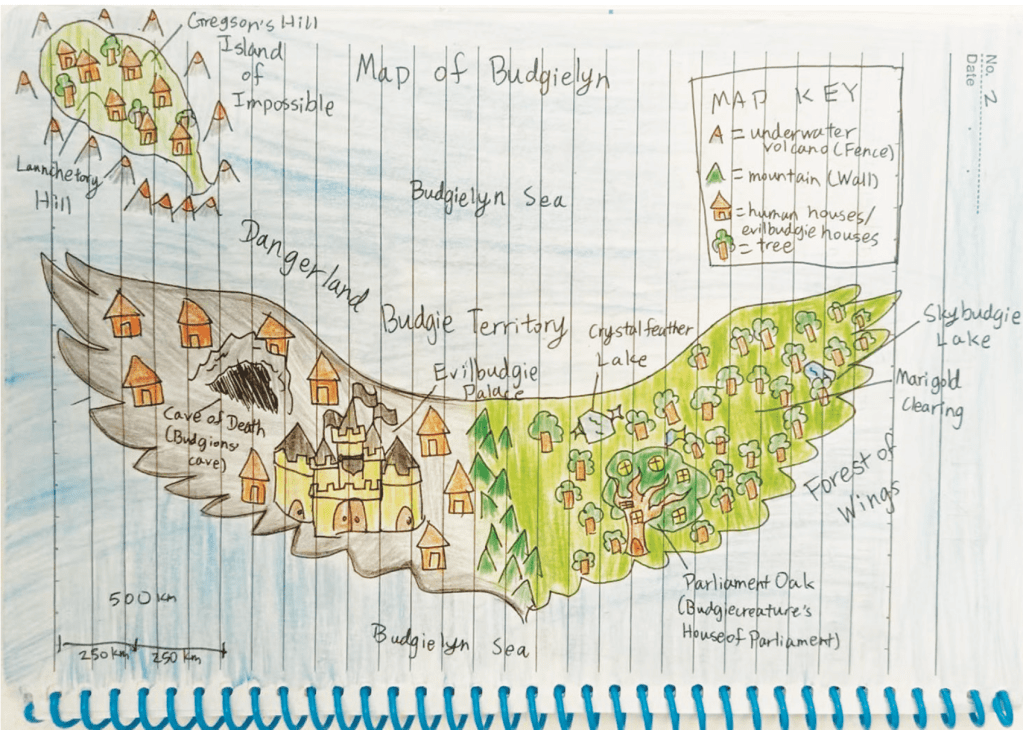
For example, as part of learning how to write fantasy, Alyssa, a fifth grader, created the intricate imaginary world of Budgielyn. Alyssa populated Budgielyn with all sorts of “budgie creatures,” such as budgie fairies and budgiecorns, as well as a variety of evil budgie creatures. (To create Budgielyn, Alyssa drew upon her deep love of her pet budgies as inspiration). 

Having built her Budgielyn world, Alyssa wrote “Grace’s Journey,” a story of a brave and plucky girl who goes on a dangerous quest to fight evil and bring balance to Budgielyn. As she makes her world a better place, Grace develops new confidence in herself – and helps readers imagine they could do the same. Throughout the story, readers encounter the fantastical magical creatures and wondrous settings that sprung from Alyssa’s imagination as she created her fantasy world. 

Photo used with permission.

As part of the research for Teaching Fantasy Writing, I studied the ways that experienced fantasy writers created imaginary worlds, and adapted their strategies for children in primary, upper elementary and middle school grades.  

In the upper grades, we can teach students a multi-step process for creating fantasy worlds. Students will enjoy—even love—this aspect of fantasy writing, since it invites them to use their imagination in exciting, creative ways. The best way for teachers to teach these steps is for them to first go through the steps themselves, and then show their work to students as a model:

  • First, have students sketch a physical world — which can be an island, a coastal area, a large landform, or (if the student wants to write science fiction) a planet, including  geographical features such as forests, mountains, lakes, rivers, deserts, etc.
  • Next, have students populate the world with beings and creatures, as well as the towns, castles, caves, and forts where they live. The sky is the limit here—students can choose humans, witches and wizards, elves, unicorns, fairies, dragons, aliens – any kind of fantasy characters!
  • Then have students do some writing about the “magic system” of the world. What magical powers will the beings and creatures in the world have? Which latent powers can they develop, and under what conditions?
  • It’s also important for students to do some writing about how the different groups of beings and creatures in their fantasy worlds get along. Is one group in power, or trying to gain power? Which groups are in conflict? Which groups are allied with each other, or work together?  
  • Finally, have students create a main character from one of the groups of beings and creatures. This character will be the protagonist of the story they will tell. Also have students create a secondary character. As the main character meets the central challenge of the story, the secondary character will function as their ally or obstacle, their sidekick or their nemesis. 

After students have completed their worldplay – a process they will love, and one that will boost their writing skills and their imaginations — it’s time for them to write stories set in their fantasy worlds. As they write, teachers show them mentor texts to teach them about the craft techniques experienced fantasy writers use, techniques students then try out in their own stories.

In the primary grades, I’ve learned that young children, rather than engage in worldplay as a separate step prior to writing their fantasy stories, do both at the same time. Since their composing process usually includes a combination of drawing illustrations and writing text, they create their imaginary worlds as they draw their illustrations. To help them with this process, we can teach them to ask these questions before they start writing a story:

  • First, what kind of fantasy story do you want to write? A fairy tale? A science fiction story? A magical adventure story (like Maurice Sendak’s Where the Wild Things Are)? 
  • What kind of setting is usually in the kind of story you want to write (a castle in a fairy tale, outer space in a science fiction story, etc.)?
  • What kind of beings and creatures are usually in this kind of story (a royal family and their attendants, and dragons in fairy tales; humans and magical creatures in a magical adventure story; etc.)

How will children have the knowledge of fantasy stories necessary to navigate the steps of worldbuilding? While some already have an extensive knowledge of fantasy, developed through read-alouds at home, their own independent reading, and/or by watching TV shows and movies, some aren’t as familiar with fantasy. As teachers, we can help all students learn about the genres of fantasy and their characteristics by immersing them in a variety of subgenres – such as fairy tales and science fiction – at the beginning of the unit. (In the book, I provide recommended lists of fantasy mentor texts for fantasy units for grades K-1, 2-3 and 4-6.)

Over the past several years, in fantasy writing residencies in K-8 classrooms all over the United States, I’ve taught lessons on how to create imaginary worlds and craft fantasy stories, both in whole and small-group lessons, and in 1:1 writing conferences. The students I’ve had the privilege of teaching have shown higher levels of excitement and engagement than I have seen in many years. These young writers have flabbergasted me and their teachers with their creativity and narrative writing skill. 

So, how do we solve the creativity crisis plaguing our children, and diminishing their prospects for the future?  Including fantasy in our writing curriculums is one of the answers! 

WORKS CITED

Bronson, Po and Ashley Merryman.  “The Creativity Crisis.”  Newsweek, July 10, 2010.

Einstein, Albert. 1929. Quoted in, “What Life Means to Einstein: An Interview by George Sylvester Viereck.” The Saturday Evening Post, October 26, 1929, p. 117.

Gopnik, Alison. “Imaginary Worlds of Childhood.”  The Wall Street Journal. September 20, 2018.

Kim, Kyung Hee.  2016. The Creativity Challenge:  How We Can Recapture American Innovation. Amherst, New York: Prometheus Books.

Livingston, Michael. 2022. Origins of the Wheel of Time: The Legends and Mythologies that Inspired Robert Jordan. New York: Tor.

Patterson, Katherine. 1977. Bridge to Terebithia. New York: HarperCollins.

Pugh, Tison. 2020. Harry Potter and Beyond. Columbia: University of South Carolina Press.

Robinson, K. (2006). Do schools kill creativity? [Video]. TED. https://www.ted.com/talks/sir_ ken_robinson_do_schools_kill_creativity?language=en

Root-Bernstein, Michele. 2009. “Imaginary Worldplay as an Indicator of Creative Giftedness.”  Chapter 29 in International Handbook on Giftedness, edited by L.V. Shavinina.  New York: Springer.

Sendak, Maurice. 1963. Where the Wild Things Are. New York, NY: HarperCollins.

Straus, Valerie.  2019. “Should we worry that American children are becoming less creative?”  The Washington Post, December 9, 2019.

Taylor, Marjorie, and Candice M. Mottweiler, Naomi R. Aguiar, Emilee R. Naylor, and Jacob G. Levernier.  2018. “Paracosms: The Imaginary Worlds of Middle Childhood.”  Child Development, Volume 91, Issue 1, pp. e164 – e178.

Wagner, Tony. 2012. Creating Innovators: The Making of Young People Who Will Change the World. New York: Scribner.

_____. 2008.  The Global Achievement Gap. New York: Basic Books.

Carl Anderson is an internationally recognized expert in writing instruction for grades K-8, and consults for schools and districts around the world. A regular presenter at national and international conferences, Carl is the author of many professional books for educators, including Teaching Fantasy Writing: Lessons that Inspire Student Engagement and Creativity and How to Become a Better Writing Teacher (with Matt Glover). Carl began his career in education as an elementary and middle school teacher. And since Carl was a boy, he has loved visiting fantasy worlds in epic fantasy novels and movies.

Building Novel Connections: How to Center Book Clubs in Today’s Literacy Classrooms

By Dr. Sarah Valter

Almost two years ago, another mom from my children’s school posted a simple question on Facebook: “Thinking about starting a book club. Anyone interested?”

It took approximately two seconds for me to reply with a (likely overeager) “ME!” And I wasn’t alone. By the next day, almost a dozen of us moms–most of us merely acquaintances who gave a polite nod to each other at school parties and social events–were on board. And thus, a book club was born. Since then, our little group has bonded over books about amazing women in historical fiction, unreliable narrators in suspense novels, and too-good-to-be-true love stories.

Why were we all so drawn to be in a book club together?

It wasn’t because we needed a push to read; each of us is a bookworm with a strong reading identity.


It wasn’t because we wanted to write about a book; we each have our own style of recording and reflecting on our reading.

And it wasn’t because we needed an excuse to gather; we all have friendships and social lives both in and out of this group.

It was because a book club was a space for us to grow together through our shared experiences with books. We could explore characters and relationships and the truths that run through our real lives and are reflected in the books we share.

As a former fourth- and fifth-grade teacher, then instructional coach, and now a literacy coordinator, I’ve been watching students navigate their way through book clubs for years. It’s often messy and unpredictable. It rarely goes well the first time (or even the second or the third). Some students struggle to keep up, while others have a difficult time not reading ahead for spoilers. 

As I’ve seen an increase over the past few years in resources that teach reading skills through shorter excerpts of books, it’s affirmed my belief that it’s more important than ever for kids to have the opportunity to meet, discuss, and learn in book clubs. Like adults, kids thrive on the connections that are built through books. 

It’s also critically important that we set students up for success. With limited time, a significant amount of material and standards to teach, and kids with a broad spectrum of needs, it’s essential to set students up with the skills and conditions for successful book clubs. To do that, we need to be clear and intentional in several areas:

  • Focus on what kids need to practice. Our days are filled with opportunities for students to refine their comprehension skills, write about reading, decode multisyllabic words, and learn new vocabulary. These are all certainly things kids can do–in small doses–in book clubs, but what is the true purpose of book clubs? When we set kids up to read and discuss a text, we are extending an invitation for them to construct knowledge in the most social of ways. We want them to come to the table with one idea about a character or plot twist and walk away with a deeper understanding or a shift in their thinking. Book clubs are the place for kids to practice talking about books in ways that push their thinking and engage them in healthy and respectful discourse with peers. All other skills should be secondary to this focus.
  • Teach conversational skills. We don’t expect kids to be natural writers or readers. Similarly, though we know they know how to talk and usually have plenty to say, they often haven’t ever been taught how to have the type of conversation that takes place at the level of a book club. They have to know how to share ideas, support them with evidence from the text, listen to one another, take turns, clarify their thinking, and be willing to shift their ideas and be open to new ones. All of these are skills we can teach through modeling, coaching, and using guided practice during whole group read alouds so that kids are ready to engage in thoughtful conversations during book clubs. These skills do take practice; we also need to remind ourselves to have realistic expectations and to slowly build them over time.
  • Keep it moving. Novels aren’t meant to take two months to read. Often, we slow down the pace of a book in the hopes that all students can “keep up,” but what actually happens is that we neglect to build a sense of excitement and urgency around the novel. While being mindful of the diverse needs of kids in our classrooms and the limited amount of in-class reading time we can provide, we need to set up a schedule of discussions that moves kids in and out of novels within the span of a few weeks.
  • Consider alternatives to clubs centered around one book. In Breathing New Life into Book Clubs (2019), Sonja Cherry-Paul and Dana Johansen lay out several types of book clubs that differ from the norm, pushing teachers to think about grouping kids by genre, author, historical event, identity, goal, or even podcast. Not only have these ideas pushed me to think about grouping kids differently, but they emphasize the ways in which book clubs encourage readers to make connections that are centered around much more than events in one book.
  • Seek opportunities for choice. Many times book clubs are established based on student reading abilities, the number of copies of a book that are available, or a system of voting. While the parameters of clubs are always up to teacher discretion, it is definitely worth it to loosen the reins and be very open to student ideas and choices. Giving kids the opportunity to practice selecting a book and a group will once more position them with the power to drive their own reading decisions.
  • Make it authentic. I have seen and–I will admit–even created many book club “packets” over the years. Why? My decisions were rooted in the need for grades and accountability. However, if anyone were to tell me that I couldn’t attend my adult book club without 3 questions and a summary written down, I would quickly abandon the idea of being part of the group. To stay true to the spirit of a book club, the work (and play) should be focused around talk and sharing ideas. When students have to complete paperwork as an admission ticket to even be part of the club, something natural and authentic is lost. Instead, try having students jot down a few ideas for things they might talk about before they meet, then follow up with a few ideas or new thinking when their conversation has ended. This will allow them to capture their ideas (and share some of their thinking with you) in a way that is not just another task.

Book clubs are, at their very core, a chance for us to hook kids on the social power of books. They bring reading to life in a new way and show our youngest reader that not all readers think and feel the same way about a book. In a time where programs are continually forcing classroom instruction to focus on short excerpts of text and conversational skills are often lost through a screen, what could be more important than allowing kids to connect through a rich conversation about a good book?

References and Recommended Reads:

Cherry-Paul, S. & Johansen, D. (2019) Breathing new life into book clubs: A practical guide for teachers. Portsmouth, NH: Heinemann.

Kugler, S. (2023). Better book clubs: Deepening comprehension and elevating conversation. Portsmouth, NH: Stenhouse Publishers.

Sarah Valter is the district Literacy Coordinator for Lindbergh Schools in St. Louis, MO. In her two decades in education, Sarah has taught in the primary and intermediate grades, mentored new teachers, coached at the building and district levels, and led professional development in literacy. She is also an adjunct instructor at St. Louis University, working with undergraduate and graduate students. Sarah is a wife and mother, spending most evenings driving from practice to practice and weekends cheering in audiences or on the sidelines. You can follow Sarah on X at @LitCoachValter.She believes strongly that all children and adults should not only have the skills to read and write, but also the motivation to live as lifelong readers and writers.