Purposeful Read-Alouds to Build Comprehension

By Katie Kelly, 2026 CCIRA Featured Speaker

With the increased attention on phonics instruction, we cannot overlook the essential purpose of reading as construction of meaning. Comprehension and critical thinking skills must be prioritized alongside foundational skills such as phonics, while also honoring and centering students’ cultural and linguistic backgrounds (Compton-Lilly et al., 2023; Duke et al., 2021). Expanding beyond narrow ideas of reading instruction to include more robust and comprehensive approaches increases students’ comprehension, engagement, and joy when reading.

Purposeful Read-Alouds

Purposeful daily teacher read-alouds serve as an easy and effective approach to supporting key aspects of reading development and engagement. Read-alouds enhance language comprehension by building students’ background knowledge, academic vocabulary, and understanding of sentence structure—key aspects that contribute to overall reading comprehension. In addition, read-alouds provide opportunities for adults to model bridging processes such as fluent reading, self-regulation, and strategic thinking (Duke & Cartwright, 2021). By modeling their own think aloud processes before, during, and after reading, adults can demonstrate how proficient readers monitor comprehension, ask questions, and make meaning from text. Thus, read-alouds not only strengthen essential language comprehension skills but also promote the cognitive and metacognitive habits necessary for independent, joyful reading.  

Intentionally Selecting Read-Alouds 

When selecting texts for read alouds, choose books that serve as mirrors, reflecting students’ identities, interests, and cultures allowing children to see themselves reflected, affirming their identities, making them feel valued, and increasing their interest in reading. It’s also important to select books offering windows into different stories, experiences, and perspectives to expand children’s worldviews (Bishop, 1990). When read-alouds intentionally represent a range of experiences and perspectives, children develop cultural awareness, a sense of belonging, empathy, and a deeper sense of shared humanity. 

Consider:

  • How does the book reflect students’ identities, cultures, and interests? 
  • Does it challenge stereotypes and move beyond single stories?
  • Is the text authentic and accurate? 
  • Could the text cause harm? If so, for whom? 

Secondly, it’s important to consider instructional entry points for read-alouds. Choose texts with rich language, complex themes, and opportunities for critical thinking and discussion. Explore standard alignment and students’ academic and social-emotional needs.

Consider:

  • What do I want students to think about, question, or take away?
  • How will this text connect with standards and help build background knowledge and vocabulary?  
  • What potential challenges may impede students’ understanding? 
  • Where can I pause to model comprehension strategies (e.g. connections, summary, inferences, asking questions, etc.)? 
  • What other texts can be layered to deepen understanding? 

Plan ahead for unfamiliar vocabulary, abstract concepts, or cultural references. Identify moments in the text to pause and clarify ideas, build background knowledge, and invite discussion. These instructional entry points create opportunities to deepen students’ comprehension, engage in discussion, and nurture classroom community. 

Book List Resources: 


Read-Aloud Using the Multiple Read Framework 

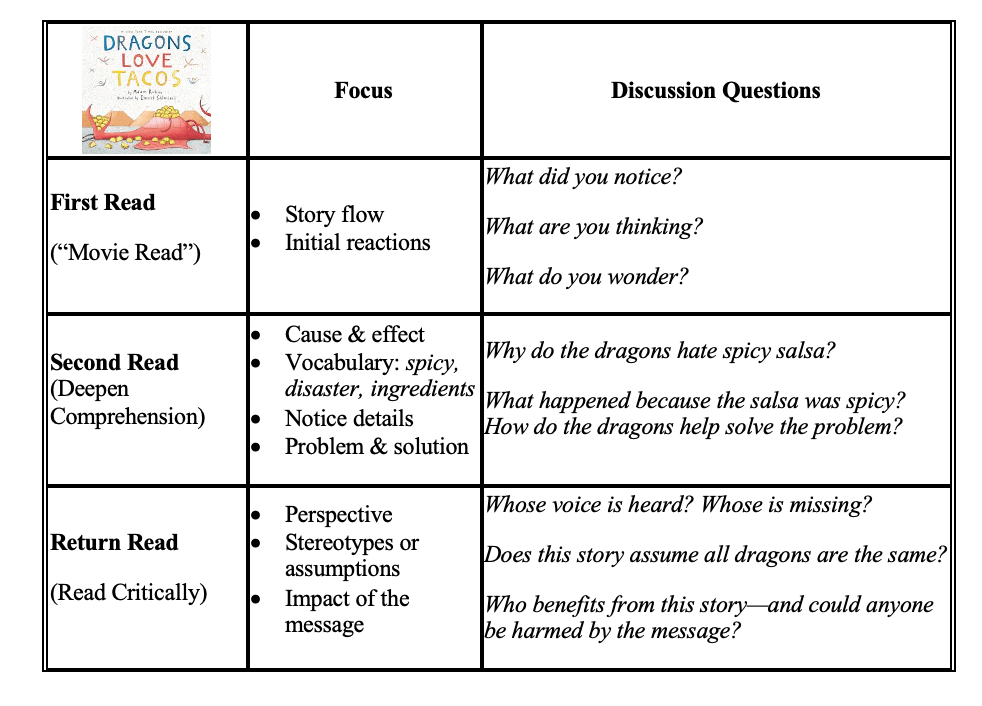
To support deeper, critical comprehension during read-alouds, engage students in multiple readings of the same text. The first read introduces the text, the second builds shared understanding, and the return read promotes critical comprehension (Kelly et al., 2023).

First Read – The “Movie Read”
Read the book in its entirety without interruption, allowing students to enjoy the story and react emotionally. Ask open-ended questions like “What did you notice?” or “What surprised you?” to build familiarity and set the foundation for deeper engagement.

Second Read – Deepen Comprehension
Revisit the text to explore vocabulary, concepts, character motivations, plot development, and key ideas to build comprehension. Model proficient reader strategies through think alouds (e.g. connect, infer, ask questions, etc.). 

Return Read – Read Critically
Analyze the text to examine perspective, power, and bias. Encourage students to question the text, challenge stereotypes, and consider alternate viewpoints. 

Sample critical questions include:

  • Whose voice is heard? Whose is missing?
  • What assumptions does this story make?
  • How might a different character tell this story?
  • Who benefits from the message of this text—and who might be harmed?

Tip: If pressed for time to reread the entire book for the second and return reads, revisit intentionally selected excerpts of the text based on instructional goals.

Sample Multiple Read Framework: Dragons Love Tacos by Rubin

This story helps readers understand how paying attention to details matters—even small ones like what kind of salsa is served. It also shows how trying to do something kind (like throwing a party) can have unexpected results when you’re not careful.

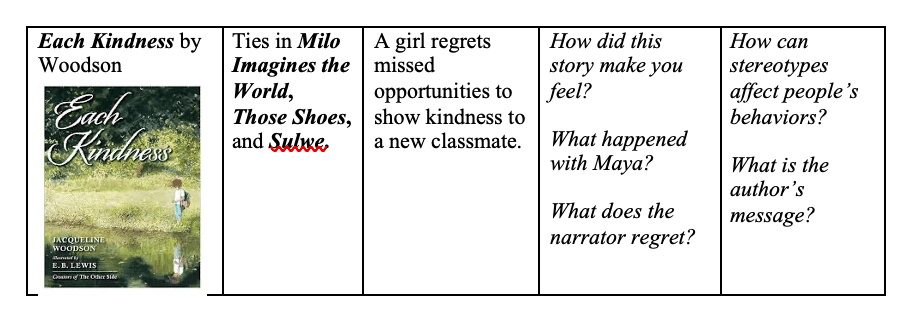
Next compare with the dragon in the The Paper Bag Princess by Munsch, then explore lessons comparing the main character, Elizabeth with female characters in traditional fairy tales. The following text set demonstrates how to build on ideas and perspectives introduced in each subsequent book. 

Text Set Connections & Extensions:

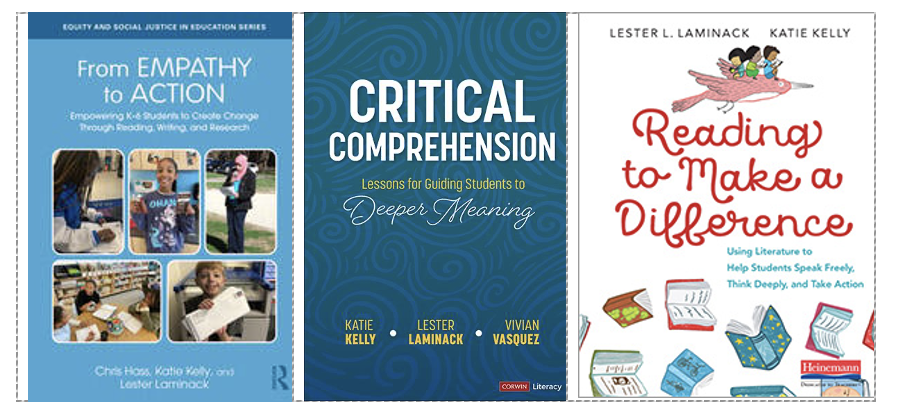
For more sample lessons using the multiple read framework, see Critical Comprehension: Lessons for Guiding Students to Deeper Meaning

Read-Aloud as Transformation 

In today’s classrooms—especially amid rising book bans and cultural erasure—it is essential to use read-alouds to center students’ voices, celebrate diverse stories, and encourage critical comprehension. Through intentional planning and repeated engagement with thoughtfully selected read-alouds, students develop not only as better readers but more empathetic, informed, and justice-oriented citizens. 

Reflect: 

  • How will you bring more purpose to your read-alouds? 

For more, check out Katie’s co-authored books including her newest book From Empathy to Action: Empowering K–6 Students to Create Change Through Reading, Writing, and Research. She can be contacted at ktkelly24@gmail.com

References

Bishop, R. S. (1990). Mirrors, windows, and sliding glass doors. Perspectives: Choosing and Using Books for the Classroom, 6(3), ix–xi.

Compton-Lilly, C., Spence, L. K., Thomas, P. L., & Decker, S. L. (2023). Stories grounded in decades of research: What we truly know about the teaching of reading. The Reading Teacher, 77(3), 392–400.

Duke, N., Ward, A.E., Pearson, P.D. (2021). The Science of Reading Comprehension Instruction. The Reading Teacher, 74(6), 663-672.

Duke, N. K., & Cartwright, K. B. (2021). The science of reading progresses: Communicating advances beyond the simple view of reading. Reading Research Quarterly, 56(1), 25–44.

Hass, C., Kelly, K., & Laminack, L. (2026). From Empathy to Action: Empowering K–6 Students to Create Change Through Reading, Writing, and Research. Routledge.

Kelly, K., Laminack, L., & Vasquez, V. (2023). Critical Comprehension: Lessons for Guiding Students to Deeper Meaning. Corwin.

Laminack, L. & Kelly, K. (2019). Reading to Make a Difference: Using Literature to Help Children Think Deeply, Speak Freely, and Take Action. Heinemann. 


In Honor of Karen Hartman

In September, we lost Karen Hartman, a fierce advocate for Colorado teachers. Throughout her years at Thornton High School, in the secondary section at NCTE, as director of the Colorado Writing Project, and co-director of The Colorado Language Arts Society, Karen never gave up. Here, four friends pause to pay tribute. We all gathered at CCIRA with Karen regularly over the years, and hope this post will remind you of the power of teaching communities. We hope to see you this February in Denver. 

No recipes

by Penny Kittle

Karen and I stayed up late eating her layered carrot cake at her dining room table after the fall CLAS conference in 2023. What makes this frosting, rich and creamy, yet light? I asked. She snickered. Karen didn’t believe in recipes, only in cooks, in instinct, in practice. You cannot replicate someone else’s good work; you must learn to calibrate on your own. Watch the pots that boil. Add salt. If your baking didn’t produce what you’d hoped, adjust. You are better off examining your own moves than criticizing or blaming the raw materials. Sit beside a student and listen, nudge, support. Celebrate their creations. I will miss those conversations, her blue eyes centered on me, her easy laugh, her love of a good story. I will miss her stacks and stacks of books and her joy in sharing them. 

Karen had left her high school classroom when I met her; she was a teacher of teachers where she remained for decades. Karen helped me persist in writing through joy and challenge. Nothing is harder, she said, than composing your ideas, your stories, and your hopes. She wrote with teachers at every meeting, every conference, every opportunity. We both echoed Don Graves, You have stories to tell that no one can tell  but you. Once teachers realize how important those stories are to them, Karen believed, they’ll put time to write in every lesson plan. (You say you don’t have time? Some new bloated textbook adoption in your district tells you this? Karen would have a response for that and it might have exceeded her self-imposed 5-f*cks-a-day rule.) Karen knew the emptiness of teaching that centers curriculum instead of students. She had zero patience for anyone who dictated the moves of teachers in our complex work. And she’d tell you: blue eyes sparking, searching, fierce and kind at once.

Karen believed in CCIRA. Teaching can be isolating work. We need each other. Conferences put teachers in conversation, and this one in particular, has always centered teacher research and experience. Quality ingredients are essential in cooking well, and a conference composed of authenticity, spontaneity, gatherings at coffee stands and in small sessions to explore and think are key to community. CCIRA cooks. They invite speakers to remind us how large and diverse this work is—spread across countries and generations and innovations. We gather. We learn together. CCIRA simultaneously affirms our instincts about learning as it challenges them. I leave inspired every time. 

I know this: Karen Hartman’s love for teachers and their students will reverberate in my life always. I raise a glass to my friend; I raise it high. May we all live our lives with such courage, kindness, and generosity.

A Cherished Friend 

By Stevi Quate

Karen was my cherished friend and feisty colleague. Without her by my side, my writing – personal and professional – wouldn’t have been the same. The flights to conferences and evenings after the sessions wouldn’t have been the same. And the professional literature we studied together wouldn’t have had the same impact. She nudged me and others to do what was best for students and not to take short cuts, and when she saw practices that disengaged students, she spoke out. Her impact on me and on educators around the globe was robust.

Dave Wendelin, former CLAS President and Director for the National English Honor Society for Secondary Schools (http://www.nehs.us/), recognized the impact Karen had on, literally, thousands of educators: 

I doubt there has been a more dedicated teacher and student advocate than Karen Hartman. Strong in opinion and visionary, Karen has unpacked the work of thousands of educators across the country…She had little patience for any barriers that might limit the independent decision-making of teachers as they nurtured their students.

Along with teaching at the University of Colorado at Denver, presenting at numerous conferences including CCIRA, editing CLAS’ journal Statement and serving as English Department Chair at Thornton High School, Karen poured her energy into keeping Colorado Writing Project* fresh and relevant.  As the director for more than a quarter of a century, she mentored and modeled and encouraged – and fed us her famous chocolate chip cookies. 

A common theme from teachers in the summer workshops was gratitude. Here’s what Hayley, a teacher in one of her projects, said about Karen: 

I wanted to thank you for opening my eyes to a new and better way of teaching writing. With only two years of teaching under my belt, I am always looking for the best practices; however, no staff development or PLC has come close to the type of life-changing experience this has been. Thank you.

It wasn’t just new teachers who expressed their gratitude. For instance, Alice wrote:

Your mom was one of my most memorable professors in grad school and was a wonderful mentor to me for many years after. She got me involved and taught me what it meant to be a professional educator. Even now, 23 years into the profession, I draw upon all she taught me. Her legacy is a great one.

It wasn’t just Colorado educators who were impacted by her vision. Back in the early 90s, CCIRA invited several teachers from South Africa to the conference. After attending one of Karen’s sessions, they wanted to learn more, so Karen invited them to attend one of CWP’s two-week workshops.  Not only did Karen sponsor their visit, but she also housed and fed them and made them feel at home. At the end of the two weeks, those educators wanted to share the CWP experience with their colleagues back in the very poor township outside of Dundee, South Africa. So the next summer, Sheila Kaehny and I joined Karen for this adventure.

During those two weeks, we learned side by side with the teachers. Mornings would begin with gathering together in a large circle. Someone would begin a song and eventually everyone joined in. Often a few teachers would move into the circle center dancing to the impromptu singing. For the rest of the day, the writing project looked like what we did back in Colorado: teachers would study professional literature about teaching writing and write themselves. From the participants’ writing, Karen learned that one teacher needed to increase the number of cows he owned before we could woo his future wife. Karen weaved his story into a personal narrative that she shared back in Colorado, causing insight into a different culture. 

Just recently one of South African educators called Karen her “global mama” and mourned her loss:  

So sad to hear the news about the passing away of our dearest friend and mother, grandmother from ashore. May her spirit live long for generations to come. Karen will be dearly missed around the globe.

My cherished friend and feisty colleague created a legacy to be celebrated and will, indeed, be missed.

*To get an idea about CWP, watch this video (https://www.youtube.com/watch?v=8xFHjPm0qYI) made by one of the teachers who studied with her.

Going Online 

By Sarah Zerwin

On a series of sunny June days in 2020, I sat on my back deck with my Google Classroom screen shared with Karen via video chat. We worked together for hours to transition the Colorado Writing Project curriculum from a two-week in-person workshop to a four-week online experience with both synchronous and asynchronous elements. Like everything else in education during that time, CWP had to pivot on a dime from what it had always been to something we had never imagined it would need to be. But Karen was determined—determined to offer a meaningful experience for teachers, regardless of the restrictions and challenges imposed by the pandemic. 

And that was Karen. Determined to offer a meaningful professional development experience to teachers. For many summers, that’s exactly what she did with the Colorado Writing Project, for teachers all across Colorado (and then for teachers across the country once we had the online curriculum built out!). As CWP director for many years, Karen was keeper of the grail—the CWP curriculum. When I came on board around 2010 and found myself at Karen’s dining room table with the other teacher consultants during the annual spring retreat, I was amazed to learn that the curriculum document in the binder in front of me was about three decades old, built and revised by literal legends of the Colorado English Language Arts world. I didn’t feel worthy. 

Fueled by Karen’s chocolate chip cookies, bottomless bowls of chocolate, and both a breakfast and lunch buffet, we made our way through each day of the two week curriculum, updating as needed to adjust to the evolving needs of teaching writing. I worked madly to upload the intricately-woven document onto my brain, amazed to see the inner workings of the most meaningful professional learning experience I had ever done myself as a CWP participant. Would I ever be able to actually bring this curriculum document to life and honor the legacy it represented? 

But Karen’s confidence in me made it all possible. Karen saw capabilities in me that I didn’t see. Her encouragement and support are a huge reason I was able to persist through several years trying to get to what eventually became my first book for teachers. In every opportunity I have, I channel Karen’s dedication to serving up professional learning experiences that challenge teachers, honor them as professionals, and care for them as human beings. In every moment planning for what happens in my classroom, I channel Karen’s dedication to pedagogy that challenges my students, honors them as readers and writers, and cares for them as human beings. 

See it was all so clear to Karen. 

Karen put in the work because it mattered for teachers and their students and the authenticity of their experiences in the classroom. That was it. That was all. And that is everything. 

An Unsent Letter to My Mentor By Sheila Kaehny

Dear Karen,

I remember a chilly April morning at the Teen Lit Conference when we met at the Tivoli before our traditional “What’s New In Young Adult Lit” presentation. You were at a table in the back, with a thick stack of handouts (yellow for you, green for me) and your red tote bag filled with thick hardovers decorated with sticky notes marking passages for read-aloud. 

I remember your smile, your Diet Coke with lime, your etched silver earrings and matching necklace, and your perfect pink fingernails.  

You were always excited to present our new YA titles, to share books to get kids reading. In your earnest “this is what’s best for kids” voice, booktalking was your gift.  You were a natural teacher, and it came through in your carefully crafted presentations.  I saw it in your writing conferences with kids and adults and when you listened and coached, helping people find answers.  You loved it all.  Both teaching and teachers annoyed you every once in a while, too, but you loved it (and all of us) just the same.

You presented at CCIRA every year. In your world, continuous improvement was teachers gathering together at conferences like the Fall Writing and CLAS for professional development.  Do you remember how cranky I was about giving up my Saturday morning soccer to participate in a weekend conference?  “Sheila, dear,” you said to me, “you can play soccer next weekend. You need this right now.” And you were right.  No matter how exhausted I was after a long weekend of learning, I left each conference energized, buzzing with ideas. 

Because of you and all those years of CWP summer writing workshops, hundreds of teachers across Colorado set aside worksheets and five paragraph essays and replaced them with authentic, meaningful instruction.  

No one has had a greater impact on my life as a teacher than you, Karen. You picked me as your student teacher; you hired me at Thornton High School. I am grateful you kept me afloat with all those late night phone calls and words of encouragement whenever I lost faith in teaching.  You were my steadying force.  I wanted to be like you.  You eventually roped me into being your Program Chair for CLAS (multiple times), and you made me a consultant for CWP.  I loved teaching and going on safari with you in South Africa. 

And now, I know you’d like me to pay it forward, and you’d like for us all to speak up a little bit more. You’d want veteran teachers to encourage young teachers to give a little time outside of school to their professional learning, to engage in the community, and to find the joy in teaching.

You had so many more books to read and writer’s notebooks to fill, Karen. So much more advice to give and criticisms of the current state of the world to post on Facebook.  Your shoes are too big to fill.  You wanted to make everyone’s life better through reading and writing and teaching, and I believed you could do it.  Heck, I watched you do it.

Oh, how I miss you, my friend.

Love from your other daughter, Sheila

Digging Deeper with Sentence Level Instruction: Teaching the Reading and Writing Connection

 By: Aimee Buckner Haisten, 2026 CCIRA Featured Presenter

At the start of every school year, I felt both excitement and exhaustion. Those first weeks are filled with routines, resetting expectations, and getting a classroom community up and running again. Yet, they’re also invigorating—the chance to begin anew with fresh ideas, renewed energy, and a rekindled passion for teaching. As educators, we’re fortunate to have this cycle of continual reflection and growth embedded in our profession.

In recent years, I’ve applied this same mindset to my own practice, especially in teaching writing. I returned to the role of learner—reading research, exploring new perspectives, and reconnecting with core principles that help students develop their voice and clarity as writers. While I once focused on using notebooks to nurture student identities and launch writing projects (Stenhouse Publishers, 2005, 2009, 2013), my latest fascination has centered around the power of the sentence.

A sentence, after all, holds remarkable capacity. It can reveal a theme, capture a writer’s complex idea, or unlock deeper understanding for the reader. The research is clear – spending time on sentence level instruction – analysis and construction-is key to developing students’ writing skills (Anderson & LaRocca, 2017; Collins & Norris, 2017; Graham, 2020;  Graham & Alves, 2021; Graham & Harris 2015; Hochman & Wexler, 2017; Sedita, 2023). By embracing the reciprocity between reading and writing—studying how syntax and semantics shape meaning—we can help students see sentences not as isolated grammar drills but as dynamic building blocks of language.

Too often, reading and writing are taught in silos, separated by subject blocks, test preparation, or curriculum pacing. This disconnect can obscure how closely these skills inform and strengthen each other. When we instead highlight their interconnectedness, we unlock more meaningful learning opportunities.

To bridge this gap, I’ve begun using a simple classroom routine – Sentence Digs – inspired by Anderson and La Rocca’s (2017) and Charles and Lily Fillmore’s work (2012). It follows a three-step process—Take Apart, Put Together, Apply—and it encourages students to engage deeply with language. They analyze sentence structure, explore its function and meaning, and reflect on the writer’s choices, all while remaining anchored in the texts they’re already studying.

This routine doesn’t rely on complicated materials or elaborate planning. Its power lies in the questions it prompts and the clarity it brings. Students not only gain insight into how sentences communicate meaning—they also learn how to craft their own with intention and precision. Rich, well-constructed sentences are gold mines for both readers and writers. And when we treat them as such, we give our students tools not just to comprehend the world around them, but to express their own complex ideas within it.

For example, you might be studying inventors in social studies or electricity in science and find yourself reading Bright Dreams: The Brilliant Ideas of Nikola Tesla by Tracey Dockray (2020). A sentence dig lesson might look like this: 

Focus: Understanding the impact of a cause/effect sentence.

            Using conjunctions to create cause/effect sentences.

Showcase Sentence: Nikola and Westinghouse were chosen | to illuminate the Chicago’s World Fair | since their AC cost much less | than Edison’s DC.

Ask: In this sentence, the author uses abbreviations that they expect the reader to know. In the context of electricity, what does AC and DC mean? AC refers to alternating current and DC refers to direct current; they both indicate how electricity is flowing through a current. 

If you prefer, you can organize your chunks on sentence strips. Move them around to help students focus on one chunk and then another. You’ll move them back together later.

Apply

During this part, students quickly apply their new knowledge about the sentence to their reading and writing. These are quick efforts and may be followed up with more practice. 

Discuss: Aside from earning money for illuminating the Chicago’s World Fair, why is this a significant event in Tesla’s life?
Writing Focus: Try writing your own sentence with a cause/effect sentence structure. Use the showcase sentence as your model. If you want to engage your students in sentence combining work to build cause/effect sentences, consider using or adapting this Think Sheet.

In my new book, Sentence Digs and during my conference sessions, we’ll dig into rich, well-constructed sentences exploring the routine to support comprehension and better writing.  My hope is that every reader and writer, speaker and listener, student and teacher feel confident in their ability to understand and use language in a way that helps them to connect with sentences, texts, each other, and the world. 

The unavoidable fact is that our school days are long but our teaching time is short. There is never enough time, so we find ourselves having to prioritize instruction. At a conference recently, a teacher asked me – how important is this work…really? Having short, weekly, explicit routines to teach syntax and semantics of sentences that carry rich meaning will not only support reading comprehension, it will also model for and support students in writing those kinds of sentences. There is gold in this reciprocity. It’s important.

About the Author: 

Aimee Buckner Haisten brings over three decades of experience to the field of education, where she has served as a classroom teacher, instructional coach, literacy specialist, published author, and international consultant. Her work has reached audiences across local, state, national, and international platforms, with a focus on elevating reading and writing instruction. Aimee’s contributions have appeared in several peer-reviewed journals, and she is the author of four acclaimed titles with Stenhouse Publishers. Her forthcoming book, Sentence Digs: Teaching the Reading and Writing Connection Through Syntax and Semantics, is scheduled for release in late 2025.

Aimee Buckner Haisten brings over three decades of experience to the field of education, where she has served as a classroom teacher, instructional coach, literacy specialist, published author, and international consultant. Her work has reached audiences across local, state, national, and international platforms, with a focus on elevating reading and writing instruction. Aimee’s contributions have appeared in several peer-reviewed journals, and she is the author of four acclaimed titles with Stenhouse Publishers. Her forthcoming book, Sentence Digs: Teaching the Reading and Writing Connection Through Syntax and Semantics, is scheduled for release in late 2025. Contact Aimee at aimeebuckner@gmail.com.

True Student Voice: Helping students be better speakers

By Erik Palmer

voice

1. The sound produced in a person’s larynx and uttered through the mouth, as speech or song. https://en.oxforddictionaries.com/definition/voice

    Student voice. What a hot topic! I’ve seen educational conferences with themes such as “Raising Student Voice” (NCTE) and “Speak Up! Finding and Using Our Voices in a Noisy World” (NEATE), social media posts about how to increase student voice, and educational publications with articles about student voice. “Voice” is one of the most popular educational buzz words.

    Unfortunately, every single one of the mentions of student voice ignores the first and most important meaning of voice: speaking. The conference with the theme “Speak Up”? Not one strand about oral communication. The “Raising Student Voice” conference had hundreds of sessions with exactly ONE session about how to improve students’ oral communication. Think about that. What an epic fail.

    When you see the word voice used by educators, it might mean choice or options as in “give students voice instead of directing their learning.” Sometimes it means opinion as in “we need to value student voice and make them feel comfortable expressing their ideas.” Sometimes it means literary style as in “Hemingway has a unique voice in his writing, and we want students to develop their voice as well.” I’m not arguing with any of those: I think we should give students choices, we should value their opinions, and we should let them have their own style. But we should also give them the gift of being able to verbalize well because when you see the word voice used by everyone else on the planet, it means what you hear.

    How can so many people talk about giving students voice without thinking about oral communication? That’s the original and most important voice! How do we declare what we want? How do we express our opinions? Overwhelmingly by speaking. We say things out loud. Often, that speaking is face-to-face, but increasingly digital media is used which expands the reach and importance of verbal communication. Tragically, students don’t speak well. You’ve noticed. Good speaking is not the norm for students. As much as we value writing, speaking is by far the number one way to have an impact.

    “All kids can talk already.” “Speaking is not on the Big Test.” “I have never been trained about how to teach speaking skills.” “I have activities where I make students speak so I have this covered.”

    These are good excuses for ignoring the direct instruction needed to give students real voice. But the truth is, it isn’t that hard to teach students how to speak well. Just as there are specific lessons to improve writing (punctuation, capitalization, word choice, sentence structure…) and to improve math (common denominator, order of operations…) and to improve reading (setting, metaphor, plot line…) there need to be specific lessons to improve speaking.

    I’ll give you one example. The biggest weakness of almost all speakers is that their talks are dull. They speak in a lifeless way. You know that it is difficult to listen to the end of any student podcast. 

    Lesson one: to demonstrate the importance of adding life to their voices, let students practice with phrases where the meaning can change depending on how it is said.

    I don’t think you are dumb. (But everyone else does?)

    I don’t think you are dumb. (You know I am?)

    I don’t think you are dumb. (You think he is?)

    Lesson two: Play this: https://www.youtube.com/watch?v=Ouic59Gv0x0 There is a visual of a voice with no life and a visual of a voice with life along with audio modeling the difference. You may have a hard time getting through the 81 seconds of the student’s talk, a great lesson in how weak speaking skills can kill listener interest.

    Lesson three: Give a small practice speech where adding life makes a huge difference. Have different students speak encouraging each one to add lots of feeling.

    One time, we had a squirrel in our house. When we opened the door to let our dog out, it ran right in. Everything got crazy! The squirrel was running all over! My mom was yelling, “Do something! Do something! Get that thing out of here.” My sister jumped on a chair and stood there crying her eyes out. My dad was chasing the squirrel with a broom from room to room.  “Open all the doors!” he yelled to me. “I did already!” I yelled back. Finally, it ran out. After a minute or so, my dad started laughing. “That was interesting,” he said with a chuckle.

    All three of those combined might take 40 minutes of instructional time, and every student will learn one of the keys to effective speaking. Will all students master this? Of course not, just as not all master the skills of writing or math or drawing or anything. But all will get better, and all will understand how to communicate better. Many more resources are here: pvlegs.com and in this book: www.routledge.com/9781032757575

    Erik Palmer is a professional speaker and educational consultant from Denver, Colorado, whose passion for speaking has been part of every one of his multiple careers. After several years in the business world, he became a teacher, spending 21 years in the classroom, primarily as an English teacher but also as a teacher of math, science, and civics.

    The author of several books, Palmer presents frequently at conferences and has given keynotes and led in-service training in school districts across the United States and around the world. He focuses on giving teachers practical, engaging ways to teach oral communication skills and showing education leaders how to be more effective communicators. Contact him here.

    Boost Student Comprehension Through Intentional Movement

    By Gravity Goldberg, 2026 CCIRA Conference Featured Speaker

    Students spend about fifty percent of their day sitting in chairs (Paul, 2021), yet studies across disciplines have shown that movement increases attention, engagement, memory, prediction, and literal and inferential comprehension. As a field, education has not focused on the research on how intentional movement can be integral in developing comprehension for students of all ages and across contexts. Incorporating movement into lessons can boost memory, lead to more literal comprehension, help with prediction, and support understanding of metaphorical language. 

    Memory In Enhanced Through Movement

    A series of studies found that memory is enhanced through movement. For example, undergraduate students who incorporated movement into their learning remembered sixty-six percent of the material they were studying compared to those who did not incorporate movement and only recalled thirty-seven percent (Noice et al, 2001). In another study, actors were found to remember their lines with ninety percent accuracy even months after a play ended when they learned their lines while they performed the movements that went along with them (Noice et al, 2000). The good news is that once a movement has been performed, students do not need to keep repeating the movement to get the benefit. They don’t need to move around while taking a test for example, and they will still get the support from the previous movement experiences. The original movement creates a mental “tag” that helps the students’ brain hold onto the information as important. 

    When teaching students to incorporate movement into their learning you can help identify what is worth remembering and then show them how to add in movement. The following table shows an example of what this might look like in a classroom. 

    When we want to remember…Look For…Try out…
    Plot points for retellingCharacter actions (verbs)Making the actions the character makes with our own bodies
    Main ideas in informational textBold words, headings, and repeated ideasActing out the information (ex, make your hand slither like a snake)
    Say the main idea while also creating a gesture to go with it (ex. draw a box in the air)
    Details that support ideasExamples, non-examples, lists, and visuals Using your fingers to connect ideas (ex, touch the top of the finger to state the big idea and then move down your finger as you state the details)
    Comparisons Similarities and differences Making a venn diagram with your gestures (ex. Each hand is a different item being compared so raise that hand while you say the information and put your hands together when the information is the same for both)

    Literal Comprehension Is Enhanced By Movement

    In one study of the Moved By Reading approach, researchers asked first and second graders to read a short passage about farm life. Half of the students in the study were given farm toys such as a barn, tractor, and cow. Periodically a light would turn on and students were asked to either reread or act out the story using the toys. After the reading, the group of readers who were asked to act out the story were better able to remember details from the story and make inferences compared to their peers who were only asked to reread. Acting out a story boosted students’ understanding by fifty percent compared to those who simply reread (Glenberg et al, 2004). In similar studies with reading math problems, Glenberg and his colleagues found that acting out the math problem’s story helped students identify information that was important for the solution. 

    In additional studies in the Moved by Reading approach, the researchers removed the toys that were used for acting out the passage. Instead, the group of students was asked to imagine manipulating the toys. They used this phrase “imagine manipulating the toys” because it was directly related to the actual movement the students had previously done and it made the directions clear. Again, students in the group that were asked to imagine the movement made huge gains in comprehension. This held true with third and fourth graders who read new stories, not just the ones they had previously read with the toys in hand (Glenberg et al, 2004). 

    The instructional implications of this approach mean it can be helpful to put out some comprehension manipulatives that students can use when first reading a text. The following table offers some suggestions for what you might offer students. Even secondary students find them helpful when reading more complex texts. 

    ManipulativeHow Students Might Use Them
    play dough Create models, artifacts, and scenes
    Make comparisons of size, shape, and distance of objects created 
    Represent pressure, tension, and experience sensory input that matches relationships
    sticky noteSequence events by using each sticky to represent an event
    Organize information into categories with one piece of information per sticky
    blocksBuild ideas by stacking blocks to represent each idea
    Construct settings that character manipulatives can move within
    popsicle stickKeep track of quantities
    Use them as pointers
    Build bridges between other manipulatives
    paper clipsTrack quantities
    Build connections
    Use them as props when figurines reenact scenes

    Prediction Is Enhanced Through Movement

    We tend to think that a student’s ability to predict what will happen next is based on prior knowledge and the ability to make an inference. This is only part of what is going on. By looking at hockey and football players who are experienced with performing sport specific actions, researchers found that having physical experience performing actions that were later read about increased their comprehension (Beilock, 2015). This means that it is not just general background knowledge that can help students comprehend text but also movement experiences in their bodies. In order for a student to predict what will happen next they need to envision what is currently happening, by running it through their body’s motor system. They are imagining themselves doing the movement and their bodies are experiencing the actions on these pages as if they themselves are performing them. 

    While this benefit of being experienced with the actions in the text is helpful to some, it obviously does not benefit all students, especially those who don’t have the prior experience of performing similar movements. Researchers have also found that observing someone perform actions does have a positive effect on predictions. For example sports fans act out the sport they are watching in their motor system, as if they were one of the players themselves. This was shown to lead to better prediction accuracy of upcoming sports actions (Beilock, 2015). For those students whose bodies are not physically able to make the movements described in the text, they can still observe others perform them and get a benefit of motor system activation and prediction accuracy.

    The following three lesson ideas can be woven into your teaching.

    • Model how to act out a scene. Then think aloud about how you use the acting experience to predict the next action(s). This can be done in small group lessons.
    • Prompt students to act out the character actions and then use that experience to predict the next action(s). This can happen during the whole class read alouds.
    • Prompt students to simulate the actions in their own minds (thus activating their motor system). Then have them mentally simulate what they think the next action will be (prediction). 

    Language Comprehension Is Enhanced Through Movement

    One type of language that many students struggle with understanding is language that draws upon metaphor. Texts include this kind of language so often we may not even have it in our awareness. Take for example, this excerpt from the popular book The Wild Robot Protects, by Peter Brown (2023). 

    “Later, Roz lightened the mood with stories of Brightbill from when he was young. The conversation flowed smoothly until Roz brought up one particular subject” (p. 17). 

    Each of the bolded phrases shows an example of language that includes metaphor that can be tricky for students to understand, especially those who are still learning English. There is nothing literal about lightening the mood or flowing in a conversation, so students who read this benefit from understanding how metaphors work. This is where intentional movement fits in. 

    George Lakoff and Mark Johnson’s book Metaphors We Live By (1981) describes the ways metaphors are almost always tied to physical movement, and therefore, need to be understood in an embodied way. Take for example when we say a person is “flying high” or “down in the dumps.” These metaphors match the physical ways we carry out bodies when we are happy (we stand taller and our back and chest widen) and when we are sad (we slump down). With thousands of examples, they show this phenomenon time and again. Our language of metaphor comes from the ways we hold and move our bodies. 

    Since there are so many metaphors in the texts we ask students to read, they can be better understood through body movements. If we explicitly teach students to make physical movements that match the metaphors they encounter, they begin to develop the ability to interpret what they mean. 

    Let’s go back to the excerpt from The Wild Robot Protects. Students can create movement to match the phrase “lightened the mood” by picking up an imaginary mood and moving it upward like a cloud in the sky. They can make their hands “flow smoothly” along the table to understand flow. Partners can pick something up to show “brought up” and discuss how it felt. The key is intentional movements that take just a few seconds, but create a lasting impact on conceptual understanding. Having done this sort of work with students across grades and contexts, once they understand the process and purpose, they find it fun and helpful. 

    Take a look at the table that follows. It shows how you can choose some common metaphorical language and bring movement in to help teach it. This table is just one example of what it might look like. Ideally, you are also using the language that is naturally coming up in conversations or texts in your own curriculum. 

    A three step process for teaching metaphorical language with movement looks like this.

    1. Pause: Pause when you come to a metaphor.
    2. Move: Move your body to match the metaphor.
    3. Ponder: What feeling is associated with the movement? How does it connect back to the text?

    Movement Enhances Comprehension

    By intentionally choosing to include movement, teachers can support students literal and inferential comprehension. These movements do not need to be separate, add-on lessons and can be attached to what teachers are already doing. As a bonus, adding in movement can boost student engagement and help keep students focused on learning. Many teachers recognize that their students are craving movement to stay regulated, using fidgets, wobble chairs, or just bouncing up and down as they read. By welcoming more movement into class, teachers can harness students’ natural need to move and help them become better readers too. 

    References

    Beilock, S. (2015). How the body knows its mind: The surprising power of the physical environment to influence how you think and feel. Atria Books. New York.

    Brown, P. (2023). The wild robot protects. First edition. New York, Little, Brown and Company.

    Glenberg, A. M., Gutierrez, T., Levin, J. R., Japuntich, S., & Kaschak, M. P. (2004). The Moved by Reading studies . 

    Lakoff, G., & Johnson, M. (1981). Metaphors we live by. University of Chicago Press.

    Noice, H., Noice, T., Kennedy,  C. (2000). Effects of enactment by professional actors at encoding and retrieval. Memory. 353-363.

    Noice, H., & Noice, T. (2001). Learning dialogue with and without movement. Memory & Cognition, 29(6), 820–827. 

    Paul, A.P. (2021). The Extended Mind: The Power of Thinking Outside the Brain. New York, NY: Houghton Mufflin Harcourt.Gravity Goldberg is an international educational consultant and author of eight books on teaching. Mindsets & Moves (Corwin Literacy, 2015) put her on the world stage with its practical ways to cultivate student agency, leading to speaking engagements and foreign translations of her work. She has almost 20 years of teaching experience, including positions as a science teacher, reading specialist, third grade teacher, special educator, literacy coach, staff developer, assistant professor, educational consultant, and yoga teacher. Gravity holds a B.A. and M.Ed. from Boston College and a doctorate in education from Teachers College, Columbia University. She is the founding director of Gravity Goldberg, LLC, a team that provides side-by-side coaching for teachers.

    Gravity Goldberg is an international educational consultant and author of eight books on teaching. Mindsets & Moves (Corwin Literacy, 2015) put her on the world stage with its practical ways to cultivate student agency, leading to speaking engagements and foreign translations of her work. She has almost 20 years of teaching experience, including positions as a science teacher, reading specialist, third grade teacher, special educator, literacy coach, staff developer, assistant professor, educational consultant, and yoga teacher. Gravity holds a B.A. and M.Ed. from Boston College and a doctorate in education from Teachers College, Columbia University. She is the founding director of Gravity Goldberg, LLC, a team that provides side-by-side coaching for teachers. Find her latest book on movement here.