Student voice. What a hot topic! I’ve seen educational conferences with themes such as “Raising Student Voice” (NCTE) and “Speak Up! Finding and Using Our Voices in a Noisy World” (NEATE), social media posts about how to increase student voice, and educational publications with articles about student voice. “Voice” is one of the most popular educational buzz words.
Unfortunately, every single one of the mentions of student voice ignores the first and most important meaning of voice: speaking. The conference with the theme “Speak Up”? Not one strand about oral communication. The “Raising Student Voice” conference had hundreds of sessions with exactly ONE session about how to improve students’ oral communication. Think about that. What an epic fail.
When you see the word voice used by educators, it might mean choice or options as in “give students voice instead of directing their learning.” Sometimes it means opinion as in “we need to value student voice and make them feel comfortable expressing their ideas.” Sometimes it means literary style as in “Hemingway has a unique voice in his writing, and we want students to develop their voice as well.” I’m not arguing with any of those: I think we should give students choices, we should value their opinions, and we should let them have their own style. But we should also give them the gift of being able to verbalize well because when you see the word voice used by everyone else on the planet, it means what you hear.
How can so many people talk about giving students voice without thinking about oral communication? That’s the original and most important voice! How do we declare what we want? How do we express our opinions? Overwhelmingly by speaking. We say things out loud. Often, that speaking is face-to-face, but increasingly digital media is used which expands the reach and importance of verbal communication. Tragically, students don’t speak well. You’ve noticed. Good speaking is not the norm for students. As much as we value writing, speaking is by far the number one way to have an impact.
“All kids can talk already.” “Speaking is not on the Big Test.” “I have never been trained about how to teach speaking skills.” “I have activities where I make students speak so I have this covered.”
These are good excuses for ignoring the direct instruction needed to give students real voice. But the truth is, it isn’t that hard to teach students how to speak well. Just as there are specific lessons to improve writing (punctuation, capitalization, word choice, sentence structure…) and to improve math (common denominator, order of operations…) and to improve reading (setting, metaphor, plot line…) there need to be specific lessons to improve speaking.
I’ll give you one example. The biggest weakness of almost all speakers is that their talks are dull. They speak in a lifeless way. You know that it is difficult to listen to the end of any student podcast.
Lesson one: to demonstrate the importance of adding life to their voices, let students practice with phrases where the meaning can change depending on how it is said.
I don’t think you are dumb. (But everyone else does?)
I don’t think you are dumb. (You know I am?)
I don’t think you are dumb. (You think he is?)
Lesson two: Play this: https://www.youtube.com/watch?v=Ouic59Gv0x0 There is a visual of a voice with no life and a visual of a voice with life along with audio modeling the difference. You may have a hard time getting through the 81 seconds of the student’s talk, a great lesson in how weak speaking skills can kill listener interest.
Lesson three: Give a small practice speech where adding life makes a huge difference. Have different students speak encouraging each one to add lots of feeling.
One time, we had a squirrel in our house. When we opened the door to let our dog out, it ran right in. Everything got crazy! The squirrel was running all over! My mom was yelling, “Do something! Do something! Get that thing out of here.” My sister jumped on a chair and stood there crying her eyes out. My dad was chasing the squirrel with a broom from room to room. “Open all the doors!” he yelled to me. “I did already!” I yelled back. Finally, it ran out. After a minute or so, my dad started laughing. “That was interesting,” he said with a chuckle.
All three of those combined might take 40 minutes of instructional time, and every student will learn one of the keys to effective speaking. Will all students master this? Of course not, just as not all master the skills of writing or math or drawing or anything. But all will get better, and all will understand how to communicate better. Many more resources are here: pvlegs.com and in this book: www.routledge.com/9781032757575
Erik Palmer is a professional speaker and educational consultant from Denver, Colorado, whose passion for speaking has been part of every one of his multiple careers. After several years in the business world, he became a teacher, spending 21 years in the classroom, primarily as an English teacher but also as a teacher of math, science, and civics.
The author of several books, Palmer presents frequently at conferences and has given keynotes and led in-service training in school districts across the United States and around the world. He focuses on giving teachers practical, engaging ways to teach oral communication skills and showing education leaders how to be more effective communicators. Contact him here.
By Gravity Goldberg, 2026 CCIRA Conference Featured Speaker
Students spend about fifty percent of their day sitting in chairs (Paul, 2021), yet studies across disciplines have shown that movement increases attention, engagement, memory, prediction, and literal and inferential comprehension. As a field, education has not focused on the research on how intentional movement can be integral in developing comprehension for students of all ages and across contexts. Incorporating movement into lessons can boost memory, lead to more literal comprehension, help with prediction, and support understanding of metaphorical language.
Memory In Enhanced Through Movement
A series of studies found that memory is enhanced through movement. For example, undergraduate students who incorporated movement into their learning remembered sixty-six percent of the material they were studying compared to those who did not incorporate movement and only recalled thirty-seven percent (Noice et al, 2001). In another study, actors were found to remember their lines with ninety percent accuracy even months after a play ended when they learned their lines while they performed the movements that went along with them (Noice et al, 2000). The good news is that once a movement has been performed, students do not need to keep repeating the movement to get the benefit. They don’t need to move around while taking a test for example, and they will still get the support from the previous movement experiences. The original movement creates a mental “tag” that helps the students’ brain hold onto the information as important.
When teaching students to incorporate movement into their learning you can help identify what is worth remembering and then show them how to add in movement. The following table shows an example of what this might look like in a classroom.
When we want to remember…
Look For…
Try out…
Plot points for retelling
Character actions (verbs)
Making the actions the character makes with our own bodies
Main ideas in informational text
Bold words, headings, and repeated ideas
Acting out the information (ex, make your hand slither like a snake) Say the main idea while also creating a gesture to go with it (ex. draw a box in the air)
Details that support ideas
Examples, non-examples, lists, and visuals
Using your fingers to connect ideas (ex, touch the top of the finger to state the big idea and then move down your finger as you state the details)
Comparisons
Similarities and differences
Making a venn diagram with your gestures (ex. Each hand is a different item being compared so raise that hand while you say the information and put your hands together when the information is the same for both)
Literal Comprehension Is Enhanced By Movement
In one study of the Moved By Reading approach, researchers asked first and second graders to read a short passage about farm life. Half of the students in the study were given farm toys such as a barn, tractor, and cow. Periodically a light would turn on and students were asked to either reread or act out the story using the toys. After the reading, the group of readers who were asked to act out the story were better able to remember details from the story and make inferences compared to their peers who were only asked to reread. Acting out a story boosted students’ understanding by fifty percent compared to those who simply reread (Glenberg et al, 2004). In similar studies with reading math problems, Glenberg and his colleagues found that acting out the math problem’s story helped students identify information that was important for the solution.
In additional studies in the Moved by Reading approach, the researchers removed the toys that were used for acting out the passage. Instead, the group of students was asked to imagine manipulating the toys. They used this phrase “imagine manipulating the toys” because it was directly related to the actual movement the students had previously done and it made the directions clear. Again, students in the group that were asked to imagine the movement made huge gains in comprehension. This held true with third and fourth graders who read new stories, not just the ones they had previously read with the toys in hand (Glenberg et al, 2004).
The instructional implications of this approach mean it can be helpful to put out some comprehension manipulatives that students can use when first reading a text. The following table offers some suggestions for what you might offer students. Even secondary students find them helpful when reading more complex texts.
Manipulative
How Students Might Use Them
play dough
Create models, artifacts, and scenes Make comparisons of size, shape, and distance of objects created Represent pressure, tension, and experience sensory input that matches relationships
sticky note
Sequence events by using each sticky to represent an event Organize information into categories with one piece of information per sticky
blocks
Build ideas by stacking blocks to represent each idea Construct settings that character manipulatives can move within
popsicle stick
Keep track of quantities Use them as pointers Build bridges between other manipulatives
paper clips
Track quantities Build connections Use them as props when figurines reenact scenes
Prediction Is Enhanced Through Movement
We tend to think that a student’s ability to predict what will happen next is based on prior knowledge and the ability to make an inference. This is only part of what is going on. By looking at hockey and football players who are experienced with performing sport specific actions, researchers found that having physical experience performing actions that were later read about increased their comprehension (Beilock, 2015). This means that it is not just general background knowledge that can help students comprehend text but also movement experiences in their bodies. In order for a student to predict what will happen next they need to envision what is currently happening, by running it through their body’s motor system. They are imagining themselves doing the movement and their bodies are experiencing the actions on these pages as if they themselves are performing them.
While this benefit of being experienced with the actions in the text is helpful to some, it obviously does not benefit all students, especially those who don’t have the prior experience of performing similar movements. Researchers have also found that observing someone perform actions does have a positive effect on predictions. For example sports fans act out the sport they are watching in their motor system, as if they were one of the players themselves. This was shown to lead to better prediction accuracy of upcoming sports actions (Beilock, 2015). For those students whose bodies are not physically able to make the movements described in the text, they can still observe others perform them and get a benefit of motor system activation and prediction accuracy.
The following three lesson ideas can be woven into your teaching.
Model how to act out a scene. Then think aloud about how you use the acting experience to predict the next action(s). This can be done in small group lessons.
Prompt students to act out the character actions and then use that experience to predict the next action(s). This can happen during the whole class read alouds.
Prompt students to simulate the actions in their own minds (thus activating their motor system). Then have them mentally simulate what they think the next action will be (prediction).
Language Comprehension Is Enhanced Through Movement
One type of language that many students struggle with understanding is language that draws upon metaphor. Texts include this kind of language so often we may not even have it in our awareness. Take for example, this excerpt from the popular book The Wild Robot Protects, by Peter Brown (2023).
“Later, Roz lightened the mood with stories of Brightbill from when he was young. The conversation flowed smoothly until Roz brought up one particular subject” (p. 17).
Each of the bolded phrases shows an example of language that includes metaphor that can be tricky for students to understand, especially those who are still learning English. There is nothing literal about lightening the mood or flowing in a conversation, so students who read this benefit from understanding how metaphors work. This is where intentional movement fits in.
George Lakoff and Mark Johnson’s book Metaphors We Live By (1981) describes the ways metaphors are almost always tied to physical movement, and therefore, need to be understood in an embodied way. Take for example when we say a person is “flying high” or “down in the dumps.” These metaphors match the physical ways we carry out bodies when we are happy (we stand taller and our back and chest widen) and when we are sad (we slump down). With thousands of examples, they show this phenomenon time and again. Our language of metaphor comes from the ways we hold and move our bodies.
Since there are so many metaphors in the texts we ask students to read, they can be better understood through body movements. If we explicitly teach students to make physical movements that match the metaphors they encounter, they begin to develop the ability to interpret what they mean.
Let’s go back to the excerpt from The Wild Robot Protects. Students can create movement to match the phrase “lightened the mood” by picking up an imaginary mood and moving it upward like a cloud in the sky. They can make their hands “flow smoothly” along the table to understand flow. Partners can pick something up to show “brought up” and discuss how it felt. The key is intentional movements that take just a few seconds, but create a lasting impact on conceptual understanding. Having done this sort of work with students across grades and contexts, once they understand the process and purpose, they find it fun and helpful.
Take a look at the table that follows. It shows how you can choose some common metaphorical language and bring movement in to help teach it. This table is just one example of what it might look like. Ideally, you are also using the language that is naturally coming up in conversations or texts in your own curriculum.
A three step process for teaching metaphorical language with movement looks like this.
Pause: Pause when you come to a metaphor.
Move: Move your body to match the metaphor.
Ponder: What feeling is associated with the movement? How does it connect back to the text?
Movement Enhances Comprehension
By intentionally choosing to include movement, teachers can support students literal and inferential comprehension. These movements do not need to be separate, add-on lessons and can be attached to what teachers are already doing. As a bonus, adding in movement can boost student engagement and help keep students focused on learning. Many teachers recognize that their students are craving movement to stay regulated, using fidgets, wobble chairs, or just bouncing up and down as they read. By welcoming more movement into class, teachers can harness students’ natural need to move and help them become better readers too.
References
Beilock, S. (2015). How the body knows its mind: The surprising power of the physical environment to influence how you think and feel. Atria Books. New York.
Brown, P. (2023). The wild robot protects. First edition. New York, Little, Brown and Company.
Glenberg, A. M., Gutierrez, T., Levin, J. R., Japuntich, S., & Kaschak, M. P. (2004). The Moved by Reading studies .
Lakoff, G., & Johnson, M. (1981). Metaphors we live by. University of Chicago Press.
Noice, H., Noice, T., Kennedy, C. (2000). Effects of enactment by professional actors at encoding and retrieval. Memory. 353-363.
Noice, H., & Noice, T. (2001). Learning dialogue with and without movement. Memory & Cognition, 29(6), 820–827.
Paul, A.P. (2021). The Extended Mind: The Power of Thinking Outside the Brain. New York, NY: Houghton Mufflin Harcourt.Gravity Goldberg is an international educational consultant and author of eight books on teaching. Mindsets & Moves (Corwin Literacy, 2015) put her on the world stage with its practical ways to cultivate student agency, leading to speaking engagements and foreign translations of her work. She has almost 20 years of teaching experience, including positions as a science teacher, reading specialist, third grade teacher, special educator, literacy coach, staff developer, assistant professor, educational consultant, and yoga teacher. Gravity holds a B.A. and M.Ed. from Boston College and a doctorate in education from Teachers College, Columbia University. She is the founding director of Gravity Goldberg, LLC, a team that provides side-by-side coaching for teachers.
Gravity Goldberg is an international educational consultant and author of eight books on teaching. Mindsets & Moves (Corwin Literacy, 2015) put her on the world stage with its practical ways to cultivate student agency, leading to speaking engagements and foreign translations of her work. She has almost 20 years of teaching experience, including positions as a science teacher, reading specialist, third grade teacher, special educator, literacy coach, staff developer, assistant professor, educational consultant, and yoga teacher. Gravity holds a B.A. and M.Ed. from Boston College and a doctorate in education from Teachers College, Columbia University. She is the founding director of Gravity Goldberg, LLC, a team that provides side-by-side coaching for teachers. Find her latest book on movement here.
Creativity is as important as literacy and we should afford it the same status.
–Ken Robinson (2006)
Photo used with permission.
In my new book, Teaching Fantasy Writing: Lessons that Inspire Student Engagement and Creativity K-6, I explore why it makes sense to include a study of fantasy writing in elementary and middle school writing curriculums. Children are permitted to write “real or imagined stories” (emphasis added) to meet narrative standards in many U.S. states. Since writing fantasy is extraordinarily engaging, it accelerates children’s learning about writing, and, almost like magic, helps them acquire powerful writing skills. And fantasy also is a genre that offers children a unique creative space in which to write about issues of great personal significance, such as making friends, dealing with bullies, gaining confidence and fighting injustice. In this, they follow in the footsteps of beloved and influential fantasy writers, such as J.R. Tolkien and Robert Jordan, whose stories reflected their respective experiences during World War I and the Vietnam War, and J.K. Rowling, whose writing helped her to work through grief and depression (Livingston, 2022; Pugh 2020).
Fantasy also gives teachers the opportunity to help students develop their creative skills. This is important because children in grades K-12 are experiencing a decades-long “creativity crisis” (Bronson and Merryman, 2010). Educational scholar and creativity researcher Kyung Hee Kim (2016) points out that scores on the most reliable measure of children’s creativity—the Torrance Test—indicate that 85 percent of children today are less creative than children in the 1980’s.
What accounts for this creativity crisis? One significant reason is that, since the 1990’s, school curriculums have become increasingly more standardized, a change driven to a large degree by the pressures of testing. As curriculums has become more standardized, play-centered activities have been squeezed out of the school day. This is a problem because play is “one of the driving engines of child development” and “encourages flexible, imaginative out-of-the-box thinking” (Straus, 2019).
That students are less creative has profound implications for their lives, and the world. More and more, the successful futures we want for children depend on their moving into adulthood with imaginative and creative skills. In his books, The Global Achievement Gap (2008),and Creating Innovators: The Making of Young People Who Will Change the World (2012), Tony Wagner names and describes seven 21st Century “survival skills” that students need to succeed in today’s innovation economy and to be social disruptors who can tackle today’s problems. One of these skills is “curiosity and imagination,” which Wagner says students develop when their childhoods are filled with creative play.
How should schools respond to the creativity crisis? They need to engage children in play-centered activities that exercise their creativity and imagination—such as writing fantasy stories in an ELA class.
What? Children writing about the adventures of wizards and unicorns can be part of the answer to the creativity crisis? Yes! When children write fantasy, students create what psychologists call paracosms, or detailed imaginary worlds. The term used when someone creates a paracosm is worldplay (emphasis added).
Yes, play can be academic. Writing can be play.
If you’ve read Bridge to Terabithia by Katherine Patterson, you may remember that one of the main characters, Leslie Burke, creates the imaginary kingdom of Terebithia. She and her friend, Jesse Aarons, enter Terabithia by swinging on a rope across a creek behind Leslie’s house. Once there, they pretend they’re the king and queen of the kingdom. The world of Terabithia is Leslie’s paracosm, which she shares with Jesse.
Psychologists have discovered that nearly one in five children create paracosms on their own, usually in middle childhood (Taylor et al., 2018). Research has shown links between this childhood worldplay and adult artistic success, as well as creative success in the sciences and social sciences. Many notable people created paracosms as children, including Amadeus Mozart, Charlotte and Emily Bronte, and Friedric Nietzsche and C.S. Lewis, among others. A study of one group of highly creative people, the MacArthur fellows, all winners of the award colloquially known as the “genius grant,” showed that 25 percent of them had paracosms as children, and that their worldplay often continued into adulthood as part of their creative process (Gopnik, 2018; Root-Bernstein, 2009).
Whenfantasy is included in a writing curriculum, every child in the classroom, with their teacher’s guidance, gets to engage in worldplay and create paracosms.
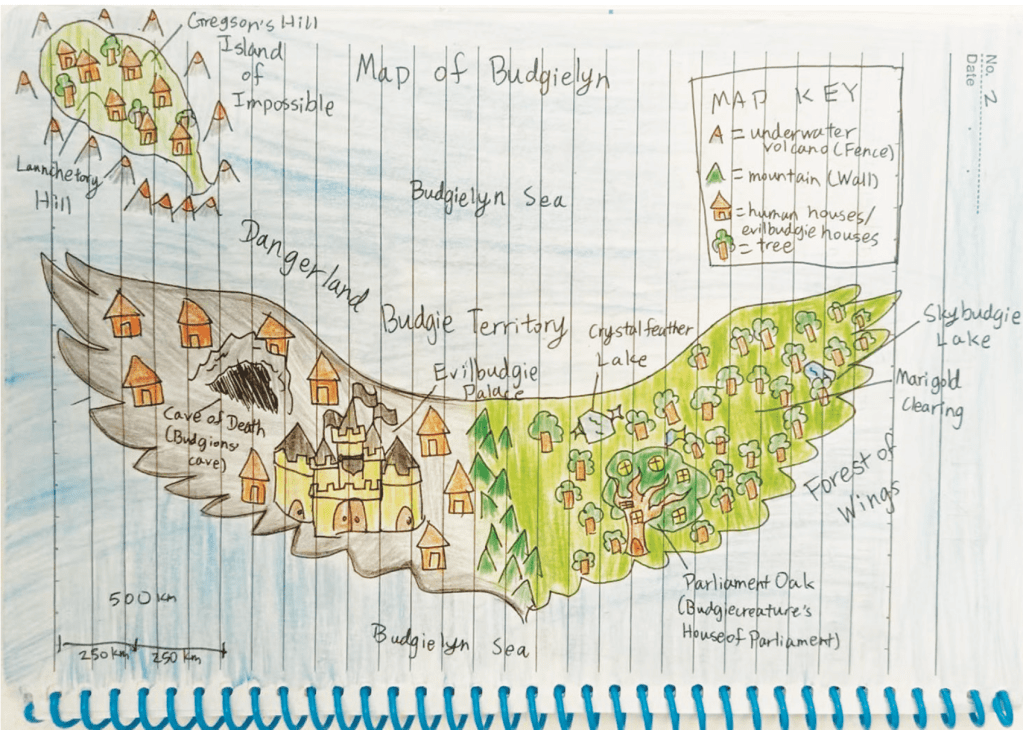
For example, as part of learning how to write fantasy, Alyssa, a fifth grader, created the intricate imaginary world of Budgielyn. Alyssa populated Budgielyn with all sorts of “budgie creatures,” such as budgie fairies and budgiecorns, as well as a variety of evil budgie creatures. (To create Budgielyn, Alyssa drew upon her deep love of her pet budgies as inspiration).
Having built her Budgielyn world, Alyssa wrote “Grace’s Journey,” a story of a brave and plucky girl who goes on a dangerous quest to fight evil and bring balance to Budgielyn. As she makes her world a better place, Grace develops new confidence in herself – and helps readers imagine they could do the same. Throughout the story, readers encounter the fantastical magical creatures and wondrous settings that sprung from Alyssa’s imagination as she created her fantasy world.
Photo used with permission.
As part of the research for Teaching Fantasy Writing, I studied the ways that experienced fantasy writers created imaginary worlds, and adapted their strategies for children in primary, upper elementary and middle school grades.
In the upper grades, we can teach students a multi-step process for creating fantasy worlds. Students will enjoy—even love—this aspect of fantasy writing, since it invites them to use their imagination in exciting, creative ways. The best way for teachers to teach these steps is for them to first go through the steps themselves, and then show their work to students as a model:
First, have students sketch a physical world — which can be an island, a coastal area, a large landform, or (if the student wants to write science fiction) a planet, including geographical features such as forests, mountains, lakes, rivers, deserts, etc.
Next, have students populate the world with beings and creatures, as well as the towns, castles, caves, and forts where they live. The sky is the limit here—students can choose humans, witches and wizards, elves, unicorns, fairies, dragons, aliens – any kind of fantasy characters!
Then have students do some writing about the “magic system” of the world. What magical powers will the beings and creatures in the world have? Which latent powers can they develop, and under what conditions?
It’s also important for students to do some writing about how the different groups of beings and creatures in their fantasy worlds get along. Is one group in power, or trying to gain power? Which groups are in conflict? Which groups are allied with each other, or work together?
Finally, have students create a main character from one of the groups of beings and creatures. This character will be the protagonist of the story they will tell. Also have students create a secondary character. As the main character meets the central challenge of the story, the secondary character will function as their ally or obstacle, their sidekick or their nemesis.
After students have completed their worldplay – a process they will love, and one that will boost their writing skills and their imaginations — it’s time for them to write stories set in their fantasy worlds. As they write, teachers show them mentor texts to teach them about the craft techniques experienced fantasy writers use, techniques students then try out in their own stories.
In the primary grades, I’ve learned that young children, rather than engage in worldplay as a separate step prior to writing their fantasy stories, do both at the same time.Since their composing process usually includes a combination of drawing illustrations and writing text, they create their imaginary worlds as they draw their illustrations. To help them with this process, we can teach them to ask these questions before they start writing a story:
First, what kind of fantasy story do you want to write? A fairy tale? A science fiction story? A magical adventure story (like Maurice Sendak’s Where the Wild Things Are)?
What kind of setting is usually in the kind of story you want to write (a castle in a fairy tale, outer space in a science fiction story, etc.)?
What kind of beings and creatures are usually in this kind of story (a royal family and their attendants, and dragons in fairy tales; humans and magical creatures in a magical adventure story; etc.)
How will children have the knowledge of fantasy stories necessary to navigate the steps of worldbuilding? While some already have an extensive knowledge of fantasy, developed through read-alouds at home, their own independent reading, and/or by watching TV shows and movies, some aren’t as familiar with fantasy. As teachers, we can help all students learn about the genres of fantasy and their characteristics by immersing them in a variety of subgenres – such as fairy tales and science fiction – at the beginning of the unit. (In the book, I provide recommended lists of fantasy mentor texts for fantasy units for grades K-1, 2-3 and 4-6.)
Over the past several years, in fantasy writing residencies in K-8 classrooms all over the United States, I’ve taught lessons on how to create imaginary worlds and craft fantasy stories, both in whole and small-group lessons, and in 1:1 writing conferences. The students I’ve had the privilege of teaching have shown higher levels of excitement and engagement than I haveseen in many years. These young writers have flabbergasted me and their teachers with their creativity and narrative writing skill.
So, how do we solve the creativity crisis plaguing our children, and diminishing their prospects for the future? Including fantasy in our writing curriculums is one of the answers!
WORKS CITED
Bronson, Po and Ashley Merryman. “The Creativity Crisis.” Newsweek, July 10, 2010.
Einstein, Albert. 1929. Quoted in, “What Life Means to Einstein: An Interview by George Sylvester Viereck.” The Saturday Evening Post, October 26, 1929, p. 117.
Gopnik, Alison. “Imaginary Worlds of Childhood.” The Wall Street Journal. September 20, 2018.
Kim, Kyung Hee. 2016. The Creativity Challenge: How We Can Recapture American Innovation. Amherst, New York: Prometheus Books.
Livingston, Michael. 2022. Origins of the Wheel of Time: The Legends and Mythologiesthat Inspired Robert Jordan. New York: Tor.
Patterson, Katherine. 1977. Bridge to Terebithia. New York: HarperCollins.
Pugh, Tison. 2020. Harry Potter and Beyond. Columbia: University of South Carolina Press.
Root-Bernstein, Michele. 2009. “Imaginary Worldplay as an Indicator of Creative Giftedness.” Chapter 29 in International Handbook on Giftedness, edited by L.V. Shavinina. New York: Springer.
Sendak, Maurice. 1963. Where the Wild Things Are. New York, NY: HarperCollins.
Straus, Valerie. 2019. “Should we worry that American children are becoming less creative?” The Washington Post, December 9, 2019.
Taylor, Marjorie, and Candice M. Mottweiler, Naomi R. Aguiar, Emilee R. Naylor, and Jacob G. Levernier. 2018. “Paracosms: The Imaginary Worlds of Middle Childhood.” Child Development, Volume 91, Issue 1, pp. e164 – e178.
Wagner, Tony. 2012. Creating Innovators: The Making of Young People Who Will Change the World. New York: Scribner.
_____. 2008. The Global Achievement Gap. New York: Basic Books.
Carl Anderson is an internationally recognized expert in writing instruction for grades K-8, and consults for schools and districts around the world. A regular presenter at national and international conferences, Carl is the author of many professional books for educators, including Teaching Fantasy Writing: Lessons that Inspire Student Engagement and Creativity and How to Become a Better Writing Teacher (with Matt Glover). Carl began his career in education as an elementary and middle school teacher. And since Carl was a boy, he has loved visiting fantasy worlds in epic fantasy novels and movies.
My early teaching years were in the elementary setting, where I discovered Project-Based Learning (PBL). I loved developing projects and other immersive opportunities for my students to learn and experience choice. Each year, as I moved into new grades, I could provide these opportunities until I found myself teaching Senior High English, and the pressures of standardized year-end exams started weighing down on all of us.
My first few months teaching the seniors were… boring. I was used to choice writing and exploring interests with my students, and I was stuck teaching them form and expectations based on rubrics for a test they would never use again but had a disproportionate impact on their grades. I wanted to find a balance, a way that student could explore their interests and learn the forms of writing required of them. My answer first started to form with a little (or a lot) of inspiration from the incredible Paul W. Hankins.
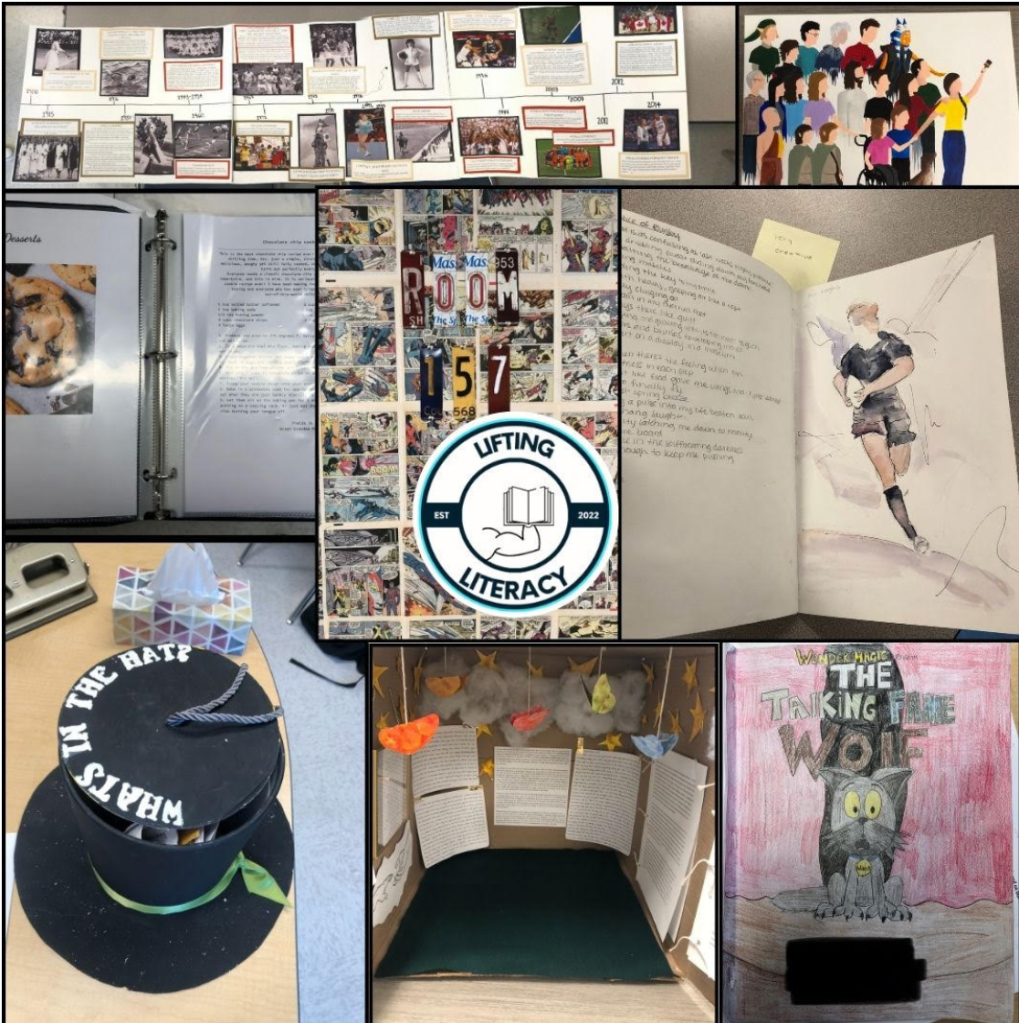
Paul and his students in the legendary room 407 brought the idea of multigenre projects and multimodal representation to life. They explored various types of writing and built incredible pieces around a theme, something my students needed to learn, and I had only been teaching most artificially. What Paul and his excellent students were creating felt so organic. After seeing some ex amples and getting some text suggestions from Paul, I dove right in. My first multigenre project was titled “Make Your Mark” a multigenre project exploring the theme of legacy.
In my first semester with the project, we had the unfortunate circumstance of COVID-19, which interrupted our time in the classroom. However, it did buy us a free pass from the tests, which were canceled. So, the project became our final. Students embraced the work at the end of the term. I had beautiful tributes written to loved ones and poems that explored the past and were hopeful for the future. Students crafted and recorded songs, built sculptures, and made movies. The creativity was off the charts. The next semester, the exams returned. I followed the same schedule, closing the year with our project, and assumed the students would be ready for their exams because of the volume of writing we were doing. That assumption was incorrect. Projects turned out amazing again, but the heavy focus on choice and joy did not translate as well as hoped to the stale exam format. I needed to make some changes.
I decided to adopt the idea of a term project in the literal sense. We would take time throughout the whole term to complete it. Introducing the project in the early days of the course, building a schedule with checkpoints, setting days throughout the course that would focus on the project, and ultimately having the project due at the end of the term. I asked the students how they felt about this process and if they felt it left them enough time to feel comfortable with their test materials while also being able to give sufficient attention to the project. The general feeling was yes, and the current form of Make Your Mark was born.
Photo collage courtesy of the author.
This year, I had a new class added to my schedule. The Grade 11 kids, or what I think my American friends would call Juniors? I wanted to incorporate a term project with these students as well, and this time, the answer came in the idea of Project Based Writing from Liz Prather. We started the year talking about the freedom to explore topics that interested them—things they would want to write about. We set up Fridays as our term project day. Something that will be protected so that students can better manage their time. Their first task was to develop a pitch; I explained this as a moment to share their topic, why they had chosen it, and what they envision as a final product so far. This past Friday, students shared ideas, some of the ideas included:
Basketball Coaching Handbook and Instructional Videos
A picture book about the life of a favorite singer
True crime podcast series
Field Guide on Animals of North America
Illustrated Review of MLB ballparks
A Food Network-type show
A Horror Movie
This is just a sample of the creativity. Each project will require written elements such as scripts or episode summaries. Some students will submit chapters of a book after researching different authors’ writing processes. Student inspiration varied from simple interest to spite (this one made us all laugh).
As we work through the term, we have days where students will share progress and get feedback from me and their peers. We will keep a close eye on how the project is going, culminating in a gallery walk where students will have their work available for peers to experience.
I have loved the energy that term projects bring into the classroom. They are a moment to breathe in a world of testing. Students get to write about what matters to them, share their hopes and dreams, or even just their creativity. Through choice students learn to share their voice and write with one. It might not be the perfect tool to prepare for exams, but we have time for that; it just can’t be all that English Language Arts is about. Writing is about telling our stories and sharing who we are. That is often lost when we only think of ourselves as numbers.
Brent Gilson is an English Teacher in Alberta, Canada. He is in his 14th year of teaching, having spent time in grades 3-12. When not teaching, planning, or marking, Brent can be found attending student sporting events with his wife, Julie, an Elementary Principal. Brent has had the opportunity to present at various conferences in Canada and the United States, namely NCTE and ELAC (Alberta’s NCTE equivalent). If you are looking for more of his work and thoughts, check out LiftingLiteracy.com



 CCIRA Professional Development Blog