“To think inclusively and to think for one’s self is very difficult…Education must enable one to sift and weigh evidence, to discern the true from the false, the real from the unreal and the facts from the fiction.”
– Dr. Martin Luther King, The Purpose of Education, 1947.
Dr. King’s words rang true in the days of the Civil Rights Movement, as they ring true today: the purpose of education is to generate a nation of thoughtful, thinking citizens.
How? P. David Pearson’s research, also from the last century, lights the way to supporting all learners’ cognitive acuity and understanding. In 1983, he and his colleagues investigated how proficient readers make sense of complex texts. They found astonishing congruency between the responses of participants in their study. Turns out, we humans pick from a pretty short list of strategies when we are processing information. We tend to:
Draw on background knowledge
Ask questions
Infer
Visualize
Determine importance
Synthesize, and
Monitor for meaning
After Pearson’s research was published, some smarty pants teachers got a hold of it and decided, “If that’s what all the successful grown-ups are doing, let’s go teach those strategies to the kids.” And so they did. Hence, the wonderful and amazing work of Ellin Keene, Cheryl Zimmerman, Cris Tovani and so many other empowering teachers who highlighted how these strategies can help learners comprehend text.
More good news: these strategies aren’t just for fiction or even just for narrative text. We do use these thinking strategies to make sense of everything: graphs, pictures, word problems, facial expressions, clouds in the sky. They transfer and apply, hence the good value in teaching these to all learners.
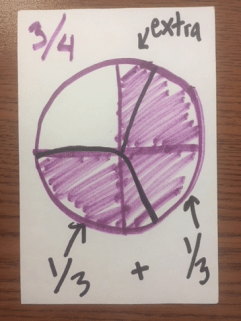
Let’s take math, for example, where we are recovering from decades of algorithm-focused instruction that sidelined understanding in favor of tricks, like “copy-dot-flop” as the means to divide fractions. How might a thinking strategy leverage deeper understanding of that concept? Let’s visit a PEBC lab classroom where the host teacher is inviting learners to visualize and represent the meaning of ¾ divided by 1/3:
“With your partner, come up with as many ways as you can to represent ¾.”
Students scramble to record thinking in their math notebooks: sketches of pizzas, measuring cups, along with coins and division problems fill their pages. Then the teacher calls the group back and gathers everyone’s thinking on the board. She reminds the learners, “Your job is to select the representation that is both accurate and makes sense to you.”
“Now, turn and talk to your partner: what would it mean to divide ¾ by 3?”
After some conversation, the class discusses as a whole and agrees that if you divide ¾ by 3, you would have ¼. Students show this in a variety of ways using the models of ¾ they already created. “Now, what would it mean to divide that same ¾ by 1/3?”
Again, students are invited to discuss with peers, to use their representations to make sense of this problem. Consensus emerges: a little more than two one thirds fit inside three fourths.
As the conversation continues, the teacher challenges the group to represent other fraction division problems as they grow their understanding of this concept. The class closes with a reflection: how do visualizing and representing help us understand? Learners have a lot to say!
This is but one example of how a thinking strategy can leverage understanding in math. There are so many more! The wonderful news is that these strategies many literacy teachers know well can be equally useful to math learners when we bring them to work in authentic ways.
In order to meet Dr. King’s purpose, to raise a nation of thinkers, we must make make conceptual understanding – not just coverage of content – our target; then, intentionally design learning experiences that support students in developing tools to help them make meaning.
To learn more along these lines, attend the June 24 – 25 PEBC Minds on Math Institute; check out Minds on Mathematics, my book on math workshop; or come to one of my sessions at CCIRA, “Math Workshop” Thursday at 10:30 or my keynote, “We Teach Who We Are,” Thursday at 4:30. I look forward to talking with you more about how we leverage meaning for each and every learner.
Wendy Ward Hoffer is the author of four books about teaching math and science for understanding: Science as Thinking (Heinemann, 2009), Minds on Mathematics (Heinemann, 2012), Developing Literate Mathematicians (NCTM, 2016), and Cultivating STEM Identities (Heinemann, 2016). She works with teachers at all levels to support learners’ understanding of math and science at the Public Education Business Coalition (PEBC) Follow her @wendywardhoffer
On the way out of a classroom last week, a middle school language arts teacher stopped me. To tell me about the joy he was seeing in his students. For the unit they were exploring, he had built in choice for the extended texts they were reading. Six titles, all tied together thematically, all appropriate to the age of the students, all presenting varied perspectives on their combined theme. “They are really enjoying selecting their own books,” he said.
I tried to maintain my stoic I’m-from-the-district-and-I’m-here-to-help facade. Inside, I was cheering.
Students in the room weren’t just choosing their texts, they were choosing their talk as well. This teacher, we’ll call him Juan, had built a lesson using the Say Something protocol where students ran their own conversations about texts and had control over what they were moved to say about what they had read. If you’re not familiar, Say Something leaves equal room for a student to say, “I have no idea what’s going on here,” and “I was intrigued by the apparent change of motivation for the protagonist in this passage.”
In addition to the choice of text and the control of talk and thought, students were sitting in community with one another. While Juan’s room had been rays of desks emanating from the “front” of the classroom near the dry erase board at the beginning of the year, arrangement and design had shifted between my visits. Now, students were seated in clusters of four, facing one another, in proximity and arrangement that lent themselves to collaboration. The “front” was wherever the learning needed it to be and students had immediate access to the thinking of their peers.
Juan’s class was exhibiting an awareness of the situated motivation my co-author Chris Lehmann and I think through as part of our book Building School 2.0. Well, he was hitting three of the four C’s. Jaun had choice, challenge, and collaboration. For the fourth C, we’d need to look at how he came to design what was happening in the room.
What We Want for Students We Must Want for Teachers
This year, we are trying something new in the district. At the end of each quarter, but with enough time before the start of the next, we’ve been hosting unit design workshops. I bring coffee, doughnuts, and some chill music and teachers are invited to drop in anytime between 9 and 4 on a Saturday and are compensated at their hourly rate. It’s a chance to get the time and space to think about the learning experiences they want to design for their students in the coming quarters. It’s a bit of an experiment.
Juan attended our last workshop. Though he’d signed up to come for two hours, he stayed for six. Newly returning to the language arts classroom, he’s been working to familiarize himself with our district’s curricular resources. He wasn’t sure what we’d be doing that Saturday, but understood it was time and space to plan.
I should point out I have nothing planned for these workshops. Beyond the coffee, doughnuts, and music, I’ve got nothing. It’s not that I don’t have a million things I’d love to say face-to-face to teachers I know don’t have time to read the e-newsletters I send out. It’s that I’m working to create a space that puts into play the fourth C (and all the others) – control. I recognize that much of the professional learning opportunities teachers experience are packed with information, curated minute-by-minute, and rarely start with, “What is it you’re hoping to get out of our time together today?” This is to say nothing of adjusting our meticulously-designed agendas to respond to the answers to those questions.
So, when Juan showed that Saturday, neither of us knew his response to “What are you hoping to work on?” would lead to the two finding a roll of brown paper to chart out his next quarter’s work, intermittently conferencing with me and his other colleagues in the room to brainstorm and barnraise his ideas.
Remarkably – though not surprisingly – Juan left that workshop with a unit plan that included every piece of what I would have put into a Saturday class on unit design. The difference? He got their on his own. The pieces he was unsure of were uncovered as he worked, and he leveraged the power of the room to get the answers he needed.
While Paris and Turner largely speak to student experience in their work around situated motivation, the implications for the systems we build for adult professional learning cannot be overlooked. If we want our classrooms to include space for students to work together, to make informed decisions, and to own their learning, then we must build similar experiences for adults.
While this is normally a message for administrators and professional development staff, it doesn’t solely reside their. We adults in the education system must be advocates of our own learning. This might mean asking questions like, “Could I help design the next faculty meeting to include more hands on activities?” or “How might we make the next PD feel like what’s happening in the best classrooms in the building?” Increasing capacity, efficacy, and joy means building with, not for.
Paris, Scott G., and Julianne C. Turner. “Situated motivation.” Student motivation, cognition, and learning. Routledge, 2012. 229-254.
Zac Chase is the pK-12 Language Arts Coordinator at St. Vrain Valley School District. With Chris Lehmann he wrote Building School 2.0: How to Create the Schools We Need. Zac has worked at Science and Leadership Academy in Philadelphia and the US Department of Education in the Office of Educational Technology. Find him on Twitter @mrchase.
The CCIRA blog is a little over a year old. In just fourteen months our audiences have enjoyed a broad range of topics related to literacy, professional development, achievement, and of course, the passivity of Peppa Pig. Guest bloggers were classroom teachers, coaches, literacy specialists, national speakers, published authors, university professors, principals and administrators. Many guest bloggers will present sessions at the 2019 CCIRA Conference on Literacy this February. Below is a list of the heavy hitters; the posts which were shared across social media channels and were most popular with our readers.
I have the pleasure of working in many schools across the country. The schools I serve are unique in their own ways. Size of schools and classrooms vary. Start and end times vary. Mandated curricular materials, initiatives, special projects, and school culture often vary. Number of preps, number of meetings, number of students with diverse needs…all vary.
Schools are unique, there’s no doubt. Sometimes, however, the ongoing problems of practice have similarities across states, districts, and schools. For example, there’s never enough time to get everything done. The school day is not getting any longer, yet the curricular demands continue to increase. There’s no such thing as a NO VACANCY sign above our classroom doors in the public sector (thank goodness!). Yet, it’s our job to meet the needs of individual students. In addition, a common occurs when competing opportunities and initiatives make it hard for stakeholders to know what’s most important, yet it’s our job to champion the goals.
What are the problems of practice that show up in your school/district? Jot them down.
While problems of practice can seem daunting at times, they often have silver linings tucked inside that help us find our way. Once we name the problem of practice, we can figure out how solve it, making the system better. School folks (administrators, teachers, support staff, parent volunteers, etc.) working with students regularly have a unique opportunity to make high-leverage moves withand for all individual students. Sure, these high leverage moves can look, sound, and feel different depending on the time of year, grade level, and individual classrooms because kids are dynamic. But, high leverage moves become easier and more personalized when we know the students we serve. Proximity helps us get to know students and then, in turn, use that intel to plan curriculum, instruction and assessment. Take a look at 3 high leverage moves that solve problems of practice by maximizing learning time, addressing students’ talents, needs, as well as creating clarity and focus.
High Leverage Move #1: Use the reading workshop model to capitalize on small group learning.
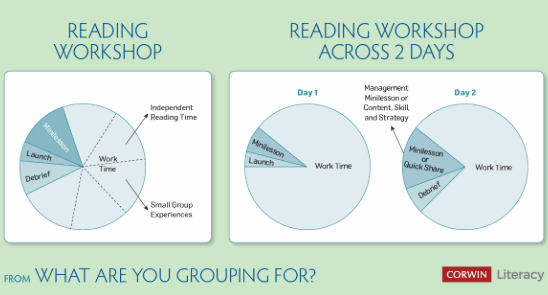
Getting to know and meet students’ needs is a challenge when schools or classrooms lean too heavily on whole group. This happens when small groups feel unmanageable. The workshop structure pictured in the graphic below makes small group learning possible because of the increased amount of time dedicated to student work time. Work time is where students have opportunities to read and work independently AND where small groups can meet. Whether you teach in an elementary or secondary setting, you might consider looping workshop across 2 days as pictured on the right. Doing so maximizes students’ work time while connecting learning from one day to the next.
The first step is to take stock of your reading workshop structure by mapping out how much time is dedicated to student work time. Take stock by listing the total minutes you have during workshop and then add up the minutes that are dedicated to work time. Kids deserve ⅔ of the total number of minutes during workshop time to do the work of learning. Handing that time over to them, regularly and consistently, is important. If you’d like to take stock of how much time readers are really working, download this template.
We know proximity matters. The closer we get to students’ conversations, interactions, and their work, the more we will meet their needs. As the next graphic suggests, small group is a sweet spot during reading workshop because proximity creates greater chances for knowing and meeting students’ individual needs.
Big Take-away: There is never enough time, but when we use the workshop model we have a better chance of maximizing student work time and meeting students’ individual needs.
High Leverage Move #2: Kidwatch to get to know students’ interests, curiosities, habits, and needs.
Educators have been studying students since the one-room schoolhouse. Yetta Goodman and Gretchen Owocki’s work helped give definition to the term kidwatching (Heinemann, 1994). My co-author and I studied kidwatching while writing our book, What Are You Grouping For? by Wright & Hoonan (Corwin, 2019). We use the term Kidwatching 2.0 because kids, and the world around us, are constantly changing, requiring us to fine-tune our observation skills. We kidwatch because it’s the purest form of student data and significantly impacts our decision-making. Kidwatching helps us know what students know and what they can do, as well as inform us about what they need next. Kidwatching helps us capture students’ strengths and areas needing a lift.
Take a look at the picture below. What do you notice? Take a look at facial expressions, seating arrangements, materials, and so on. Make a jot list in your head or on scratch paper.
Or, you might consider using the note catcher below. Here you would note what you see (since it’s a picture), why what you see matters to student learning, and any wonderings or questions you have.
What do I see/hear?
Why does it matter to student learning?
Wonderings
This group of 5th grade boys are digging into several texts– picture books, biographies, sports joke books, a trivia calendar, and more–focused on sports. This small group previewed and oriented to the texts before choosing one to read. You may have guessed that they excitedly grabbed the Sports Illustrated for Kids because they wanted to see which all-star player was featured in the center fold out. If you are kidwatching in the classroom, your notes would also include what you hear. Student talk is really important because it gives a clearer, richer picture of student thinking.
Kidwatching notes often lead to teacher and student conversations which lead to more kidwatching. Intentional kidwatching almost always feeds new inquiries and new interactions because it’s a recursive process. If you’d like an electronic version, download this Kidwatching 2.0 template.
Big Take-away: When we get to know students’ interests, curiosities, habits and needs through kidwatching, we have a better chance of meeting students’ individual and collective needs.
High Leverage Move #3: Curate to inspire students to be connoisseurs of text.
Think about all of the things you learn about students by observing, listening, interacting, and studying their work. We must use all that we know about our students to curate texts for them to read. As teachers, we curate to meet students social and emotional needs. We gather texts that we think will stoke students’ personal interests and passions. Sometimes we curate texts to nurture students’ knowledge development and/or conceptual understandings. And, of course, we collect and use different texts to address curricular demands and to differentiate instruction to respond to students’ individual needs. Inviting students to curate texts for themselves and others is important too because doing so,
Fosters student independence,
Invites student choice and voice to selecting reading materials,
Increases reading volume,
Develops skills and habits that carry over into adulthood.
Take a look at the tub in the picture below filled with texts focused on women who have influenced and/or made contributions to our world.
The teacher read aloud the book, Separate is Never Equal: Sylvia Mendez and Her Familys Fight for Desegregation. Students were surprised by the lasting impact that Sylvia Mendez and her family had on changing California desegregation laws. This story sparked interest which resulted in a small group of 6th graders diving into different texts focused on women who made significant contributions to the world. Some of these texts were curated by the teacher, while others were curated by the students. When students curate texts for themselves and others, it promotes autonomy, student independence, and an increased desire to read. As you might imagine, the number of texts in the bucket increased over several days and the number of texts that students explored and read consequently increased. Teacher and student curation provides opportunities to increase reading volume, student choice, and independence. If you are interested in curating texts based on students’ individual needs, consider using the A Little Bit About or Tell Us Your Thoughts.
Big Take-away: When we curate texts for students, and invite students into the curation process, we are prioritizing increased reading volume, student choice and independence.
Which high leverage moves will you use to solve your problems of practice? Consider using the reading workshop model to capitalize on using small groups to increase proximity and maximize student learning time. Use kidwatchingin order to get to know students’ interests, curiosities, habits, and needs so that you have a better chance of meeting students’ individual and collective needs. Curate texts that inspire students to be connoisseurs of text so that the priority becomes increasing reading volume, student choice and independence.
References
Clinton, C. (2017) She Persisted: 13 American Women Who Changed the World. New York, NY: Penguin Books.
Owocki, G. & Goodman, Y. (1994) Kidwatching: Documenting Children’s Literacy Development. Portsmouth, NH: Heinemann.
Schatz, K. (2015) Rad American Women A-Z: Rebels, Trailblazers, and Visionaries who Shaped Our History . . . and Our Future!. San Francisco, CA: City Lights Books.
Thimmesh. C. (2002) Girls Think of Everything: Stories of Ingenious Inventions by Women. New York, NY: Houghton Mifflin Books.
Tonatiuh. D. (2014) Separate Is Never Equal: Sylvia Mendez and Her Familys Fight for Desegregation. New York, NY: Abrams.
Wright, J. & Hoonan, B. (2019) What Are You Grouping For? How to Guide Small Groups Based on Readers–Not the Book. Thousand Oaks, CA: Corwin.
JULIE WRIGHT is a teacher, instructional coach, and educational consultant with over twenty-five years of experience in rural, suburban, and urban education settings. She holds National Board Certification as well as a B.S. in Education, M.A. in Language Arts and Reading, a K-12 Reading Endorsement, and extensive school leadership post-graduate work, including a pre-K through grade 9 principal license from The Ohio State University. Julie serves as an Adjunct Faculty Member at Ashland University and is the co-author of What Are You Grouping For? How to Guide Small Groups Based on Readers–Not the Book (Wright & Hoonan, 2019). Follow Julie on Twitter @juliewright4444 or for more information on how she can support your efforts, visit www.juliewrightconsulting.com.
by Regie Routman, featured speaker at the 2019 CCIRA Conference
Is providing all students equal access to an excellent education a constitutional right? I believe it is; equity means we ensure all students receive what they need and desire to reach their full potential as individuals and productive citizens. Appallingly, for countless students, educational inequity reigns. Recent class-action lawsuits filed by students and their parents in Detroit, Michigan and Providence, Rhode Island argue that public schools have violated children’s rights by failing to educate them well. That is, students have received such a poor quality education that they are graduating high school unprepared to be knowledgeable, fully contributing members of society.
The Preamble to the U.S Declaration of Independence (1776) declares:
We hold these truths to be self-evident, that all men are created equal, that they
are endowed, by their Creator, with certain unalienable Rights, that among these
are Life, Liberty, and the pursuit of Happiness.
I would argue that the opportunity to pursue a happy, productive life and to actively participate as an informed citizen is an “unalienable right” and that “life, liberty, and the pursuit of happiness” requirethat we fully educate all our students. Tragically, this is not the case in many schools today, especially schools with large populations of students of color, students from low-income families, students where English is not their first language, and/or students who struggle. Too often, too little is expected and failure to receive a quality education creates a lifelong opportunity gap. We must do better!
I’ve been an educator, teaching and mentoring teachers and leaders in diverse schools in the U.S. and Canada for over 45 years. What I know in my heart and soul is we have not embraced equity for all; we do not yet as a society see it in our best interests to educate all our students. Segregated schools are once again a fact of life in today’s urban cities; so are low expectations, excuses, and continual seeking of “quick fixes”—all of which fuel a system of low achievement that perpetuates unhappiness and failure to thrive for large segments of our population.
In my latest book, Literacy Essentials: Engagement, Excellence, and Equity for All Learners (Stenhouse, 2018), Equity is the section that is most important to me and that was also the hardest to write. While all my work has dealt with making school life and learning more equitable, I knew less about Equity than Engagement and Excellence. I therefore did extensive research, reading, and reflection to assess and make recommendations on why and how equity matters and how “with higher expectations and excellent, targeted teaching we can raise achievement and change lives.” (p. 258.)
9 Key Actions We Can and Must Take to Ensure Equity for All
1. Adopt a mindset that believes all students are uniquely capable and can learn at high levels. I have never been in a classroom, school, or district where expectations are too high. Challenge old assumptions and beliefs. See beyond labels, test scores and poverty. Think: “Accelerate student learning,” not just “raise student achievement.” Get to know students and their families; let parents know their child’s strengths before discussing needs. Parental support can be vital for helping kids succeed. Accept responsibility for being each student’s teacher. Share some of our own successes and missteps: let students know how and what we have learned from our own learning failures. Raise expectations for what’s possible for all. Let students know—and follow through—that we care about them and their future and will do our best to support them every way we can.
2. Share the power with students.Invite students to create “our classroom,” not “my classroom.” For many students, especially those who have been repeatedly marginalized or denigrated, the classroom may be their only welcoming, safe haven—emotionally, socially, and intellectually. Listen more than we talk. Ensure that everyone’s voice is heard and respected. Together, seek to develop a culture of trust, respect, kindness, and risk taking. Create an environment that is beautiful, nondiscriminatory, and literacy and content rich. Give students a fair say in what goes on the walls, what’s in the classroom library, and how to make excellent and culturally responsive resources accessible to all. Do more small group work with students heterogeneously grouped. Allow more choices for how the classroom works, books students read, and topics students inquire and write about. Give students more options on how to display their learning. For example, instead of requiring everyone to do a written report, demonstrate and provide shared experiences and guidance in other forms and formats such as videos, podcasts, interviews, poems, songs and raps, and original multi-media presentations.
3. Become professionally knowledgeable. No shortcut here! Until we become highly knowledgeable as teachers of literacy—regardless of what subject we teach–we will always be seeking the “right” program, text, or expert to tell us exactly what to do. Equity for all requires that we teachers and leaders know relevant, research-based and principled literacy practices and how and when to apply those practices in all content areas. Strive to make Professional LITERACY Communities that meet regularly part of your school’s culture. (See Read, Write, Lead: Breakthrough Strategies for Schoolwide Literacy Success, ASCD, 2014, pp. 219-253 and Regie Routman Series at https://www.heinemann.com/series/79.aspx for specific guidelines and tools for high level, ongoing, professional learning.) Start by developing shared beliefs as a school. Only when teachers and the principal come together on shared beliefs that align with principled practices is it possible to effectively teach and assess responsively (what some call differentiated instruction) and for schoolwide achievement to take hold and be sustained.
4. Make stories integral to the life of the classroom. Value and respect all cultures and backgrounds. Provide daily opportunities for students to tell their stories, listen to stories, and share their stories in various formats. Stories are what humanize and connect us and help build a community of collaboration, acceptance, and respect.It’s why I have interwoven about a dozen personal and professional stories into Literacy Essentials. Be sure to view the thought-provoking TED Talk by author Chimamanda Ngozi Adiche on the importance of hearing everyone’s authentic cultural story, which is so crucial for us as educators working with students from diverse backgrounds. You can view and listen to Adiche’s TED Talk, The Danger of a Single Story. Think about ways you can celebrate, publish, and make students’ written and oral stories public.
5. Apply an Optimal Learning Model. The Optimal Learning Model (OLM)—or what I often call “responsive-teaching-in action”–underpins all the teaching and assessing work I do. While a gradual handover of responsibility is part of the OLM, what’s most important is knowing what types of—and why, how much, and when—demonstration, support, and practice are necessary before expecting the learner to productively apply what we are teaching. Through applying the OLM, we demystify the learning process so students come to understand what strategies and actions can lead to success.
Implicit in the OLM is adopting a whole-part-whole instructional approach, not a part-to-whole approach which breaks up learning into bits and pieces and makes learning harder for students. Many students never do figure out how all the parts fit together. Yet understanding how specific skills fit into a meaningful context is crucial for students’ sustained engagement and independent application of what we are teaching them. Equity means we are teaching students how to learn, that is, our expert teaching includes actively developing students who self-question, self-monitor, and self-direct their learning.
6. Reduce the need for intervention. I continue to be stunned by the numbers of students who are referred to—and wind up receiving– special services. My Reading Recovery training decades ago taught me the value of good first teaching being the best intervention. For research-based and practical specifics on why and how to reduce the need for intervention, see chapter 4 in Read, Write, Lead (ASCD 2014, pp. 137-180.) http://www.ascd.org/publications/books/113016/chapters/Reducing-the-Need-for-Intervention.aspx
7. Intersect literacy, curriculum, and standards with real world issues. The only way to prepare students of all ages to be informed, responsible, engaged citizens at all stages of their lives and careers is to expertly integrate reading, writing, speaking and listening across the curriculum. When I first started working in underperforming schools, I focused on improving and accelerating reading and writing achievement. I learned that becoming readers and writers was insufficient. Especially in high challenge schools where pressure to raise test scores is relentless, social studies, science, and the arts are often sidelined or taught poorly. Yet, in order to be informed and fulfilled citizens and advocates for others and ourselves, we must know history, current events, how the world works, and much more.
To see how to meaningfully “fit it all in” in the limited time we have, see detailed lesson plan framework at https://sites.stenhouse.com/literacyessentials/lesson-plan/and adapt the information for your curriculum, standards, and students’ interests and needs. As well, we need to be teaching all students how to excel in oral and written communication such as public speaking, writing a coherent and concise statement, and collaborating well with others. All of these competencies are necessities for success in almost any job today and in the future, and many employers prize those skills over specific knowledge in a domain.
8. Ensure all resources, literature, and texts are relevant to students, first-rate quality, and accessible to all. Guarantee our classroom libraries, charts, word walls, content studies, etc. are established with students and that they equitably reflect and honor their diversity, abilities, and interests. Don’t settle for second-rate texts or resources! You can’t teach reading or writing well without reading, examining, and discussing outstanding literature.
9. Make sure use of technology enriches learning, not just keeps kids busy. Too often Ipads, Chrome Books, and the like are seen as “the answer.” Beware of students moving through levels on a device for accurately assessing students’ progress or of having technology as the main instructional driver. Ensure our use of technology–or for that matter, any commercial program–supports and enhances our shared goals, shared beliefs, curriculum, and interests in a meaningful, equitable, and relevant manner. Ultimately, the best technology is still one caring teacher, meaningfully interacting with a student s/he values and recognizes for strengths, interests, and needs.
Regie Routman is a longtime teacher, leader, and author who is committed to improving the literacy and learning lives of students, especially those in high-challenge schools. She currently works on-site in diverse schools and districts coaching and mentoring principals, teachers, and leaders at all levels. Her latest book is Literacy Essentials: Engagement, Excellence, and Equity for ALL Learners.(Stenhouse, 2018) See www.regieroutman.org for more information on Regie’s many books, resources, blogs, professional offerings, and contact information.




 CCIRA Professional Development Blog